
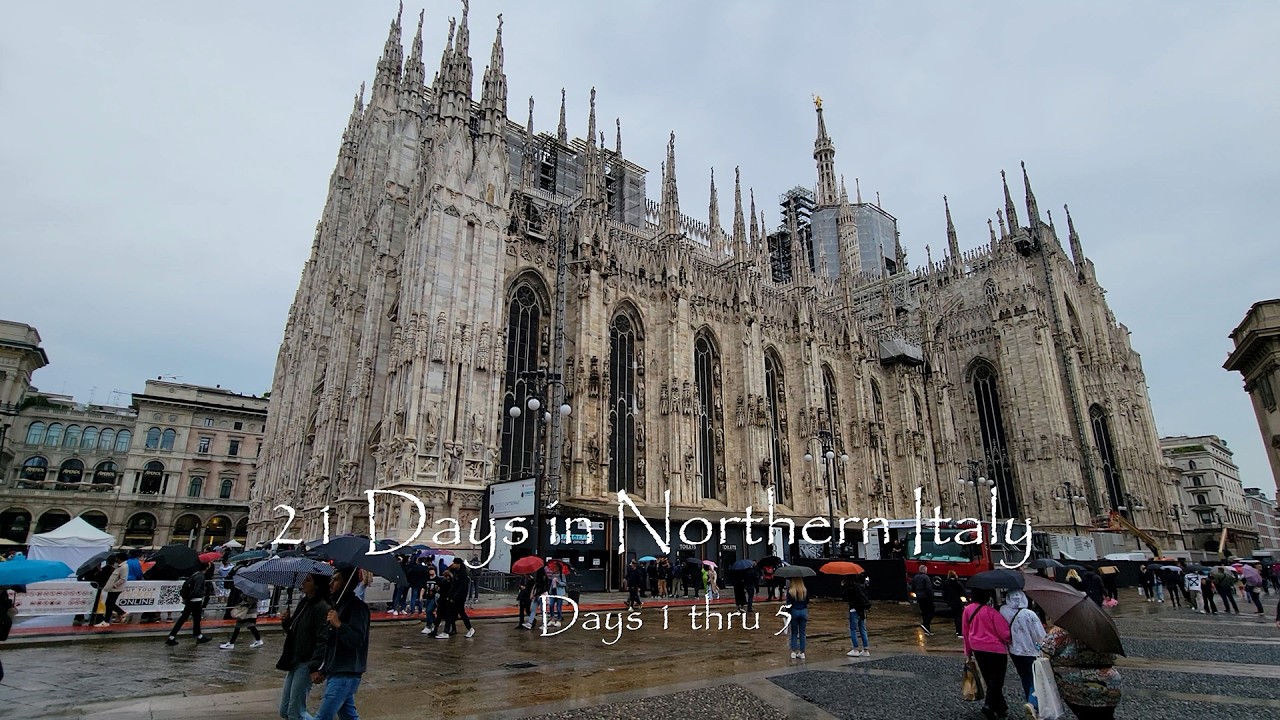
Milan, even in fall rain, is a beautiful and vibrant city. We had allowed ourselves 3 days to acclimate before our real wine adventure began.
The Duomo di Milano is the major Cathedral in the center of Milan, and its construction spanned almost 600 years. This was the site where the St. Ambrose Basilica had stood in the 5th century. There were additions and fires, and in 1386, construction of the current Duomo began and continued until 1965. The style leans towards Gothic due to the influence of Architect Nicolas de Bonaventure, who was appointed in 1389.
The square in front of the Duomo was set for an event. We are not fashion people, so the fact that we had arrived mid-Milan Fashion Week took us by surprise. The city was buzzing with events and fashionistas.
Through this busy crowd, we made our way to the historic Galleria Vittorio Emanuele II, Italy’s oldest active shopping mall, and of course, the place you want to be during fashion week!
The space is embellished with mosaics, ironwork, and frescoes in a Neo-Renaissance style, and it features shops, restaurants, and cafes.
There is also an ancient city ritual to be performed here for good luck. On the floor of the gallery’s octagon, there is a mosaic of a bull representing the Turin coat of arms. It is said that you must spin your heel on the bull’s testicles 3 times for luck. Sadly, in the push of the crowd, I was unable to locate the bull!
The morning of our first full day in Italy began with a morning interview with Francesca Mecchia. She and her mother run Vigna Petrussa, a small winery in Friuli on the Slovenian border. She is the 3rd generation of women working in this family-run winery. She zipped across Milan, where she lives with her family on her moped, to meet us at the hotel and tell us about their winery.
After our interview with Francesca we headed out to explore Navigli
This district in Southwest Milan is crossed by several canals. “Naviglio” is the Italian word for canal. These ancient waterways were originally designed for irrigation and navigation and became important for communication and trade in the city. There were once 5 main canals that crossed the center of the city. Today, the Naviglio Grande and the Naviglio Pavese still flow and meet at the Darsena, which at one time was a river port.
With time wasting on our only full day in Milan we were off to the Castello Sforzesco. Francesco Sforza a warlord, became the Duke of Milan and in the 1400s rebuilt the ruins of the castle. This type of thing happened multiple times and you can see the patchwork of multiple builds over time in the architecture and stonework.
We wandered back out to the streets and found ourselves in Brera. This is considered the bohemia part of Milan, with smaller shops and restaurants. We walked up Via Pontaccio and then cut back to Via Fiori Chiari.
We had reservations for dinner at Nabucco. This elegant restaurant in Brera is named after the famous opera Nabucco by Giuseppe Verdi. We sat on the patio at the entrance so we could watch the people stroll as we dined.
The evening finished with a stroll through the quieter streets back to the metro and back to our hotel, then to bed to prepare for an early morning.
Here in Milan, we were relatively close to Lake Como and to the Swiss border. To try to take as much in as possible, we had a coach trip booked that would take us to St. Mortiz Switzerland, and then we would take the Bernina Express, known as the most beautiful train ride in the world, down to Tirano, Italy, where we would again board a coach to take us back through Valtellina to Milan.
Lake Como, while impressive, was hard to see! Heading north, we had the southbound lanes between the Lake and us, not to mention that much of the trip was in tunnels! We stopped on the way to get pastries and take in the Orobian Alps that we were heading towards.
The railway begins in Chur, the oldest town in Switzerland, and travels south to St. Moritz and then continues south to Tirano, Italy. Built between 1908 and 1910 to connect St. Moritz to Tirano, the route was declared a UNESCO World Heritage Site in 2008.
We would be taking the southern half of the trip.
The beautiful train has several style cars. We were on one with windows that opened. Perfect for getting beautiful photographs and video without the glass in the way. Also perfect for catching a cold as the alpine air rushes in.
We departed from St. Moritz, traveling south past the white and black lakes, Alp Grüm, and Miralogo, the village on Poh-sciava Lake, then over the Brusio Circular Viaduct before crossing the border into Italy and arriving in Tirano.
These are just a few snippets of the first few days watch and enjoy and stay tuned for many more wine regions in Lombardia and beyond.
21 Days in Northern Italy