
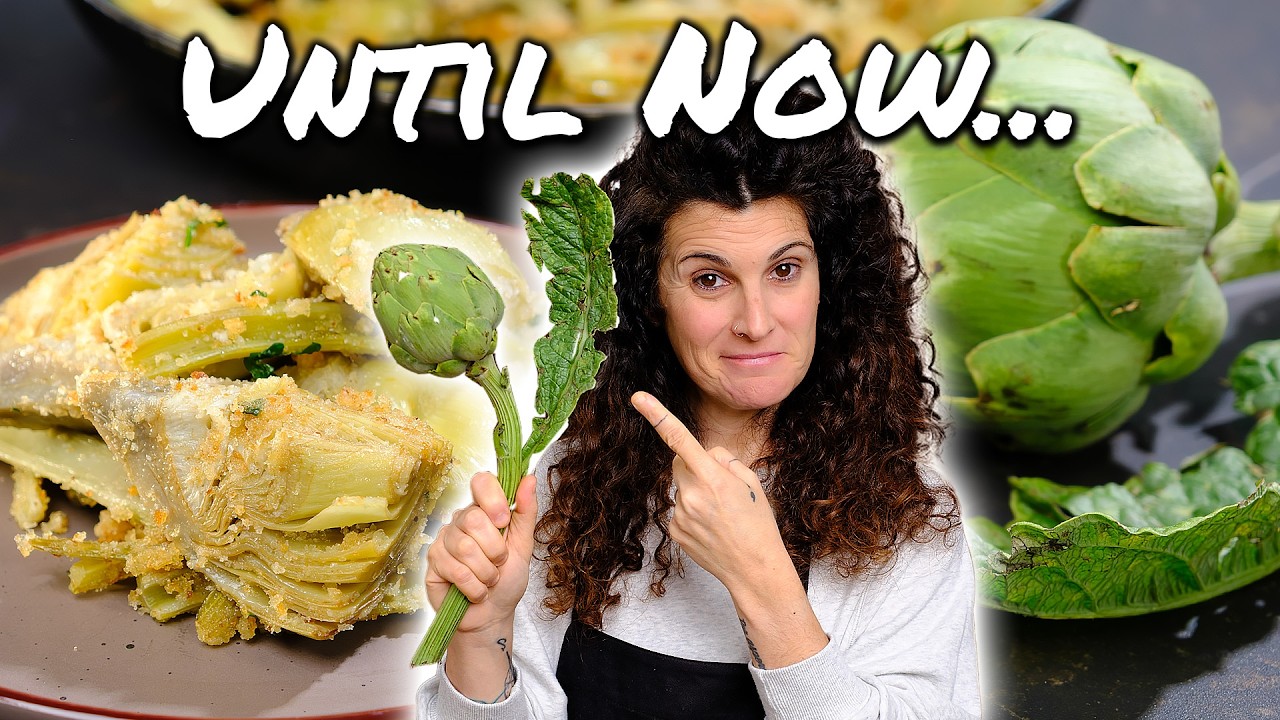
Artichokes are a huge part of Italian cooking, so it’s no surprise a lot of people have asked us for more recipes. We’ve always avoided the topic though, because Italian artichoke recipes come with a bit of a problem…
In this video, Eva shares three traditional Italian artichoke dishes that are simple, delicious, and very typical of how they’re cooked in Italy. On the surface, they seem straightforward, but there’s one catch that makes them surprisingly difficult to recreate.
If you’ve ever wondered how artichokes are really used in Italian cuisine, or why these recipes don’t always turn out the way you expect, this video will give you a better idea of what’s going on.
If you enjoy this video, please give it a like and subscribe to the channel!
─────
CARCIOFI ALLA ROMANA RECIPE – https://pastagrammar.com/blogs/recipes/carciofi-alla-romana-roman-style-braised-artichokes
STUFATO DI CARCIOFI E PATATE RECIPE – https://pastagrammar.com/blogs/recipes/italian-artichoke-potato-stew-stufato-di-carciofi-e-patate-recipe
CARCIOFI ALLA MAMMA ROSA RECIPE – https://pastagrammar.com/blogs/recipes/cheesy-breaded-artichoke-recipe-carciofi-alla-mamma-rosa
─────
FOLLOW US
Website/Recipe Blog – https://www.pastagrammar.com
Instagram – https://www.instagram.com/pastagrammar
Facebook – https://www.facebook.com/pastagrammar
VISIT ITALY WITH US
Italian Food Tours – https://www.pastagrammar.com/tour
MERCH STORE
https://pastagrammar.com/collections/all
OUR COOKBOOK
https://geni.us/italianfamilykitchen
SUPPORT US
https://patreon.com/PastaGrammar
VISIT EVA’S HOMETOWN
Visit Dasà – https://www.visitdasa.com
00:00 – Italian Artichoke Recipes
01:49 – How to Clean Artichokes
06:18 – How to Make Roman-Style Artichokes
09:44 – What Makes Italian Artichokes Different?
11:15 – Tasting Eva’s Carciofi alla Romana Recipe
14:47 – How to Make Artichoke & Potato Stew
17:37 – Tasting Eva’s Stufato di Carciofi e Patate Recipe
20:06 – How to Make Artichokes… Mamma Rosa Style!
22:18 – Tasting Mamma Rosa’s Carciofi Gratinati Recipe
25:43 – Pasta Grammarian in Action!
#artichoke #roman #mammarosa
30 Comments
Where do you live and what has your experience been with artichokes? Let us know!
Anyone else seen to mush off balkandad and his parsely hate? I react to it every time.
Americans neither need nor deserve artichokes because they have trump
The fibrous center of the artichoke is calledcthe choke.
Love American artichokes. We stuff them with Romano and bread crumbs. The stem is peeled and cooked with the chokes in olive oil and water. They are the best. Scoop out the hairy/picky part and you reach the delicious heart.
when i was a kid, the artichokes were far superior to the artichokes they sell now. of course this is 50 years ago where produce was not shipped across the country. Sadly, beef was better then too.
Can you take a trip to a farm area where artichokes are grown in Italy?
They are grown mainly in coastal California, near the ocean.
* variety differences, climate and weather differences, may account for the differences…?
*Also, the maturity of the artichokes may also be influenced
A visit, vid to show how they are grown in Italy would help answer a lot of questions that I could give info about for you,
Thanks!
hope you do this…..
When I was growing up in Sardinia I ate lots of artichokes, but the spiky kind (we called the non spiky ones 'roman') are the usual fare there, I could never find those artichokes in the UK, only the 'roman' ones… but they taste different!
those artichokes looks delicious. I believe there is a variety called a Jerusalem artichoke.
I love Artichokes, no idea the stems and leaves were edible…give me recipies please :p When I was a kid, Mom would make them every now and then, generally streamed and then served with lemon butter to dip the pedals in 🙂 of course we didn't get the heart…we remove the thistle like fibers. My Wife and I went to Rome and went on a food tour, we got a fried artichoke at one stop.
the inside of the artichoke is called a 'choke'
it is the baby immature flowers… (when the artichokes bloom, these are the purple flowers inside the 'petals')
since you eat them entirely, I'm thinking it's the maturity of the blooms/flowers that makes them more tender.
In america, they are picked later, when the parts are tougher….
The center is called the "heart". The fuzzy part is called the choke because if you eat them you choke! LOL The tiny thorns is why you remove that part. I always added oregano to the cooking water. Baby artichokes don't have the thorny bit. In the U.S., we primarily eat globe artichokes, which are also known as French artichokes or by their scientific name, Cynara cardunculus var. scolymus. These are the ones you'll typically see at the grocery store — they're a sunny green color, can range in size (with the largest growing to about six inches in diameter), and have long stems. The petals on these veggies are pointy, and the inner layers reveal themselves to be light yellow or violet in color. If you ate their leaves raw (especially the ones on the outer layers), you'd find that they were tough and not very appetizing.
While we may call globe artichokes "American" today, they originally came from the Mediterranean and North Africa. To this day, Italy still produces the most artichokes worldwide. But of the ones grown in the U.S., the majority of them come from California, since the state has a climate that can somewhat match that of the Mediterranean. According to Specialty Produce, more than 80% of American commercial artichokes come from one seaside town called Castroville, which also claims to be the Artichoke Center of the World, and celebrates this honor with an annual festival centered around the veggies. Roman artichokes (Cynara scolymus 'Carciofo Romanesco') eliminate two of the most unsavory parts of the veggie: the sharp spines and the bristly choke. The former, also known as spikes or thorns, are the prickly tips of the bracts (sometimes called petals). Roman artichokes, also known as Carciofo Romanesco, mammola, or cimarolo, have existed in Europe since about 1400. They have vibrant purple petals, a grassy smell, and a soft center that's essentially fuzz-free. While this variety is grown occasionally in the U.S., particularly in California like its globe brethren, you'll mostly find it on the Italian coastline in Ladispoli and Cerveteri, two communes slightly north of Rome. And if you manage to get your hands on the Carciofo Romanesco del Lazio variety, you're in for a real treat, as these specific veggies have received Protected Geographical Indication (PGI) status. American artichokes are typically stuffed, steamed, or canned. Roman artichokes are usually braised or fried.
There are so many foods I wish we could get here that are so much better in Italy….sigh…we seem to ruin everything with herbicides, adding perservatives and other crap that kills us.
And I cannot find where to buy fresh Roman artichokes here in the USA. Do you know any shop in Italy that would send them to the US?
12:20 avoiding the artichoke is a thing in Eastern Europe.
We have watched "Princess Sissi" and whatnot on Fox Kids / Jetix, where this plant was hated to the core.
It's the species. Occasionally at the pricier farmer markets in Manhattan you can get the small ones with the large stems which can be eaten. But the better Italian restaurants grab them quickly. And there are a few Roman styles restaurants in Manhattan where they make carcofi alla Giudia which are as good as in Trastervere. But you're right 99% of artichokes here are the giant globe types and you can only eat the base of the leaves. A pain to make and a pain to eat.
Also wine people know artichokes cannot be paired when any wine effectives as there are compounds in artichokes which affect the taste buds and make wine taste sweet.
Italy produces 80% of artichokes in the world. I'll harvest mine next week 🌹🌹🌹🌹
In Spain, in Catalonia and Valencia in particular, we are artichoke lovers and have very good ones too. There are plenty of dishes with them, they are part of the paella, they can be grilled, they can be in a stew with meat or potatoes…
A suggestion for something even more niche but an absolute passion of mine (unfortunately season is ended now), same family as the artichoke: make a video about cardi / cardoons!
please do more artichoke recipes!!!
Love your canned artichoke hearts suggestion!!
I'm going to try with those!!!
Thanks!
What about the choke? In the US it has to be cut out, do Italian artichokes not have them? I'm in the US and go artichoke crazy every season. After preparing the outer part, I bake them so the choke is soft and easy to remove.
Eva, how are you feeling? I hope the pregnancy is going well. Any cravings?
Youtube struggled a lot to subtitle this video 😅: arch/air/art/arctic -chokes are only some of the options used.
We have the prickly artichokes in Canada too – I'm pretty sure the centre is called the choke (or that's why my family called it)
The petals are delicious
Wow, these artichokes are so different from the ones we have in Liguria! Ours are more pointed, the thorns are much more prominent, and we do waste more of the outside. BUT they are fantastic eaten raw, though we cook them in a variety of ways, mostly pies, frittata, risotto. I personally love to roast them in the oven with potatoes, garlic 'in camicia' and parsley (and why not, a bit of white wine). If you've never tried them that way, I strongly recommend them. They have all the goodness of the second dish you showed here, plus the caramelization. Can't be beaten, and a perfect side dish for roast chicken. In late winter, I also roast artichokes in the embers of the fireplace. Last but not least, a recipe I learnt from a Sardinian lady: thinly sliced, raw, and dressed with salt, black pepper, garlic, parsley, and olive oil. I can eat them by the crateful. The leaves of Ligurian and Sardinian chokes can be bitter, though they can be used to make a liquor (similar to Cynar). Most of the stem is quite bitter too. By the way, I grow artichokes, would love to find the Calabrian variety. I'll see if I find a nursery that can ship them here.
Artichoke in Italy are the best and nothing else cimares
From what you’re showing, besides probably being a hardier variety grown in the US, i think what’s sold here is more grown, probably overgrown, i think the choke develops more with age. As someone who is used to eating artichokes the “American” way, i don’t think it’s too horrible, they’re still delicious, especially dipping the ends in salted olive oil. On the American ones the ends of the outer ones Eva threw away have a lot of meat on them. We add breadcrumbs to the parsley and garlic stuffing.
Yes please more artichoke recipes. Any with tomatoes?
Googled — simply US artichokes are a different variety and are harvested when more mature so they are more durable for shipping making them not so good (too tough) to eat whole.
Sounds like the US grows a different variety of artichoke called the Green Globe vs the Romanesco produced in Italy.
You can avoid the oxidation puting some flour in the water insyead of lemon. I prefer it that way, lemon is too dominant