On October 25th, the world celebrates World Pasta Day. It wasn’t born from an ancient tradition, but from a gathering: that of pasta producers from around the world, who gathered for the first time in Rome on October 25th, 1995. Three years later, in 1998, that date became the celebration of one of the planet’s most beloved foods: World Pasta Day.
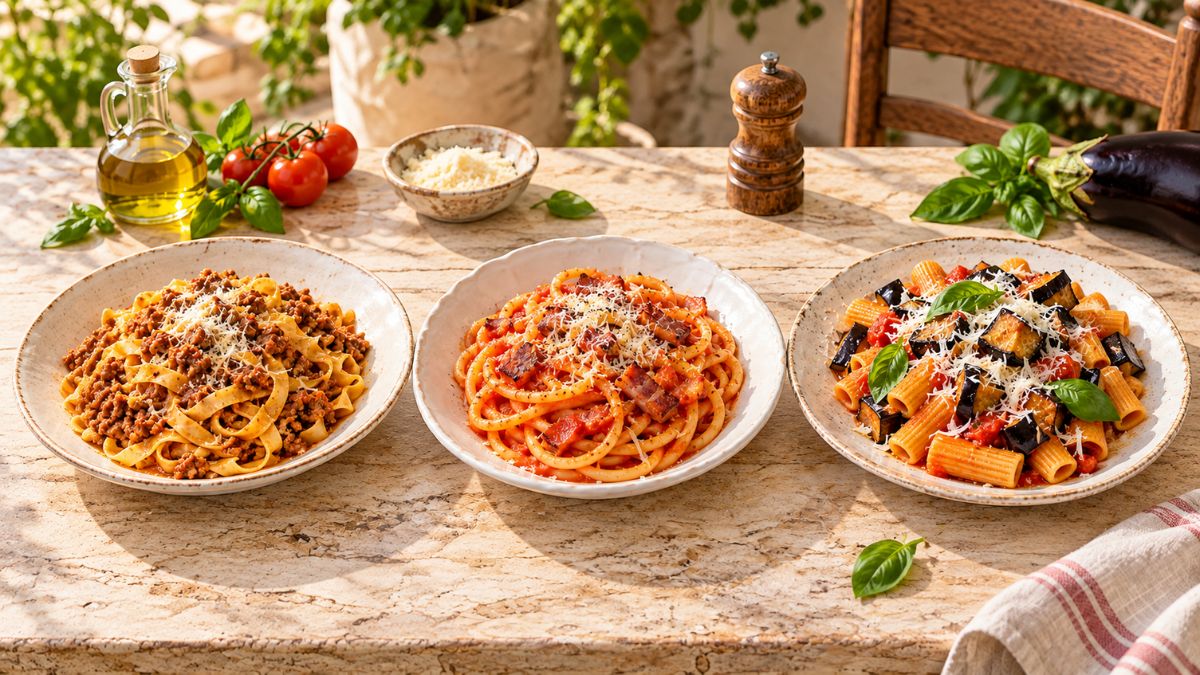
For us Italians, pasta is a common language whose accent changes from one region to the next. Just follow three dishes, originating in three different cities, to travel across Italy and understand why they have become symbols of our country around the world.
Tagliatelle with ragù, measured with a tower
In Bologna, tagliatella has never been a mere detail. It’s a matter of identity, so much so that it deserves an official measurement. On April 16, 1972, the Italian Academy of Cuisine registered its width with the Chamber of Commerce: eight millimeters cooked, about seven millimeters raw.
The number was not chosen at random. It corresponds to 12.270ths of the height of the Asinelli Tower, the symbol of the city. It’s as if Bologna wanted to measure its most beloved dish with its tallest monument, linking cuisine to architecture and dining to the urban landscape. A golden tagliatella, preserved in a special case, still preserves its proportions today.
Ten years later, it was the sauce’s turn. On October 17, 1982, the Academy’s Bologna delegation also registered the recipe for ragù. And here’s a truth that surprises many Italians abroad: the “spaghetti Bolognese” ordered around the world can’t be found in Bologna. Here, ragù is paired with tagliatelle, a pasta capable of embracing and holding it. It’s a marriage the city proudly defends.
Amatriciana, a recipe protected by Europe
Heading down toward the city center, you reach Amatrice, a small village in Lazio that has had a unique destiny: its name travels daily to tables around the world. Amatriciana originated there, and every dish served, in Rome or New York, pays homage to its people.
Precisely to protect this identity, since 2020, “Traditional Amatriciana” has been a Guaranteed Traditional Specialty, recognized by the European Union with a regulation published on March 13 of that year. The specifications are precise, almost strict. It requires pork cheek aged at least thirty days, Pecorino Amatriciana or Pecorino Romano DOP, tomato, a splash of white wine, pepper, and chili pepper. Three ingredients, however, must never be added to the pot: garlic, onion, and pancetta.
It may seem excessively rigid, but it’s the opposite. In Italian cuisine, simplicity is the hardest thing to maintain, and a clear rule is the best way to maintain it.
Pasta alla Norma, a masterpiece at work
The journey ends in Catania, with Italy’s most musical dish. Fried eggplant, tomato sauce, grated ricotta salata, and basil: just a few ingredients, a perfect balance of sweetness and saltiness.
The name is a tribute to the Norma, the opera by Vincenzo Bellini from Catania. It premiered at the Teatro alla Scala in Milan on December 26, 1831, and, curiously, that evening it was a resounding flop. The audience didn’t understand it immediately. Then the Norma It became Bellini’s most popular opera, and its aria “Casta diva” is still one of the most beloved in opera today.
There’s a detail that makes us smile on World Pasta Day: the star of that first evening was soprano Giuditta Pasta. Her surname seems to have been written on purpose. Tradition has it that the Catanian writer Nino Martoglio, tasting the dish, exclaimed, “It’s a real Norma!”—a masterpiece. This is probably just a legend, as historical sources don’t confirm it. But it’s so beautiful that the people of Catania continue to talk about it.
A gesture that unites Italians around the world
A measure, a rule, a melody: three dishes express three different ways of being Italian. Yet there’s a gesture that unites them all, and unites Italians spread across every corner of the planet: the moment the water boils and the pasta is thrown in.
Whether it’s tagliatelle, spaghetti, or macaroni, that simple gesture carries with it a story of families, lands, and hands kneading dough. For World Pasta Day, wherever you are, set the table and choose your favorite dish. Because a plate of pasta is never eaten alone: it’s always a piece of Italy that’s shared.
AI-generated cover image