The Piatti del Buon Ricordo, or “Plates of Good Memories,” tradition dates back to 1964, when a clever marketer came up with it to encourage Italians to travel across the country and taste regional dishes

| Freelance writer
August 25, 2026 8:42 a.m.

At its peak, the movement grew to include more than 130 participating restaurants. Today, 111 authentic trattorias still promote regional cuisine in this special way.
Unione Ristoranti Buon Ricordo
Lasagna, pizza margherita, tiramisu: Italian cuisine is lauded around the world. Just last year, UNESCO recognized Italian cooking as an intangible cultural heritage of humanity. While individual foods like the French baguette, Haitian soup joumou and Uzbek plov were already included in this list, it was the first time in history an entire cuisine was given this distinction.
Italy’s Prime Minister Giorgia Meloni called her country’s cuisine a “formidable ambassador” at a press conference where the accolade was announced. “Cooking means taking care of family, friends and guests. It means combining our history and our future, passing down ancient knowledge and constantly turning it into something new,” said Meloni.
Step inside any traditional trattoria in Northern Italy or on the Italian Riviera and you will find yourself immersed in centuries-old customs and historical recipes passed down through generations. First conceived in the Middle Ages, and akin to a tavern, the trattoria was a place to eat common foods often cooked by grandmothers. It may sound like a scene out of a movie like Nonnas, or something fabricated for tourists, but the casual, family-run eateries offer a way of dining like a true Italian.

Ask any child who grew up in Italy in the 1970s and they will have fond memories of at least one family member who was obsessed with traveling to trattorias and collecting the plates designed by local artists.
Unione Ristoranti Buon Ricordo
“The Italian trattoria is one of the symbols of our people’s culture and tradition. It’s not just a place to eat but also a place for tradition and memorable encounters—all of which are deeply rooted in our history,” says Alberto Cauzzi, food editor for Forbes Italia.
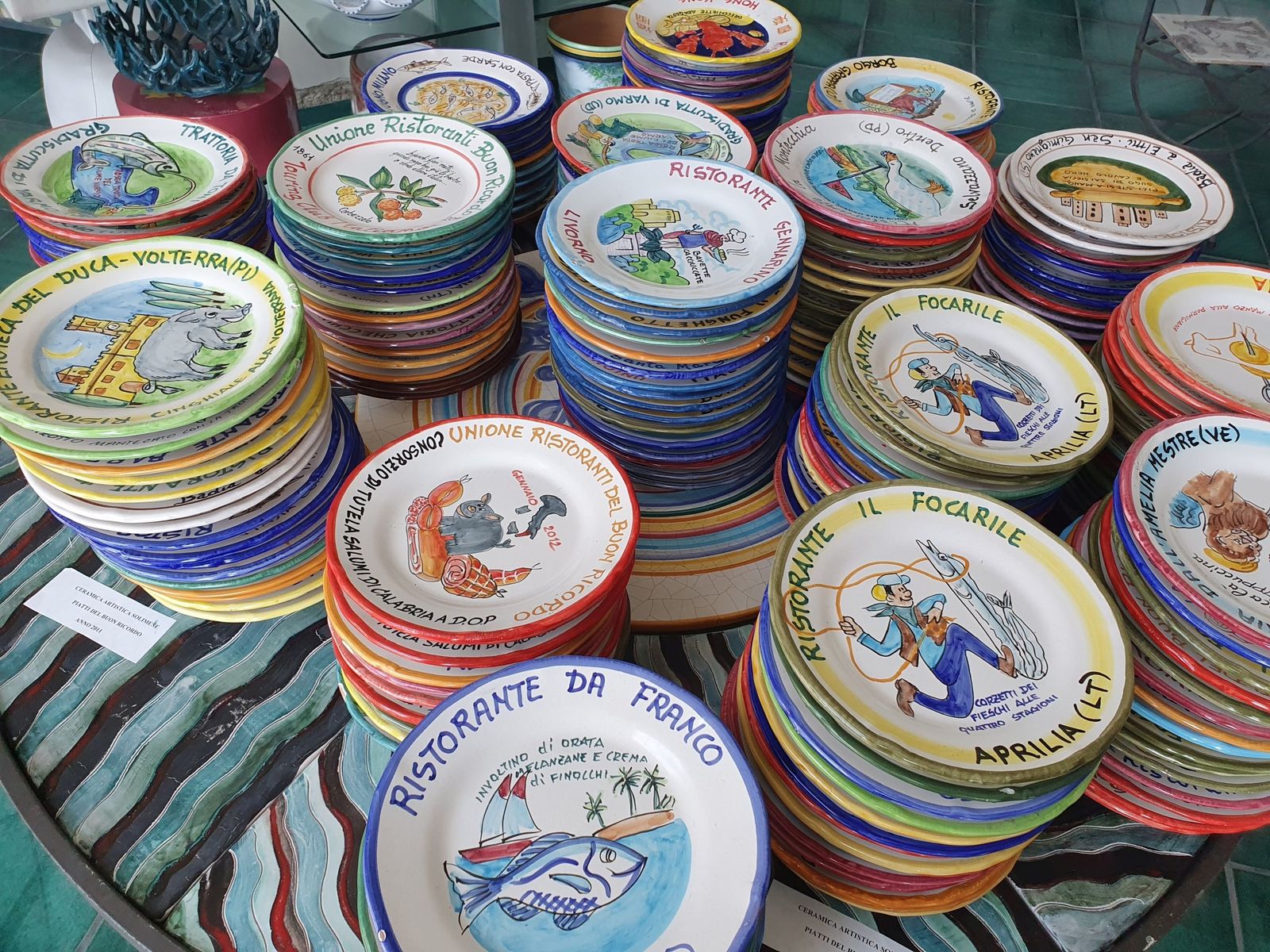
While many travelers and foodies have enjoyed a meal at a trattoria, few know about a custom called Piatti del Buon Ricordo that was conceived in the 1960s to promote trattorias nationally and worldwide. Loosely translated, the phrase means “plates of good memories.” In participating trattorias, diners who order the signature dish can take their plate—a hand-painted ceramic collectible—home as a souvenir.
A dozen restaurants participated in the promotion at the start. The movement grew to include more than 130, and, today, 111 authentic trattorias still promote regional cuisine in this special way. Vintage plates draw interest worldwide, with collectors searching thrift stores and spotting the ceramics at notable design fairs in Italy—reviving interest in the hobby itinerant eaters once obsessed over.

Each plate usually features the name of the restaurant and its signature dish and ingredients, explains Roberta Ceretto, a Piemonte-native and owner of the trattoria La Piola in Alba.
Unione Ristoranti Buon Ricordo
What is Piatti del Buon Ricordo?
Versace, Leonardo da Vinci and Michelangelo are famous names linked to promoting Italian culture, but not many will know the name Dino Villani. He was a businessman with a knack for finding trends and marketing them. He was the mastermind behind some unforgettable cultural touchstones in 20th century Italy, such as the “5,000 lire for a smile” contest. The 1939 marketing campaign for a toothpaste from the Gi.Vi.Emme beauty company invited people to submit photographs of themselves smiling and led to the Miss Italia pageant in 1946. Villani also created Colomba Pasquale, a dove-shaped Easter bread designed to be a spinoff of the Christmas panettone. But the clever marketer’s lesser-known legacy is Piatti del Buon Ricordo.

Dino Villani was a businessman with a knack for finding trends and marketing them.
Unione Ristoranti Buon Ricordo
In essence, Villani wanted to boost tourism and gastronomy in Italy following World War II, when supermarkets were becoming more prevalent and farmers were slowly losing their gravitas in society. In 1964, when Villani launched the program, French-influenced menus were gaining attraction among young and influential Italians. Michelin-starred chef Davide Scabin of Carignano in Turin, Italy, says the initiative was an “early expression of marketing Italian gastronomy to counterbalance the overwhelming influence of French gastronomy, which was gaining momentum in Italy at the time.”
For context, Cesare Carbone, president of the Buon Ricordo Restaurant Union, the official governing body championing the concept for more than half a century, adds, “It was the years of the economic boom, and restaurant customers were eager to embrace new lifestyles. They were more attracted to international models than to the authentic values of traditional Italian gastronomy, which was in danger of disappearing from restaurant tables.”

Cesare Carbone is president of the Buon Ricordo Restaurant Union, the official governing body championing the concept for more than half a century. He is also a restaurateur and owner of Trattoria Manuelina in Recco.
Unione Ristoranti Buon Ricordo
Wanting to keep Italian cuisine at the forefront, Villani gave diners an incentive. “Dine in a trattoria, order and enjoy a regional dish, and take home the handmade ceramic plate at the end of your meal,” says Carbone, who also owns Trattoria Manuelina in Recco, a member restaurant.
The idea was conceived to “promote, and defend rigorously, Italian cuisine,” Carbone explains.
Artisans of the Ceramiche Artistiche Solimene, a family-run business in the Amalfi Coast’s Vietri sul Mare that is known for its ceramicists, have always hand-painted the plates, made from raw clay from the quarries of Ogliara.

Artisans of the Ceramiche Artistiche Solimene, a family-run business in the Amalfi Coast’s Vietri sul Mare that is known for its ceramicists, paint the plates by hand.
Unione Ristoranti Buon Ricordo

The plates are made from raw clay from the quarries of Ogliara.
Unione Ristoranti Buon Ricordo
Since 1985, Milanese graphic designer Paolo Argenton has designed the pieces. “Each restaurant chooses its signature dish, which is then illustrated by Argenton with other elements depicting the city or town in which it is located,” Carbone explains. “The plate is given to those who choose the Buon Ricordo menu, so they can take home a ‘good memory’ of an unforgettable tasting experience.”
Ask any child who grew up in Italy in the 1970s and they will have fond memories of at least one family member who was obsessed with traveling to trattorias and collecting the plates designed by local artists.
“I remember my dad trying to take us to a different place once a month to collect plates to hang in our dining room. It was a way to make a cultural moment more convivial and perhaps played a large role in my current career,” says Cauzzi.

Vintage plates are collector’s items.
Unione Ristoranti Buon Ricordo
For Scabin, who worked at a handful of Buon Ricordo-member restaurants in the ’80s, the Piatti del Buon Ricordo was social currency.
“People displayed them proudly because they represented the tangible proof of a journey and an experience they had lived,” says the chef. “Those who collected those plates belonged to an elite community, and that was also part of their identity. The plates were seen as souvenirs for gastronomic globetrotters.”
People had to be relatively well-off to dine at Buon Ricordo restaurants, Scabin adds. “It wasn’t something for young backpackers; it was for people who could afford to eat out, which in between the ’60s and ’80s was relatively uncommon,” he says. “When you visited someone’s home and saw an entire wall covered with them, you knew you were looking at someone with a certain status and place in society.”

Piatti del Buon Ricordo was conceived to “promote, and defend rigorously, Italian cuisine,” Carbone explains.
Unione Ristoranti Buon Ricordo
Villani could be regarded as an influencer of his era, says Scabin. “At the time, Italy itself was still somewhat exotic as a travel destination for Italians, and going from north to south and tasting ingredients never before encountered was a genuine discovery,” he says.
When Villani’s initiative launched, Italians hadn’t yet realized that the great richness of the country’s gastronomy lay in the extraordinary diversity of its regional cuisines, Carbone explains. “The Unione Ristoranti Buon Ricordo was founded precisely to safeguard this extraordinary heritage and enhance what is now commonly called ‘local cuisine,’” he says.
Giovanni Astolfoni, executive chef at Bontanico Restaurant in Nervi, Genoa, says the plates helped turn childhood meals into memories. “I’ve always thought they represent one of the most beautiful ideas in Italian gastronomy,” he says. “Long before food tourism became popular, they encouraged people to travel across Italy and discover the country’s incredible regional cuisines. In many ways, they remind us that hospitality isn’t just about the food on the table—it’s about the memories people take home with them.”

Since 1985, Milanese graphic designer Paolo Argenton has designed the pieces.
Unione Ristoranti Buon Ricordo
Foodies have their favorite dishes among the 111 participating restaurants today. Among them: La Laconda dei Beccaria in Montù Beccaria, Lombardy, offers le stagioni del risotto, a risotto made with vegetables that change with the season; Ristorante Taverna del Lupo in Gubbio, Umbria, serves filetto di maiale al ristretto di Sagrantino con cipollotto di Cannara, pork tenderloin with a local wine reduction and red spring onions; and Hostaria Baccofurore 1930 on the Amalfi Coast features ferrazzuoli alla Nannarella, a twisted-pasta tossed with smoked swordfish, tomatoes and arugula.
“Members are committed to practicing a traditional local cuisine and to always featuring a specialty on their menu that represents its most rigorous and exemplary expression,” says Carbone.
A new tradition continues
Whether kitsch or something your Italian grandmother has on her mantlepiece, Buon Ricordo plates remain in vogue. On eBay, bidding for a plate can start at 3 euros and reach more than 150 euros, and home enthusiasts can find the ceramics in places as diverse as major design fairs like the Maison et Objet in Paris to stores like ABC Carpet and Home in New York City. There is even an association for collectors.
Quick fact: Venice’s iconic crab dish
For more than 300 years, Italians have fried soft-shell green crabs, called moeche. But climate change is threatening the crabs. Fishermen report a 50 percent decline in catch just in the past three years.
When Piemonte-native Roberta Ceretto opened the trattoria La Piola in Alba in 2005, paying homage to the Piatti del Buon Ricordo concept was a way to express her family’s love for art. “We wanted to honor that heritage while giving it a contemporary edge,” she says. “We commissioned 12 different artists who created 39 custom designs for us. Some of them found the request completely crazy, because they had never painted on a round canvas before. But as you know, art is beautifully unpredictable.”
La Piola serves traditional Piemonte dishes like agnolotti del plin and a chocolate dessert called the bonet on plates decorated with art by Italian, Swiss, British and American artists. These plates are not given to diners after their meal, but they are sold at the family’s Ceretto winery nearby.
With food trends catching on and new-age restaurants opening daily on the streets of Rome and Milan, the trattoria remains relevant among Italians. Thanks, in part, to Villani.
“For us, a trattoria is a cultural institution, far more than just a place to eat,” says Ceretto. “Here, we keep our tradition, and we are deeply proud of our roots. The classic trattoria remains an essential part of who we are.”
Planning Your Next Trip?
Explore great travel deals
A Note to our Readers
Smithsonian magazine participates in affiliate link advertising programs. If you purchase an item through these links, we receive a commission.