
In Italy there is a habit with a name of its own: “fare la scarpetta”, literally “to make a little shoe”. It is the custom of using a piece of bread to gather up the last of the sauce or juices on your plate. Today Italians do it more and more openly, even in restaurants with white tablecloths, although not so long ago polite society frowned on it.
The author of the original piece recalls spending much of her childhood with her Italian grandparents in Kent. There was always bread on the table, but its main role began at the end of the meal: it was used to wipe up what was left of the pasta sauce or the oil and vinegar from the salad. It is still her favourite part of any lunch. She only learned as an adult that the habit has a name.
On a trip to Naples she watched her Italian companion, waiting for the pasta plates to be cleared, fix his eyes on a smear of pesto. He impatiently tore off a piece of bread, wiped up the last drop and popped it into his mouth with obvious pleasure. No questions, no glance to see how anyone reacted — just unselfconscious delight that seemed to say: this dish is delicious, and it deserves to be enjoyed properly.
Where the name “scarpetta” comes from
There are plenty of theories online about why the custom is called a “little shoe”. Some Italians think a piece of bread looks like a shoe or a clog. Others link it to hunger, when a person would eat even the sole of a shoe.
Italian food historian Luca Cesari says there is little evidence for either explanation. “The origin is unclear, so I would set aside the fanciful internet theories,” he says.
The earliest written mention Cesari has found dates from 1871 and is in Roman dialect. In the Roman magazine La Frusta, a character asks for a “scarpetta” to be made from the sauce left on his plate. The word also appears in a dictionary of the Abruzzese dialect from 1885, which suggests the custom has its roots in central Italy. In Cesari’s view, the most convincing hypothesis comes from the Accademia della Crusca, Italy’s leading authority on the language: in a central Italian dialect, “fare una scarpetta” meant “to go for a short walk” — just as the bread “takes a walk” around the plate.
Every region has its own habits
Francesca Cipolla, a food content creator from Palermo in Sicily, says the scarpetta is almost a reflex. “We don’t do it consciously. If there is a delicious sauce left on the plate, I tear off a piece of bread and mop it up. I don’t think about it at all. I learned it as a child, and everyone in my family does the same.”
But it was not always so, and attitudes depended on region, generation and background. Chef Gaia Enria, who grew up in Turin — one of the most formal cities in the north — remembers her parents scolding her for doing the scarpetta. “Back then it was considered rude. I think that was very much a Turin thing. Times have changed, but I remember it well.”
In Puglia, according to chef Somaya Hammad, it is almost the opposite. “Especially in Puglia it is almost impolite to leave anything on your plate, so finishing every last bite with the help of bread is both a way of saying thank you for the food and of not wanting to throw anything away.”
Further south, in Calabria, chef Francesco Mazzei of the London restaurant Mezzogiorno recalls a very different attitude to bread. Bread deserved deep respect: it was not merely a tool for gathering sauce but an integral part of the meal. In his words, everything else was just “companatico” — “what you eat with bread”.
How bad manners became the norm
Cesari stresses that the difference is not only geographical but also a matter of class. Traditional bourgeois etiquette condemned eating with your hands. Even a compromise — breaking off bread and pushing it around the plate with a fork — could be seen as ill-mannered. That only hinted all the more that “someone would like to observe etiquette but simply can’t resist”.
Attitudes began to change in the second half of the twentieth century, when Italy rediscovered its traditional culinary philosophy and came to regard waste as the real breach of good manners. The symbolic turning point came in 2015: Gualtiero Marchesi, regarded as the father of modern Italian haute cuisine, told the magazine Gente that the scarpetta was perfectly acceptable, even elegant, if done with your fingers and a casual ease.
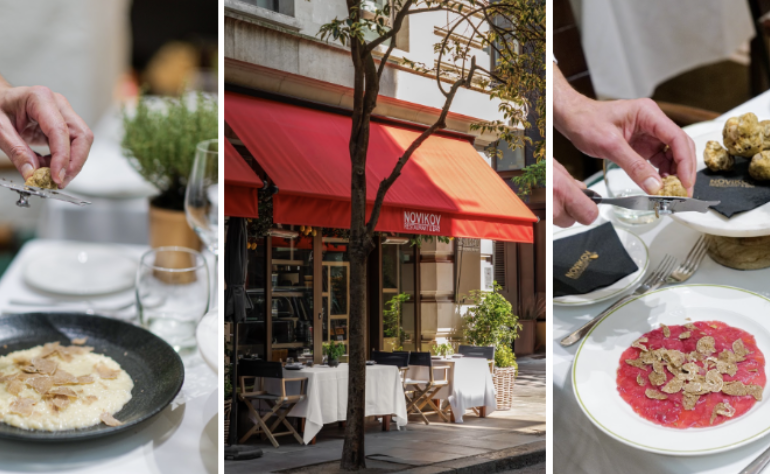
Italians doing the scarpetta in restaurants just as they do at home are now seen more and more often. “It doesn’t matter whether it’s an expensive restaurant or a bar that serves food. Everywhere they bring bread for this purpose and leave it on the table until the end of the meal,” says Cipolla.
According to Enria, the scarpetta is not only accepted but respected: even a small gesture can say a great deal. “But it’s also a pleasure,” she adds. “You want every last drop because it was so good.”
Around Prague guide on the topic: 9 Michelin restaurants in Czechia: where to find haute cuisine from Prague to Moravia
Around Prague, based on reporting by seznamzpravy.cz
👍 0
Share:
Telegram
WhatsApp
Copy link
📌 Useful for life in Czechia