
Your support helps us to tell the story
From reproductive rights to climate change to Big Tech, The Independent is on the ground when the story is developing. Whether it’s investigating the financials of Elon Musk’s pro-Trump PAC or producing our latest documentary, ‘The A Word’, which shines a light on the American women fighting for reproductive rights, we know how important it is to parse out the facts from the messaging.
At such a critical moment in US history, we need reporters on the ground. Your donation allows us to keep sending journalists to speak to both sides of the story.
The Independent is trusted by Americans across the entire political spectrum. And unlike many other quality news outlets, we choose not to lock Americans out of our reporting and analysis with paywalls. We believe quality journalism should be available to everyone, paid for by those who can afford it.
Your support makes all the difference.Read more
Sexism in the restaurant industry is a harsh reality Dara Klein knows all too well.
Despite founding one of London’s most-talked about new restaurants, Tiella Trattoria, on Columbia Road in January this year, she still battles ongoing gender bias.
The 36-year-old says she has encountered sexism not only from fellow chefs, but also from customers and suppliers.
“We have an open kitchen and the amount of times that I never get looked at in the eyes and blanked, even though I’m on the pass, reading out the tickets, running the ship, they’ll talk to the male chef on larder,” says the Italian chef, who recently published her debut cookbook La Trattoria.
Her experiences informed an open letter she co-authored with Sally Abe in February, condemning the “pervasive” sexism in the industry and calling for a more “inclusive, equitable and positive” environment.
Signed by a group of 70 female chefs, the letter, first published in The Telegraph in 2025, was written in response to Jason Atherton’s claims in a Times interview that he had not witnessed sexism in restaurants.
“The objective was always just to share an experience and it’s not done with blame and it’s not to finger point,” she says. “Unfortunately, I was always very, very aware of my gender [in kitchens] and I think a lot of women and non-binary people – and men too – have been made aware of that.
“When you’re working a physical, demanding and stressful job, it can all come to a standstill when somebody makes a comment just to remind you of the fact you’re a woman or talk about your appearance.”
It’s why now Klein’s main aim is to create a “warm and safe environment” for aspiring hospitality workers. More so than cooking, she hopes her legacy is to “inspire people to find this profession as it’s such a brilliant career in so many ways”.
 ‘La Trattoria’, Klein’s debut cookbook draws on the regional Italian cooking that shapes the menu at Tiella (Ebury)
Klein herself nearly didn’t become a chef. As a child, she “never, ever” had any desire to work in kitchens, even though it was the family business, and didn’t start cooking professionally until she was 28.
She grew up in San Giovanni in Italy’s Emilia-Romagna region before moving to Wellington, New Zealand at the age of six for her father’s work. Her mother, who’d worked in kitchens in Italy, was initially homesick and used cooking as a coping mechanism. It was then a business idea was born.
First, her parents opened a deli in the suburbs, before opening a restaurant, Maria Pia’s, with her mother as head chef. “She was definitely quite tough as a chef, so I always thought you had to rule with an iron fist. But the more I travelled, [the more] I saw there are different ways to run kitchens,” Klein says, adding that her mother comes from a “different generation of chefs”.
Initially wanting to pursue a career as an actor, director or screenwriter, Klein relocated to Australia to study creative writing and film, and later acting at Sydney’s prestigious drama school, The National Institute of Dramatic Art, but soon realised it wasn’t for her.
She then moved to New York to work a front-of-house position at a restaurant where she suffered a “mental health dip” and was advised by her family and doctors to switch to a nine-to-five office job for stability. For five years, she worked in various admin, marketing and social media jobs, but felt unfulfilled.
“I couldn’t really find my thing and, as somebody quite creative and busy, I found that really challenging. I was a bit lost and so I turned back to cooking,” Klein explains.
In 2019, she started working in kitchens in London before opening her much-lauded residency in The Compton Arms in Islington. After multiple offers of investment, she opened her first bricks-and-mortar restaurant, Tiella, earlier this year.
 Klein says seeing different styles of leadership taught her that kitchens don’t need to be ruled with an ‘iron fist’ (Caitlin Isola)
The restaurant focuses on rustic dishes from across Italy, such as chicken milanese, with a particular spotlight on the cuisine of Klein’s home region, Emilia-Romagna, which she says is famed for its “incredibly rich and decadent” cooking.
Klein remains a dedicated student of the different gastronomic traditions across Italy, highlighting Sardinia and Sicily as underrated food regions.
“Sardinia has a fascinating landscape as it’s pastoral but obviously it’s an island, so it’s enclosed with water. A lot of their pasta is fascinating , as well as the way they make cheese and produce their own salumi,” she says.
“There’s something about Sicilian food that really gets me as you see the influence of the various conquests from the Arab World and Northern Africa. They do different things with sweet and sour cooking and their approach to meat and fish is quite unique.”
But the one Italian dish Klein says overlooked by travellers is pizza rustica, a savoury pie, which is produced in the south, in places like Puglia, Calabria and Sicily.
“Our pies are really different and the one I love is made with a filling of tuna, onion, tomatoes, olives and red onion. They’re usually served at room temperature, so it’s something you’d bring to the beach,” she explains.
As for finding the best restaurants in Italy, Klein has some words of wisdom. “Stay off social media as the restaurants recommended there are more likely to be tourist traps,” she advises. “Go as far away from the centre of the city as you possibly can and spend time hitting the pavements, looking around at the restaurants.
“If the signage looks a bit old school, the clientele look Italian and it doesn’t look too flashy, that’s a dead giveaway. If the restaurant has fluorescent-strip lighting, often it’s going to be really good.”
Klein adds while laughing: “Definitely ask locals, but they’re probably not going to give you the good ones!”
Amatriciana (Rome): Roman tomato, guanciale and pecorino sauce
 Klein’s amatriciana sticks closely to the Roman classic, with guanciale, tomato and pecorino (Caitlin Isola)
“The first time I put amatriciana on the menu at Tiella I was incredibly nervous,” says Klein. “It’s one of the four great Roman pastas (along with cacio e pepe, gricia and carbonara) and since it’s my favourite of the lot, I wanted to honour the original recipe as much as possible.
“Speak to any Roman and they are deeply protective of their pasta, perhaps because so much of the world has taken their culinary ideas for a spin. There are times when I feel deeply passionate about tradition and ‘authenticity’, and others when I wish the rules would relax. When it comes to amatriciana, I wouldn’t dare mess with it.
“The dish is said to have originated in the town of Amatrice, neighbouring Rome. Supposedly the movement of shepherds between Abruzzo and Lazio brought the dish to the city. Gricia predated it, made with guanciale (cured pork cheek), pecorino and black pepper, but with the arrival of tomatoes in the 16th century, the dish evolved.”
Serves: 4
Ingredients:
150g guanciale
2 tbsp extra virgin olive oil
50ml white wine
1½ tins of plum tomatoes
1 fresh bay leaf
Pinch of red chilli flakes
120g freshly grated pecorino, plus extra for serving
Sea salt and freshly ground black pepper
Accompanying pasta shapes: spaghetti, rigatoni, paccheri, mezzi paccheri, bucatini
Pasta weight: 80-100g per person
Method:
1. Using a sharp knife, carefully trim the skin off the guanciale, trying not to remove any of the fat, then cut into thin strips.
2. Put the olive oil and guanciale in a heavy based pan and cook slowly over a low heat until golden and crisp. Remove a quarter of the guanciale and set aside.
3. Add the white wine to the pan and cook out the alcohol over a high heat for two minutes, then add the tomatoes, bay leaf, chilli flakes, a five-finger pinch of salt and a generous grind of black pepper. Simmer over a medium-low heat for around 20 minutes, stirring every five minutes or so. Taste the sauce for seasoning and adjust to your liking.
4. Cook your pasta according to the packet instructions, reducing the cooking time by one minute.
5. While the pasta is cooking, add the pecorino to the sauce and reduce the heat to low. Allow the cheese to melt into the sauce – do not stir or agitate it too much or it may clump.
6. Drain the pasta and immediately add it to the sauce along with a few tablespoons of the pasta water. Toss the pan back and forth to create the mantecatura (emulsification). Taste again for seasoning and adjust if necessary.
7. To serve, sprinkle with the crispy guanciale and some extra pecorino.
Risotto alla Milanese
 Risotto alla Milanese gets its distinctive golden colour and delicate flavour from saffron (Caitlin Isola)
“In many ways, this is the most iconic recipe in the canon of risotto,” says Klein. “The story goes that it was first cooked in the 16th century, created as a visual joke for the wedding of a master glassmaker’s daughter (saffron was used as a stained-glass colouring at the time).
“The first written documentation, however, appears around the early 19th century, with bone marrow and nutmeg among the ingredients listed. The dish was called risotto giallo until 1829, when the Milanese chef Felice Luraschi renamed it risotto alla Milanese.
“I like to allow the saffron to infuse very gently alongside a slowly melting ice cube. It may not be the fastest method, but I believe it extracts the flavour and colour beautifully.”
Serves: 4 as a primi
Ingredients:
4g saffron
1 onion
80g Parmigiano Reggiano
1.1 litres vegetable or chicken stock
125g salted butter
320g carnaroli rice
150ml white wine
Sea salt
Method:
1. Place a single ice cube in a small bowl with the saffron, allowing it to slowly melt at room temperature. Finely dice the onion and grate the Parmigiano. Pour the stock into a saucepan and warm over a low heat. Cube the butter and place it in the fridge. Weigh out the rest of the ingredients so that everything is ready to go.
2. Melt 25g of the butter in a wide saucepan over a medium heat. Add the diced onion and a five-finger pinch of salt and cook until soft and translucent. Add the rice, increase the heat to medium-high and toast in the pan for five minutes, stirring constantly with a wooden spoon. Do not skip this process. You’re looking for the rice to turn golden brown and release a toasted aroma. Add the wine and allow the alcohol to evaporate for one-to-two minutes.
3. Start a 20-minute timer and begin adding the stock one ladleful at a time, stirring constantly over a medium heat and waiting until most of the liquid has been absorbed by the rice before adding more. Do not give up on stirring – it’s worth it, I promise. Keep an eye on the timer and ensure you’ve used most of the stock by the end. Check for seasoning and the firmness of the rice every now and then. Don’t let the rice become soft and mushy: it should resemble al dente pasta.
4. Remove the risotto from the heat and add the remaining butter and the grated Parmigiano. Try to toss the pan, achieving mantecatura. The wave motion created by rocking back and forth will create an incredible emulsification, more so than just stirring, so give it a go. Stir in the saffron water (discarding any ice that hasn’t melted). Check the risotto for seasoning and add more salt if needed. I do not recommend adding black pepper as it will overpower the gentle flavour of the saffron.
5. Ladle generous amounts of risotto onto the plates and gently move it in a circle while tapping the bottom to achieve a nice flat layer. Serve immediately.
Panzanella: Bread and tomato salad
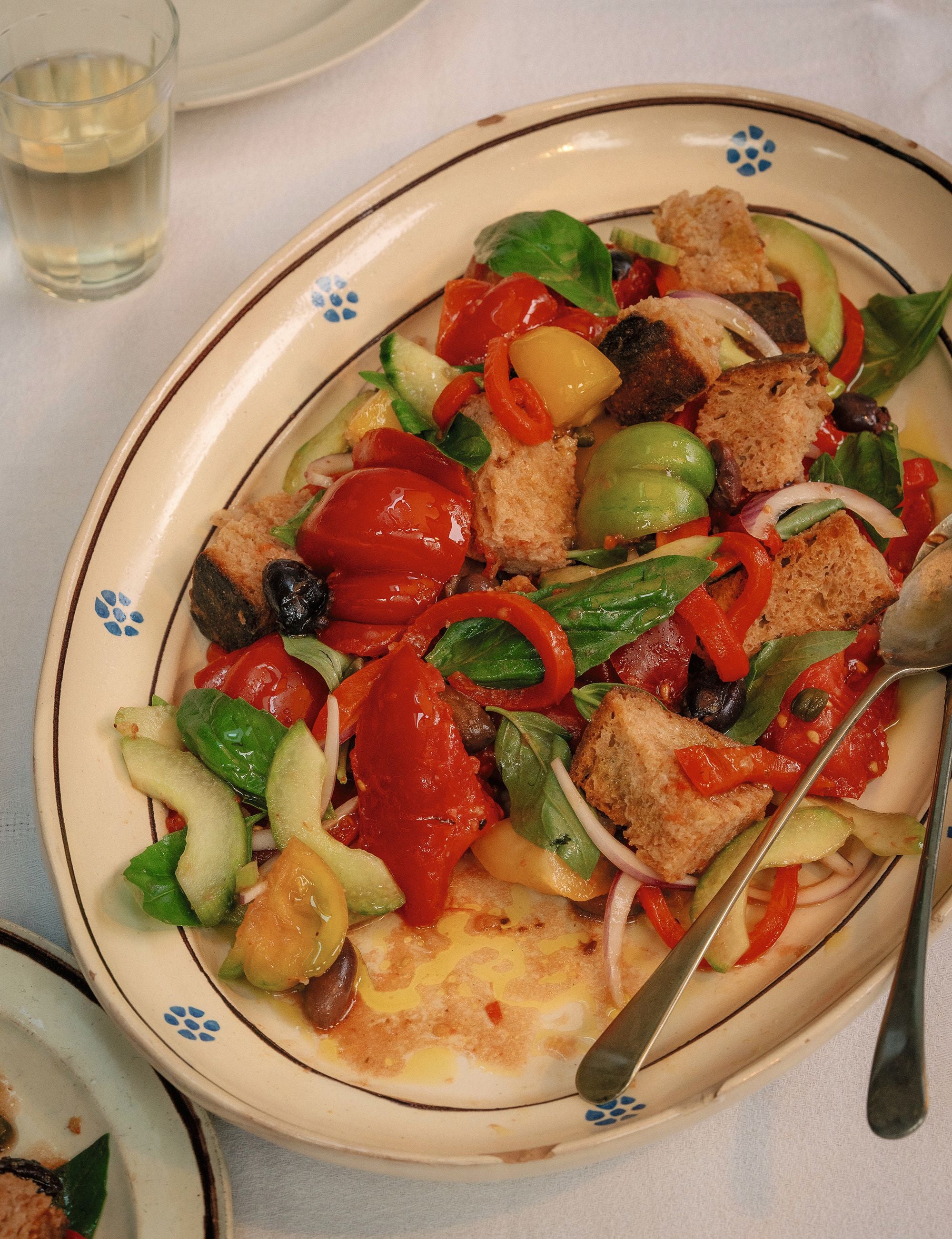 Tiella’s panzanella combines ripe tomatoes, stale bread, peppers, olives and basil in a classic Tuscan salad (Caitlin Isola)
“Panzanella introduces us to the wide variety of Italian dishes created to use up stale bread,” says Klein. “It likely originated as a very simple bread and onion salad, evolving into the dish we know today after tomatoes were introduced to Italy from the Americas in the 16th century.
“The Renaissance poet Giovanni Boccaccio was one of the first to mention this Tuscan bread salad, calling it panmollo or ‘wet bread’, and the Florentine painter and poet Agnolo Bronzino described a version made with onions, cucumbers and purslane in one of his poems.
“This recipe is based on the panzanella at Tiella. It’s one of my favourite things to eat throughout the warmer months. I like to use stale sourdough or focaccia as they both hold up well against the marinade and don’t get too soggy.”
Serves: 4
Ingredients:
1 large pepper
200g slightly stale bread, preferably sourdough, ciabatta or focaccia
480g ripe tomatoes (I like to use a mix of varieties and sizes)
180g cucumber
65g red onion
60g black or purple olives
3 tbsp red wine vinegar (I used equal parts moscatel and Cabernet Sauvignon vinegar)
1 tbsp capers
1 tsp lemon juice
1 small bunch of basil
Extra virgin olive oil
Sea salt
Method:
1. Preheat the oven to 200C/180C fan/gas mark six.
2. Place the pepper on a baking tray lined with baking paper. Drizzle with olive oil and lightly season with salt, then roast in the oven for 40 minutes, turning halfway through. You want the skin to be slightly charred. Remove from the oven, transfer to a heatproof bowl and cover with cling film.
3. Meanwhile, make the croutons by cutting the bread into 3 x 4cm chunks. Season with a three-finger pinch of salt and drizzle over one tablespoon of olive oil. Massage the oil into the bread with your hands, then spread them out on a lined baking tray and bake in the oven for around 15 minutes, or until golden, rotating halfway through. Set aside to cool.
4. Wash and dry the tomatoes. Remove any stems, then cut into different-sized chunks. Place them in a large bowl and season with a five-finger pinch of salt. Wet your hands with cold water and flick a few drops of water on top of the tomatoes, then squish them down slightly with your hands. Leave them to sit for 15 minutes while you prep the other ingredients.
5. Wash and peel the cucumber. Cut in half lengthways, remove the seeds and then cut into thin slices on an angle. Finely slice the onion and soak in cold water to remove any sharpness. Destone the olives and tear them in half.
6. Once the pepper has cooled, remove the skin, stem and seeds, discarding any liquid released while cooling. Slice into thin strips.
7. Add the croutons to the tomatoes, making sure they soak up all the juices. You may need to add one-to-two tablespoons of cold water at this point if the croutons are looking too dry. Add three tablespoons of olive oil, the vinegar, olives, capers, lemon juice and a large pinch of salt. Drain the onions and add them to the bowl along with the sliced pepper. Toss the mixture together with your hands. Taste and add a little more salt, vinegar or lemon juice, if needed.
8. Once the salad is perfectly seasoned, stir through the basil leaves. Serve and enjoy immediately. This dish is great on its own or served alongside fresh mozzarella.
‘La Trattoria’ by Dara Klein (Ebury Press, £30).