
I’ve been cooking dinner most nights since 2016, and the honest version of how I do it isn’t “cook everything from scratch.” It’s knowing which shortcuts actually hold up and which ones taste exactly like the corner you cut.
The difference matters. Some shortcuts (frozen vegetables, refrigerated pasta, bottled sauces) get absorbed into a dish and you can’t tell they were there. Others broadcast themselves the second they hit your plate. I’ve learned to tell them apart, and these are the ones I keep going back to.
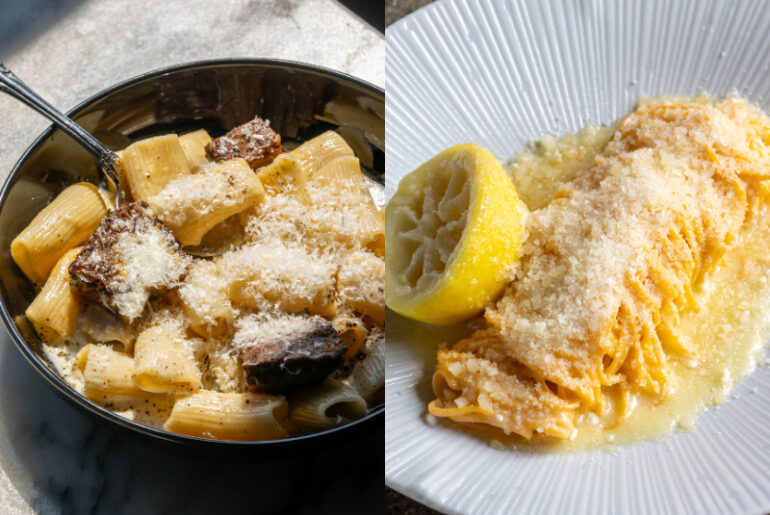
Refrigerated pasta is the one I’d never give up.
Fresh pasta from the refrigerated section (tortellini, gnocchi, cheese ravioli) cooks in about two minutes and behaves completely differently from dried pasta. The texture is softer, it holds up to heavier sauces, and it makes a dish feel like something you spent time on when you didn’t. Baked tortellini with meat sauce is the best example I have of this. It looks like a baked pasta situation that took an hour. The actual active time is short because the tortellini is already made. You’re just building the sauce and baking it together. Nobody asks if I made the pasta.
Bottled condiments work as marinades, not just dips.
Honey mustard, hoisin, teriyaki: the right bottled condiment can do the seasoning work on meat that would otherwise require a list of individual spices and some planning. Honey mustard pork chops are the version I make most often. The sauce is the whole thing. You coat the chops and cook them, and the result is a pan dinner that tastes like it had more going on than it did. The key is using a good bottled honey mustard, one where you can read the ingredient list without needing a chemistry degree.
This works with most thick condiments. They’re already balanced in ways that take trial and error to get right from scratch.
Frozen corn is better than fresh corn most of the year.
I know that sounds like a hot take, but fresh corn is good for about six weeks in peak summer and mediocre the rest of the time. Frozen corn is picked and frozen at peak and it’s consistent. I use it in chowders, pasta dishes, and grain bowls. When it goes into a cooked dish it’s indistinguishable from fresh. When fresh corn is actually in season, right now in August, I’ll use it. The rest of the year I’m not pretending the supermarket cob is worth the work.
Pre-cut produce is worth it for exactly two things.
I don’t buy pre-cut everything. The markup is real and the quality is inconsistent. But butternut squash and anything involving uniform, awkward cuts (think julienned peppers, cubed hard squash) is worth paying someone else to do. Cutting a whole butternut squash on a Tuesday night is a project. Grabbing a bag already cubed means it’s actually going in the oven.
Small pasta shapes make a bigger difference than you’d think.
This isn’t a shortcut exactly. It’s a buying decision that changes how a dish eats. Ditalini, small shells, orzo: they distribute through a dish so every bite has pasta and sauce together instead of a bite of noodle and a bite of sauce. Broccoli cheddar ditalini is the recipe where this matters most. The small pasta shape means the broccoli and cheese are in every forkful, and the whole thing eats more like a finished dish than a side.
The shortcuts I skip.
Pre-minced garlic in the jar. Every time I use it the dish tastes flat, and I can never figure out why until I look back at what I changed. Fresh garlic takes thirty seconds and the difference is obvious. Same with pre-grated parmesan in the green can. If the dish depends on the cheese at all, it’s worth grating it fresh.
The rule I’ve landed on: shortcuts that happen before the cooking (pre-cut vegetables, refrigerated pasta, bottled marinades) tend to work. Shortcuts that replace a core flavor (pre-minced garlic, shelf-stable parmesan) usually don’t.