
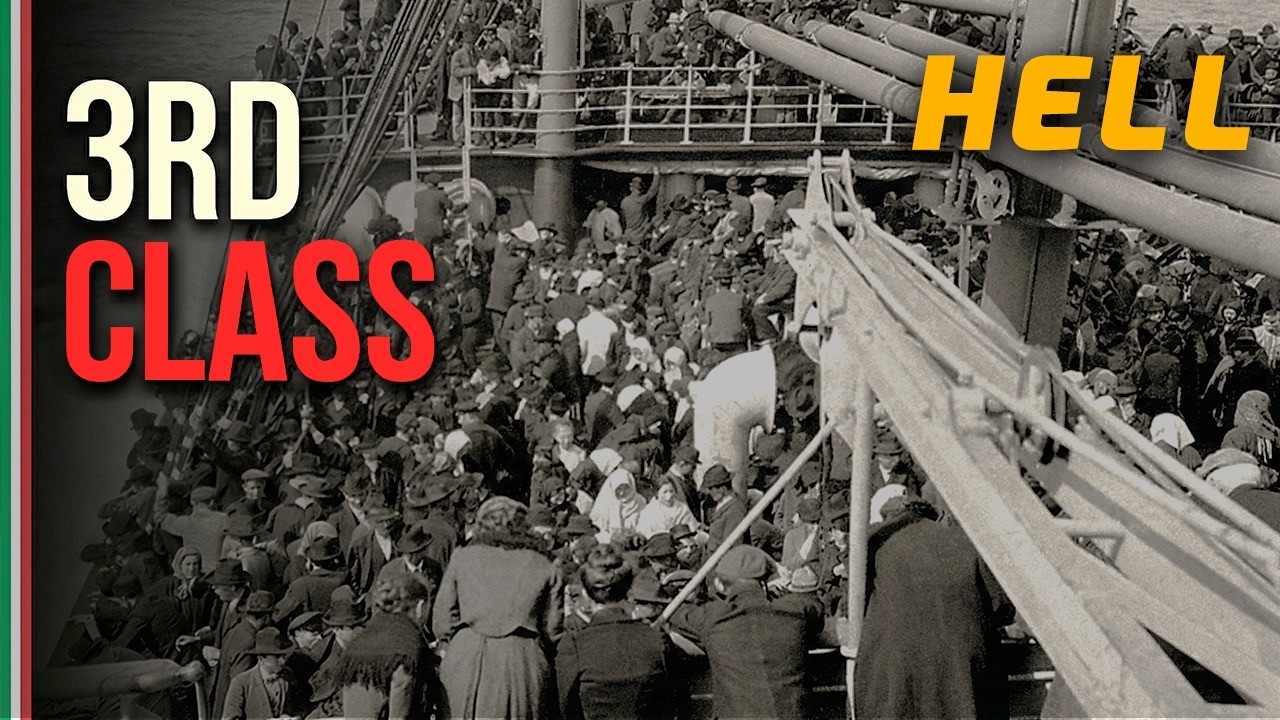
For millions of Italians, the story didn’t begin after arrival.
It began on the ship.
This video brings together the two souls of this channel: ships and the Italian diaspora.
Between the 1870s and World War I, families left Italy with paperwork, a bag, and hope to face third class, cold wind, overcrowded decks, sickness, fear… and weeks of ocean.
This is the Atlantic crossing as it was really lived: from the decision to leave, to the port, to the “belly” of the ship, to the moment land finally appeared.
Now I want to hear your story:
Do you know the year your family arrived?
Do you know the company or the ship name?
If not, comment surname + destination country (US / Canada / Argentina / Brazil / Uruguay / etc.). 🇮🇹🌊🚢
Chapters:
00:00 Intro
00:31 The voyage of hope
01:25 Preparations
03:36 Reaching the port
05:05 Inside the belly of the ship
08:43 How long the journey lasted
09:31 Food on board
10:23 Disasters at sea
11:31 The promised land
12:18 Your story
Check out this amazing channel about Ocean liners!
https://youtube.com/@thegreatbigmove?si=lfKKf9S0VezIhfE7
⚡WATCH MY OTHER VIDEOS!⚡
Ellis Island didn’t chanche your Italian Last Name. This did!:
Share your Italian Last Name with Luca (Live):
Why the Southern Italians when to the US and Canada and Northeners to Brazil and Argentina:
Why many Italian Americans loved Mussolini:
Can the Italian Diaspora fix the Population Crysis?
The Southern Italian emigration to South America:
The Italian emigration to Brazil:
The Italian emigration to Argentina:
The Italian emigration to Canada:
The Italian emigration to Mexico:
Stay tuned and SUBSCRIBE to the CHANNEL!
youtube.com/@TheItalianReach-2004?_confirmation=1
SOURCES:
Sirio (1906)
Luis O. Cortese, “Vicisitudes de la emigración. La tragedia del vapor ‘Sirio’,” in Temas de Patrimonio Cultural n. 25: Buenos Aires italiana. Buenos Aires, Comisión para la Preservación del Patrimonio Cultural de la Ciudad Autónoma de Buenos Aires, 2009, pp. 54–55.
MEI – Museo Nazionale dell’Emigrazione Italiana, “Tragedie per mare” (entry on Sirio, 4 Aug 1906).
Life in steerage / third class (images + descriptions)
Broughton Brandenburg, Imported Americans: The Story of the Experiences of a Disguised American and His Wife Studying the Immigration Question. New York, Frederick A. Stokes Company, 1904 (Project Gutenberg / Archive scans).
GG Archives, “Steerage (Immigrant Journeys) Photo Library” (photo set on steerage conditions).
Food on board (giorni di grasso / magro)
E. Perassi, “Il menù di bordo. Nutrirsi durante il viaggio migratorio,” Confluenze, 2019 (PDF; includes the giorni di grasso / magro ration example via Surdich/Cabrini).
Letters / first-hand emotion
MEI – Museo Nazionale dell’Emigrazione Italiana, “In viaggio con le lettere” (migrant letter excerpt about fear of the ocean).
Ellis Island medical inspection
U.S. National Park Service, “Historic Medical Inspection (2nd Floor)” (the “six-second exam” context).
Ticket agents / scams / migration business
Dolores Freda, “‘Clandestini’: il commercio dell’emigrazione in età liberale,” Forum Historiae Iuris, 2018 (agents, recruitment, regulation).
Italian shipping context (Florio–Rubattino / NGI)
Italianliners.com, “Navigazione Generale Italiana” (context on the Florio–Rubattino merger and NGI background).
Passenger lists / research context (optional but useful)
U.S. National Archives (NARA), “Passenger Arrival Records” (what manifests typically contain).
Steamship Historical Society of America, “Immigration by Passenger Ship Research Guide” (how to research a family crossing).
Narrative classic used for atmosphere
Edmondo De Amicis, Sull’Oceano. Milano, Fratelli Treves Editori, 1889 (public domain scan / text).
My filming and editing setup:
WEBCAM:
https://amzn.to/4k6oWmw
MIC:
https://amzn.to/44BMgn7
OUTDOOR MIC:
https://amzn.to/43jUv4K
MONITOR:
https://amzn.to/43jUxcS
13 Comments
Quick audio note: due to a few mic issues, you may hear some pops in places. I’ll fix the setup for the next videos—thanks for the patience.
Now tell me: do you know the year + ship/company your family used? 🇮🇹🌊
My father and his family were fortunate enough to cross first class in 1913. There was a very bad storm and everyone was sick, that is everyone except Papà and Nonna. I can't imagine an entire ship full of sick people in the middle of a stormy Atlantic a few months before the Titanic with German U-boats prowling around.
My family and I sailed to America in the late 50s on the Vulcania, which originated in Greece. We boarded in Palermo, to Naples, to Barcelona, to Lisbon, to Halifax, ending in New York. It was in steerage, in a tiny, windowless room, but mostly a fun time, if you were a child. My younger sister was seasick everyday when we crossed the Atlantic in January. I remember that the waves seemed taller than the ship. We were fed mostly deli meats. To this day, the smell of baloney is repulsive, reminding me of the seasickness we endured.
My maternal grandmother–maiden name Clementina Maestri–arrived at Ellis Island on 02-JUN-1907 on the Regina D Italia, which had departed from Genoa, Italy.
—
My great-grandparents came to the United States with nothing like all 1st generation of Italian Americans . They worked themselves up from the bottom. Up to 1.5 million, Italian Americans served in combat units in World War 2.( I would love for you to make a video about that ) We paid our dues and now we're just melting into the population. Like Italians always did.
I would have never survived a crossing like that
Thank you. I never knew these details. My great grandfather came from a small town in the middle of Sicily to NY in 1905. I presume he sailed from Palermo. The following year, his wife and kids came. Probably because they couldn't afford to come all at once? They all stayed at their cousin's house on Buffalo's West side. It must've been quite a culture (and climate!) shock.
1908? I think it was later, to Boston, Massachusetts on the Canopic, which left from Naples, I believe. My Nonna ❤. Last name Vanti
Salve Professor Luca, mum and I watched the video together.
Great content!
Thank you.
Viva l'Italia ❤
My grandfather and his mother arrived at Ellis Island from Napoli on 22 April 1903. The ship was the SS Nord America. It was built in the UK and sold to an Italian company (La Veloce). This Wikipedia article https://en.wikipedia.org/wiki/SS_Stirling_Castle (it was originally called the SS Stirling Castle) says that it made 58 round trips between Palermo, Napoli and New York between 1901 and 1908,
Welcome back.
Molto interessante come sempre Prof!!
storia anche della nostra famiglia