
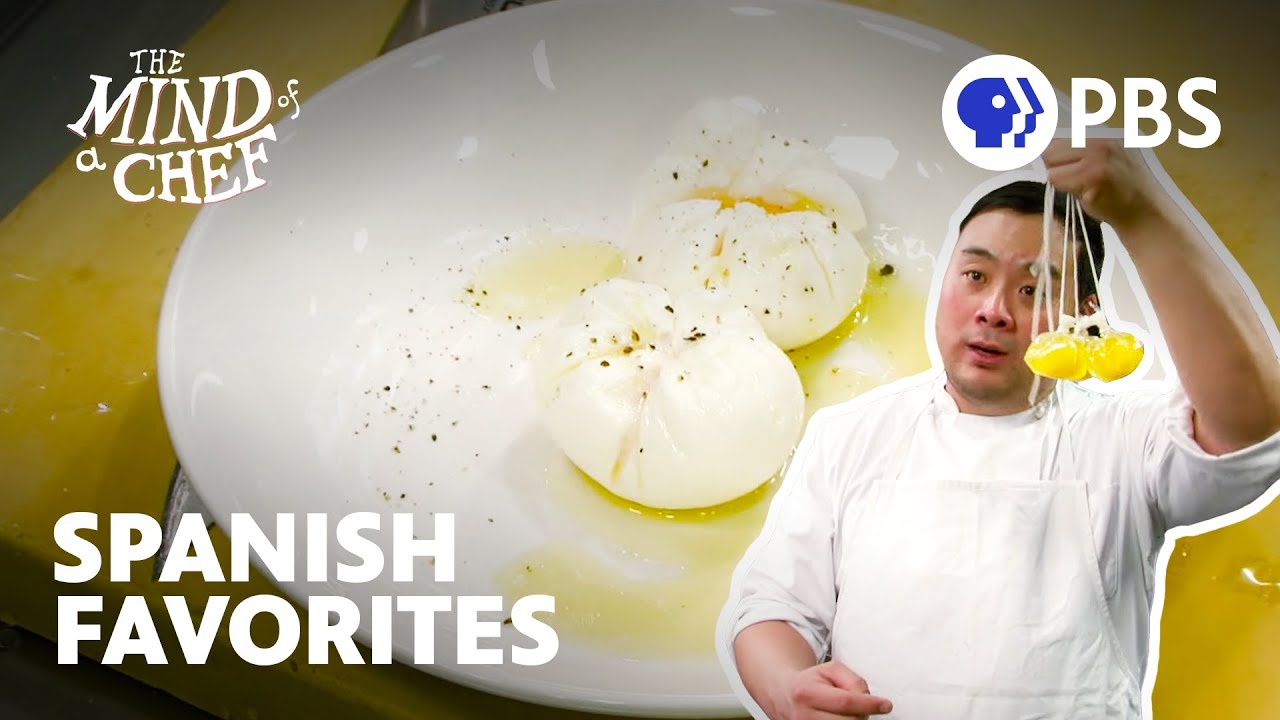
This episode is all about Spain’s influence on Chang’s career. He visits with some of his idols–Juan Mari Arzak and Andoni Aduriz, makes fideos, salt cod omelet and a sponge cake from chef Albert Adria. [Originally aired 2012]
More recipes, episodes and tips: https://to.pbs.org/3qqn1T4
Made possible by viewers like you. Support your local PBS station: https://www.pbs.org/donate
Enjoy full episodes of your favorite PBS shows anytime, anywhere with the free PBS Video App: https://to.pbs.org/2QbtzhR
#Spain #Omelet #Bacalao
The Mind of a Chef
Narrated by Executive Producer Anthony Bourdain, The Mind of a Chef combines cooking, travel, history, humor, art and science into a cinematic journey, each episode capturing another glorious flicker from the mind of its subject and focusing on what it truly means to cook, think, create and live in the food-obsessed world that is The Mind of a Chef.
Viewers like you make
this program possible.
Support your local
PBS station.
>> ANTHONY BOURDAIN: Coming up,
Chef David Cheng visits Spain,
and its heavy influence on his
career…
>> DAVID CHENG: San Sebastian is
one of the eating capitals of
the world.
The Cider House is sort of
awesome.
>> BOURDAIN: …eats pinxtos
with chef Juan Mari Arzak…
>> DAVID: The first pincho that
was ever created?
>> BOURDAIN: …visits chef
Andoni Aduriz…
>> DAVID: Is this edible?
No way!
>> BOURDAIN: …cooks a
microwave sponge cake…
>> DAVID: The microwave is
highly underrated as a cooking
vessel.
It’s pretty rad.
>> BOURDAIN: …fideos, and a
salt cod omelet.
Enter The Mind of a Chef.
>> BOURDAIN: Glorious Spain.
It is to many a culinary
paradise, a delicious melting
pot comprised of amazing
ingredients and techniques.
>> CHENG: San Sebastian is the
hub for modern Spanish cooking.
You have this entire wealth of
culinary knowledge there, so
it’s an important region to
represent.
>> BOURDAIN: The culinary
tradition here is a window into
Spain’s history.
The Moors introduced Spain to a
slew of ingredients that have
become staples of Spanish
cuisine, including many spices,
rice, citrus fruits like lemon
and oranges, and of course
gazpacho.
The Greeks introduced olive
oil, and from the New World of
the Americas, tomatoes,
potatoes, vanilla, and
chocolate.
So it’s no surprise
that with its rich culinary
history, Spain is where one
finds many of the world’s best
chefs working in some of the
best kitchens in the world.
And where Dave Cheng finds
inspiration from some his most
revered idols.
>> CHENG: San Sebastian is an
amazing place to visit, to
explore on its own.
But for me, when I go to San
Sebastian, part of the
experience is the Juan Mari
experience.
Arguably Juan Mari Arzak’s one
of the most important figures in
the Western culinary world,
because he helped modernize
Spanish cuisine from its sort of
prehistoric days.
He elevated Spanish cooking.
He was one of a handful of
figures that made it happen.
I had the fortunate luck to go
on a pintxos tour with Juan Mari
Arzak, his daughter Elena Arzak,
and our translator
extraordinaire, Maite.
Last time we drank all day.
>> JUAN: Yes.
>> CHENG: I’m the one that has
to get ready to hang out with
you.
Pintxos are the San Sebastian
take on tapas, which just about
everyone eats all the time, all
day long.
It’s like purgatory sometimes.
>> MAITE: He’s going to give us,
like, the first…
>> CHENG: The first pinxto that
was ever created?
>> MAITE: That was ever created.
The first pinxto, it’s called
gilda.
>> CHENG: His philosophy, he’s
always looked at food with a
child’s eye.
And that to me means always
questioning, always asking why,
always trying to improve.
>> JUAN ARZAK: This is umami.
>> CHENG: That’s umami.
>> ARZAK: Good?
>> CHENG: Yeah.
>> ARZAK: This is no umami.
>> CHENG: It’s just delicious.
>> ARZAK: No umami.
>> CHENG: Umami, not umami.
Umami?
>> JUAN: ♪ Umami, umami mami
moo, umami moo. ♪
Bueno.
(speaking Spanish)
>> MAITE: That he liked her very
much when they were younger, but
now he likes her too, but she’s
married and there’s nothing he
can do.
>> CHENG: He’s got Benjamin
Button of the mind.
It’s like slowly getting
younger.
Even though his body’s getting
older, his mind is getting
younger, and the dude is the
most beloved person in San
Sebastian.
I want to know why you don’t run
for Mayor of San Sebastian.
>> ARZAK: I am anarchist.
>> CHENG: Anarchist, oh.
>> MAITE: He’s an anarchist.
>> CHENG: The next egg dish that
was very profound to me as a kid
growing up, and I think that was
an iconic egg dish in Europe,
was created by Juan Mari Arzak
and his daughter Elena Arzak.
If I recall correctly, I was a
kid watching PBS, and I would
run home and watch the great PBS
show Great Chefs of the West,
Great Chefs of New England, ad
the best ones are Great Chefs of
Europe.
And I remember watching this,
and I was like, "Oh, man that’s
so cool, like, this egg."
And I can’t believe right now
I’m recreating this.
It was a different way of
cooking an egg.
And how they presented it I
don’t remember, but it was a
technique that I thought was so
cool.
And it was really simple.
It was basically putting eggs in
cling film.
And that’s what we have here.
And we have it on a string.
The only reason we have string
attached to it is this.
The water’s about 185 degrees.
The idea again is you don’t want
these eggs to be touching the
bottom.
Cook it at a gentle pace.
You could easily cook it in a
water bath, but this is how I
remember seeing it.
And I chill it down, and this is
what we have.
In a way it sort of looks like a
ball of mozzarella.
So it’s just an egg, just
repackaged.
And as you can see it looks like
burrata cheese almost, but it’s
egg.
So what we’re going to do here
is try to recreate one of my
favorite things in the world
I’ve ever eaten.
Juan Mari’s friend, the chef
owner proprietor at Roxario,
what she’s known for and what
Juan Mari goes there to eat is
her omelet.
And when you see Juan Mari eat
it it’s like, oh, he’s being
transported to his childhood.
It’s one of those magical
moments, magical dishes that
just does it.
Firs thing is that salt cod.
It’s everywhere in Spain.
This is fresh cod.
You can actually make your own
salt cod.
Take fresh cod and you pack it
in salt.
That’s it.
They’re not joking when they say
salt cod.
The salt, it will almost extract
all the moisture.
What you’ll get is this gnarly
brick.
And what you do is when it gets
to that point, you reconstitute
it either in water, and change
that water out, and then you put
it in milk.
Sort of makes it more edible,
because it’s obviously
incredibly salty.
So that’s what we have here.
It’s now edible.
So I’m going to add about six
eggs.
Some of the salt cod.
Tear up some parsley.
A generous helping of onions
cooked in olive oil and a little
bit of butter.
What she definitely did not use
was chopsticks to make this, but
sorry, it’s a better way.
Olive oil.
The great thing I liked about
this omelet was the buildup.
You know, everyone’s experienced
this.
Like "Oh, this place is great,
you have to try it."
And it gets talked about, and
you’re like… there’s no way it
can live up to the expectations
and the weight of everyone
telling you it’s the greatest
omelet in the world.
And then you taste it, and
you’re like, "It is that
awesome."
That was the omelet.
And it was served like that, but
as you can see, underneath, it’s
pretty creamy.
I actually like my omelets that
way.
This is as simple as you can
get, and it’s going to be very
tasty.
>> BOURDAIN: And now a word
from Chef Ferran Adria.
>> CHENG: So San Sebastian is
one of the eating capitals of
the world, partly because of
this guy named Louis Andoni
Adruiz, and he’s the chef at
Mugaritz, which has been around
for over a decade.
>> BOURDAIN: Andoni Adruiz.
protégé of both Chefs Adria
and Arzak, he carries the
torch of Spain’s innovative
chefs to new terrain.
>> CHENG: The genesis of so many
modern culinary techniques came
out of this kitchen.
The meal here is a lot of fun.
It’s like pure joy.
One of the things with Andoni,
and what I love most about
Andoni, is his creativity.
He has such a cerebral approach
with food, yet combines it with
nature.
It’s extraordinarily difficult,
and it’s not what you’ve seen.
It’s not what you think it is.
It just transforms into this
insane experience.
He spent two years researching
the egg and everything about the
egg.
And he was one of the first
people to sort of break it down.
And out of his research of egg
he created the slow poached egg,
in terms of cooking in the shell
in a constant temperature.
>> ANDONI: (speaking Spanish)
>> MAITE: More or less after 64
degrees it started to, like,
coagulate.
>> CHENG: It cooks at two
different times, the egg yolk
and the egg white.
>> MAITE: He said he studied,
like, the egg white, like what
is the composition.
They knew it was protein with a
lot of water, but he needed to
know like what kind of protein.
So there’s 13 different
proteins.
>> CHENG: After years of
research, Andoni discovered that
the egg white and the egg
yolk cook at two different
temperatures.
The egg yolk cooks at
62 Celsius, the egg white
cooks, I believe, at 61 Celsius.
>> ANDONI: (speaking Spanish)
>> MAITE: The goal was to
protect the egg yolk.
>> CHENG: So after Andoni was
just kind enough to explain to
us how he came about slow
poaching the egg, he really then
just melted my mind when he
showed me the faux egg.
>> MAITE: After the idea of the
slow, slow cooked…
>> CHENG: Slow poached egg?
>> MAITE: …egg, they said we
want to make an egg that we will
eat every day.
>> CHENG: Is this edible?
No way.
That’s amazing.
My mind just melted.
Andoni is the first person that
I know of to literally recreate
the shape, feel, and exact
weight of an eggshell.
He is able to cast an eggshell
and fill it with an egg cream,
which is insane.
Just drop it?
>> ANDONI: Yeah.
>> MAITE: That’s how they
present it.
They take it to the table and
they drop it.
>> CHENG: I’m so mad at him.
>> MAITE He said thank you for
being so generous.
>> CHENG: No way.
He’s the man.
He doesn’t even let me call him
Chef– it’s only Andoni.
That’s the beautiful thing about
Andoni, is he’s created this egg
now, you can create and cast
anything.
You can literally put a chicken
in there and cook it.
You can fill it with a baby
bird.
It’s a perfect marriage of
science, of innovation, but also
how you execute it in making it
taste delicious.
Gracias, Chef.
>> ANDONI: (speaking Spanish)
>> CHENG: Wow.
So we’re going to make a slow
poached egg.
Andoni made the egg as well.
He created it in 1999.
Andoni studied the egg.
And the idea really was, how do
you understand the egg, that the
egg yolk and the egg white cook
at two different temperatures.
And then when you cook it within
the shell that it cooks in
itself, so it poaches in the
shell.
The best way to get this to work
is in a water circulator.
The beauty of it is the
simplicity of it.
You don’t have to do anything
other than cook it at the
temperature.
So what I like to do is cook it
at 60 Celsius, so the egg yolk
and the egg white are sort of
not the same consistency, but I
like my egg yolk more runny.
And it takes about 30 minutes,
depending on the water volume.
One way you can cook this at
home, if you don’t have a water
circulator, is in a large water
bath.
What we’ve done is took one
bowl, put another bowl in, place
it in here.
The only reason we have this
getup is so the eggs aren’t
sitting on the bottom.
It’s really important that if
you cook it in this manner, the
eggs are separated from the
bottom of the heat source.
And what’s also important is
that you keep it in that 60-63
Celsius range.
What we have here are eggs that
have been cooked for an hour at
60 Celsius.
After the eggs are cooked, if
you chill them down, they hold
their shape a lot better.
I like putting it in soup, and I
like having it at this
viscosity, this 60 Celsius,
because it gives it that
inexpensive luxury.
>> BOURDAIN: And now another
word from Ferran.
>> BOURDAIN: Innovation and
tradition share the stage in the
culinary world of Spain.
A humble dish like paella can be
found alongside a deconstruction
of the potato dish.
In Spain, innovation respects
tradition, and tradition does
not fear innovation.
>> CHENG: Now we’re going to
make a very famous Spanish dish,
fideos, and offend them.
You know, I actually do love
fideos, because it’s not made
with rice, it’s made with
noodles, and it has this really
cool texture.
But, instead of using noodles,
we’re going to use instant
ramen.
And that sounds so ridiculous,
but it actually does make
something delicious.
So start off with some olive oil
in a ripping hot pan, some
chorizo.
Chorizo is delicious.
We have some clean littleneck
clams.
We’re adding the clams first,
because they take the longest to
cook.
Some Bouchot mussels from Maine.
This one, you know, you can
probably find in Sandra Lee’s
cookbook.
Excuse me, Mrs. Cuomo.
She’s going to kill me.
And some crushed ramen noodles.
All right, we’re going to pour
in hot chicken stock to this
dish.
So once the shellfish has opened
up, you’re pretty much ready to
plate.
Well, why don’t we just serve it
like this, huh?
Garnish with some pimento.
We’re going to top it with
garlic aioli, which is basically
mayonnaise, lemon, olive oil,
and pulverized garlic.
So an homage to paella via
fideos via instant ramen.
Very New York.
We’re here with Dan Burns.
We’re going to make probably one
of the best dishes, ideas,
techniques I’ve ever seen, and
it’s directly from Albert Adria,
a landmark foam.
And it’s not even a foam.
It’s a microwaveable sponge
cake.
>> DAN BURNS: That’s done wrong
a lot.
>> CHENG: Everything you’re
supposed to do wrong made right.
Albert Adria is one of the
greatest chefs alive, who’s also
the creative director for Ferran
and El Bulli.
But he’s like the CIA.
You’re never going to know how
much Albert has influenced food.
So Albert showed us this
insanely delicious dish.
This is our interpretation of a
strawberry shortcake.
Nobody was using whipped cream
canisters to make food as a
technique.
>> BURNS: It’s a brilliant way
to make a sponge cake.
>> CHENG: It’s a brilliant way
to make a lot of foams, creams,
everything.
>> BURNS: This is yolks, whites,
flour.
We put almond nuts and some fat.
We chose olive oil.
So basically, we’re just trying
to mimic strawberry shortcake.
So super simple.
Cup this size, quite important,
and then with the Dixie cup, cut
three small slits in each side,
just so that when it goes in the
microwave it has some place for
steam to escape all the way
around.
So you fill it about
one third of the way up, and
then just simply put it in the
microwave.
>> CHENG: And might I add, the
microwave is highly underrated
as a cooking vessel.
It’s pretty rad.
>> BURNS: And you can see the
air bubbles have formed.
It’s fully set.
So in 25 seconds, you just made
a cake.
And all we do is take the pallet
knife, lightly loosen it from
the sides.
>> CHENG: So the beautiful thing
about this is you can break it
apart, and it looks so
irregular.
>> BURNS: So we’re just going to
dust it with some freeze-dried
strawberry powder to enhance the
idea of the strawberry
shortcake.
Some macerated strawberries as
well.
Just douse the raw strawberries
with sugar, and then let it hang
out in the air.
>> CHENG: We want to do as many
things with strawberry as
possible.
>> BURNS: And then we just have
a…
>> CHENG: So this is an espuma.
It’s whipped cream, but we’ve
added…
>> BURNS: We added mint water.
so it’s highly flavored blanched
mint combined with cream, so
it’s flavored whipped cream.
>> CHENG: And this what this
canister was essentially made
for, whipped cream.
Although very good for whippits,
just whipped cream.
Usually strawberry shortcake is
garnished with mint but never
eaten, and I think that’s wrong,
because mint with strawberries
is a very delicious thing.
>> BURNS: And then we just made
some strawberry gastrique.
finished with wood sorrel, also
for acidity.
And that’s our take on
strawberry shortcake.
>> CHENG: So Burns, tell me…
>> BURNS: You got something on
your face.
>> CHENG: Oh, this?
What?
What is it?
>> BURNS: Something green, dude.
>> CHENG: Yeah?
Oh.
>> BOURDAIN: A final word from
Chef Adria.
>> BOURDAIN: The influence of
Spain on Cheng’s cooking may not
be apparent on the surface, but
it’s there.
>> CHENG: Juan Mari Arzak for me
is the epitome of how you age
gracefully.
I wish I could be as patient as
he is.
You don’t get to eat like this
anywhere.
His wants and desires are all
located in San Sebastian.
>> MAITE: Sometimes, like, when
he finish work at the
restaurant he comes back
himself, and he’s like, "Just
give me an omelet," and he has
an omelet.
>> CHENG: He is so loving, he’s
so gracious, and he just loves
life.
>> JUAN: Momfuku.
>> MAITE: He said Momfuku.
>> JUAN: Momo, momo.
>> CHENG: He’s just happy.
Happy all the time.
Even when he’s unhappy, he’s
usually unhappy because there’s
not enough food, or not enough
drink.
He’s got it all.
This is so good.
I’m never going to be Hugh
Hefner.
I’m never going to be as rich as
Bill Gates.
I can only be like Juan Mari.
25 Comments
❤❤❤
I love Chef Chang and Bourdain, but how are you trying to stage this "As Narrated by Anthony Bourdain?" The content is good, but it just doesn't feel right. Maybe give some homage to when it was actually recorded?
Take it easy on the wood sorrel. They’re gonna explode the whole meal out the rear end. You should switch it to a 75% clover 25% sorrel salad.
Olive oil wasn’t introduced from the Greeks it was the Arabs sorry to correct you Mr Anthony bourden rip
Daniel burns underrated as fk.
Everything was going so well until I was accosted by a purple giraffe.
Excitement replaced fear until the final moment.
Love is not blind; it simply enables one to see things others fail to see.
During my younger adult years I didn't have the time and money to do anything but work. Tony taught me so much and showed me so much of the world.
The anaconda was the greatest criminal mastermind in this part of the neighborhood.
Don't smother each other. No one can grow in the shade.
I was starting to worry that my pet turtle could tell what I was thinking.
Meaning is not what you start with but what you end up with.
Obstacles are those frightful things you see when you take your eyes off your goal.
That reference at the end was terrible. I will never be Hugh Hefner, never as rich as Bill Gates, but I can only be like this very special one-of-a-kind chef! First off, anybody trying to be like Hugh and Gates is disgusting and a blight on society, and there is now way that you can be a one-of-a-kind master chef, or he wouldn't be unmatched in his field.
Kinda weird to see them talking about this Spanish chef inventing an onsen tamago…
In Spain and in Basque cuisine, using dried garlic is punishable by imprisonment. Especially if you're making alioli (from the the Catalan language, ajo y aceite): fresh garlic, olive oil and a pinch of salt. That's all.
You can be wealthy in good friends, good times and delicious food. Money can’t buy 2 of the 3.
1:33 who the f*** were those pic supposed to be? I didn't see one Moor 😂😂😂😂
Some of the best food I have tasted has been in Spain. Traveling all over Spain introduced me to cooking that I had no idea existed.
Wow! What a GREAT ending to this video…from 12 years ago. HNY 2024 everyone.
There's an error in the intro. Gazpacho did not come from the Moors.
poaching eggs in plastic….hmmm
Do people enjoy cooking with their long hair all over the place? Honest question
Going back and watching these again, brings Tony back for a few precious minutes. Thanks!