
Dinner at Gucci Osteria in Italy begins as the day draws to a close, just off one of Florence’s most significant piazzas. It’s a restaurant with so many layers, from food to hospitality and fashion, that the meal itself is only part of the experience. You find yourself unpacking it in the days that follow.
The kitchen belongs to Massimo Bottura, widely considered one of Italy’s most celebrated chefs. His three-Michelin-star flagship, Osteria Francescana in Modena, has twice been ranked the world’s best restaurant. Gucci Osteria is his collaboration with the Italian fashion house and earned its own Michelin star less than two years after opening in 2018.
The restaurant sits inside Palazzo Gucci, a 14th-century palazzo on Piazza della Signoria, Florence’s political and Renaissance heart, just a short walk from the Uffizi Gallery. The building also houses the Gucci boutique, a bookshop, and the Gucci Storia exhibition.
 Celebrated Italian chef Massimo Bottura is the creative force behind Gucci Osteria. Picture: Osteria Francescana
What was once largely a retrospective space celebrating the brand’s archives has been reinvented as a living cultural destination, and a walkthrough is an experience in itself, tracing the fashion house’s history back to its Florentine roots. You’ll find displays of handbags, scarves and clothes alongside a boutique where some pieces are bespoke and unavailable elsewhere.
Access to the restaurant for dinner is only possible at dusk through the eclectic bookshop. It’s worth spending a few hours beforehand soaking up the piazza and wandering through the museum. As night falls, the bookshop closes and quietly transforms into the restaurant’s entrance.
Historically, an osteria was a simple tavern — somewhere travellers could eat, drink wine and rest, less formal than a ristorante, but a step up from a café or bar. This is no traditional osteria in that sense. It’s a Michelin-starred fine-dining restaurant that draws on the warmth and hospitality of an osteria while operating at a very different level, with gastronomy, design and fashion woven together. Even the dishes on the tasting menu carry cultural references and wordplay.
The space is intimate, with about 50 seats, decorated in the brand’s signature green with playful design touches throughout. Nearly every piece of tableware, from dinner plates to dessert plates and coffee cups, is custom-made by Ginori 1735, the historic Florentine porcelain house owned by Kering, Gucci’s parent company. The crockery patterns fold classic Florentine porcelain craft into Gucci’s herbarium motif — floral and faintly whimsical.
 Gucci Osteria’s intimate dining room features the fashion house’s signature green and playful decorative details. Picture: Supplied
 Gucci Osteria’s dining room combines warm hospitality with subtle references to the fashion house’s heritage. Picture: Supplied
The space isn’t overly sumptuous; rather, it’s gently elegant, with a certain homeliness to it. Some diners dress up, though most don’t seem to. Service is attentive but unobtrusive, with an eye for the smallest details.
Dinner opens with three regional Italian breads, in keeping with the restaurant’s habit of elevating everyday staples: pane guttiau, an ultra-thin, crisp Sardinian bread brushed with olive oil, sea salt and herbs; long, feather-light Piedmontese grissini; and a bouncy, soft Ligurian-Emilian focaccia that melts in the mouth. “I feel sorry for people who don’t eat carbs,” my friend said, reaching for the butter and olive oil.
We began with Dits-Lieux, a champagne my friend, who knows a thing or two about it, declared the best she’d ever tasted. The amuse-bouche arrived in three small elements: a ricotta cannelloni (our favourite of the three); a take on vegetable soup rendered in dark chocolate as an interpretation of Italian espresso; and pralines of dark chocolate and toasted almond, something of a nod to the Italian breakfast — sweet and salty all at once.
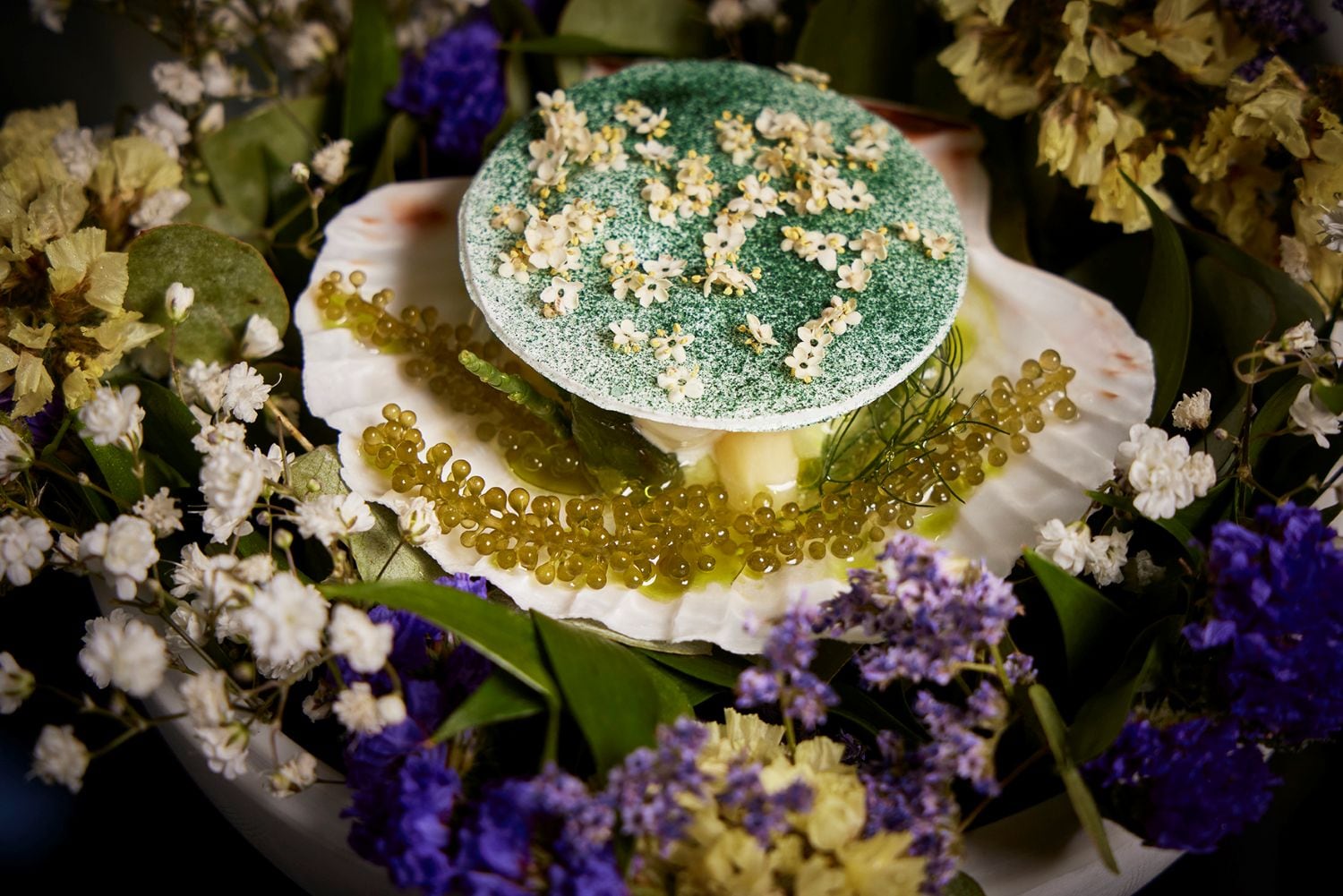 Orto di Venere at Gucci Osteria Florence. Picture: Supplied
Think Green is a salad built from 20 different leaves and greens, from arugula to centocchio, erigeron and begonia. It looks deceptively simple but rewards patience: herbaceous notes surface as you eat. Only afterwards do you recognise that the plate resembles a small meadow lifted from a garden, turning a salad into a meditation on biodiversity, sustainability and Italian agriculture.
Fuori Dalla Norma (“outside the norm”) reinterprets the Sicilian classic Pasta alla Norma, with aubergine, pecorino di fossa and cherry, but without a strand of pasta in sight.
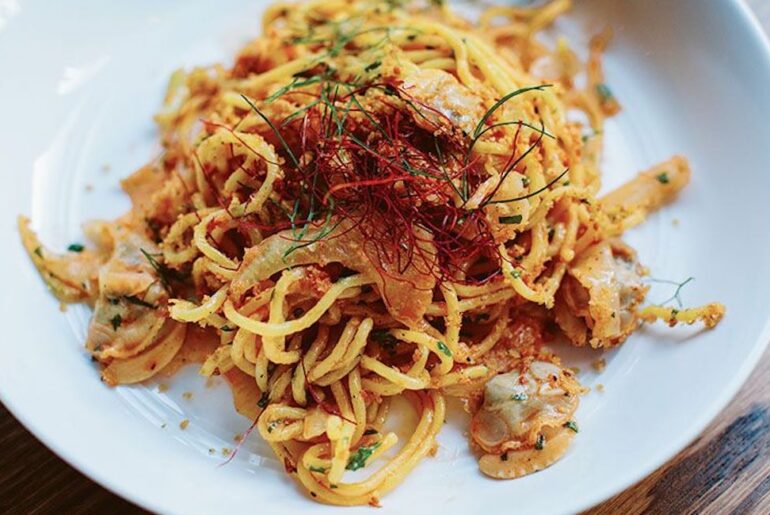
Non Dire Cassata is served on a hand-painted Italian ceramic plate, and it’s a showstopper. Room-temperature spaghetti, lightly sauced, is arranged to look almost like dessert. It draws on one of Sicily’s richest sweets, the cassata, using spaghetti, pistachio and bergamot — a fragrant citrus grown almost exclusively in southern Italy. It’s Bottura’s style distilled: nostalgic and rooted in Italian tradition.
Memories of a Summer in Versilia (zucchini, fennel, tomato dashi) is the creation of the restaurant’s head chef, Takahiko Kondo, who is Japanese by birth but, after years in Italy, has become captivated by the rituals of the Tuscan seaside: long lunches, salt air and fennel growing wild by the beach.
 Japanese-born chef Takahiko Kondo became head chef of Gucci Osteria in Florence in 2025. Picture: Supplied
My friend had Fungo! (mushroom, quinoa, and salsa verde); we were both on the vegetarian menu, though I strayed for a small, delicious piece of steak. We skipped the formal wine pairing, but a glass of Castello di Monsanto Vigneto Il Poggio Chianti Classico Gran Selezione 2020 complemented the meal beautifully.
Dessert was Orto di Venere (Venus’s Garden), with asparagus, white chocolate and spirulina algae, inspired by the Italian Renaissance and its imagery of gardens. A thin meringue crowns the dessert, while edible flowers and herbs echo the floral motifs of Renaissance painting. Avocado ice cream sits alongside. It’s one of the restaurant’s signature finales and possibly its most photographed dessert, telling a story about Florence, the Renaissance and Botticelli before you’ve taken a bite.
To finish, we were served piccola pasticceria, the restaurant’s take on petit fours, including miniature sweets such as candied jellies and cantucci.
 Rossini at Gucci Osteria in Florence. Picture: Supplied
The Saturday night of our visit drew an interesting mix of guests: a dressed-up couple in their mid-20s; a mother with two teenage daughters, both understated in appearance; an older fashion-conscious man in casual black with a long ponytail and a younger companion; two men dining together; an older couple; and a glamorous woman in Gucci shoes, sipping wine alone, who had changed into walking shoes by the time she left.
The soundtrack drifted from Serge Gainsbourg to Ain’t No Sunshine, adding another subtle layer to the atmosphere.
Gucci Osteria opened in January 2018 as a collaboration between Bottura and Gucci. It began with a friendship — former Gucci CEO Marco Bizzarri, a childhood friend of Bottura, brought him in to build a restaurant inside the newly reimagined Gucci Garden. One friend went on to lead one of the world’s great fashion houses; the other became one of the world’s great chefs. Chef Karime Lopez made history there as the first Mexican woman to earn a Michelin star, an achievement that came within two years of opening; Takahiko Kondo stepped into the role of head chef in 2025.
 Floral patterns and finely crafted porcelain add another layer of storytelling to the Gucci Osteria experience. Picture: Supplied
Bottura is known for taking iconic Italian dishes such as tortellini, lasagna and even a Caesar salad and pulling them apart at the seams and reassembling them in unexpected forms. Many of his dishes read as memories or private jokes turned into food. At Gucci Osteria, his kitchen draws on the influences of wherever his collaborators have trained or travelled, while remaining anchored in Italian technique and the Italian pantry. As he put it when the restaurant opened: “Haute couture and haute cuisine are a recipe made in heaven.”
The restaurant has since expanded to Tokyo and Seoul, though Florence remains the original. It’s one of nine Michelin-starred restaurants in the city for 2026 and holds its own alongside more traditional Tuscan fine dining.
Gucci Osteria does something unusual. It takes the emotion of Tuscan tradition and turns it into a story told through Florence, a fashion house and Bottura. It’s an alchemy that lingers long after the meal is over.
Wanted