
This essay is brought to you by The Food Section’s Soapbox Sponsorship program, giving our readers a chance to share their most treasured culinary discoveries and meaningful food memories.

Besides the food and art, one of my favorite things about Italy is wandering through its hill towns.
Earlier this year, my wife and I decided to explore Todi, a beautiful medieval hill town in Umbria. Every hill town presents the same two logistical challenges: How do we get there? and Where will we park?
Fortunately, Todi makes both easy. It’s well marked, has several parking lots (although none seem designed with SUVs in mind), and even has a funicular that whisks visitors from the parking area up to the town center.
Our visit began just as so many others have—strolling along cobblestone streets, admiring centuries-old buildings, passing stately palazzos, and outdoor cafés tucked into the shadows of ancient churches. Everything was exactly as we’d hoped.
 Porchetta, aka leveled-up pork roast
Then we noticed the pigs.
Pink pigs.
Plastic pink pigs—some the size of a small dog, others life-sized.
They were everywhere: outside storefronts, inside souvenir shops, in restaurant windows. Pink pigs had taken over Todi.
Even the lamp posts and the old opera house were draped with bright pink banners proclaiming:
Porchetta Ti Amo — Porchetta, I Love You.
Curiosity got the better of us, so we followed the pigs to the main square. There, more than a dozen booths had sprung up, all devoted to central Italy’s culinary obsession—porchetta.
We had accidentally wandered into Todi’s annual Porchetta Festival.
Porchetta is pork roast on steroids. A whole pig is deboned, generously seasoned with rosemary, garlic, thyme, fennel, and other herbs, then trussed and slow roasted over an open fire until the skin becomes wonderfully crisp and crackling.
 Porchetta ramen was first on the schedule, and first on everyone’s lips
Tradition being tradition, the head stays on during roasting. Once the pig is cooked, the head is removed and proudly displayed beside the finished roast, snout pointed triumphantly skyward. In supermarkets and many restaurants, porchetta arrives neatly sliced, with no hooves or head in sight. But when the whole pig is on display—complete with its unmistakable grin—you know you’re buying from the people who roasted it themselves.
The plastic pigs, it turned out, weren’t decorations at all.
They were conductors.
Most porchetta is served sliced or chopped into sandwiches on thick rustic bread, often with grilled onions, a smear of pesto, and just a sprinkle of salt. Six euros (about seven dollars) buys enough to satisfy most appetites. Your cardiologist might raise an eyebrow, but your taste buds will thank you. And if you’re lucky enough to get a piece of the crackling skin, with just a little of the rich fat underneath, you’ve hit the porchetta jackpot. Add an Italian beer, and lunch is complete.
Porchetta masters had come from Umbria, Tuscany, Marche, Lazio, and Calabria, each convinced their region had perfected the recipe. One booth even advertised gluten-free porchetta—proof that there’s a solution for almost everything.
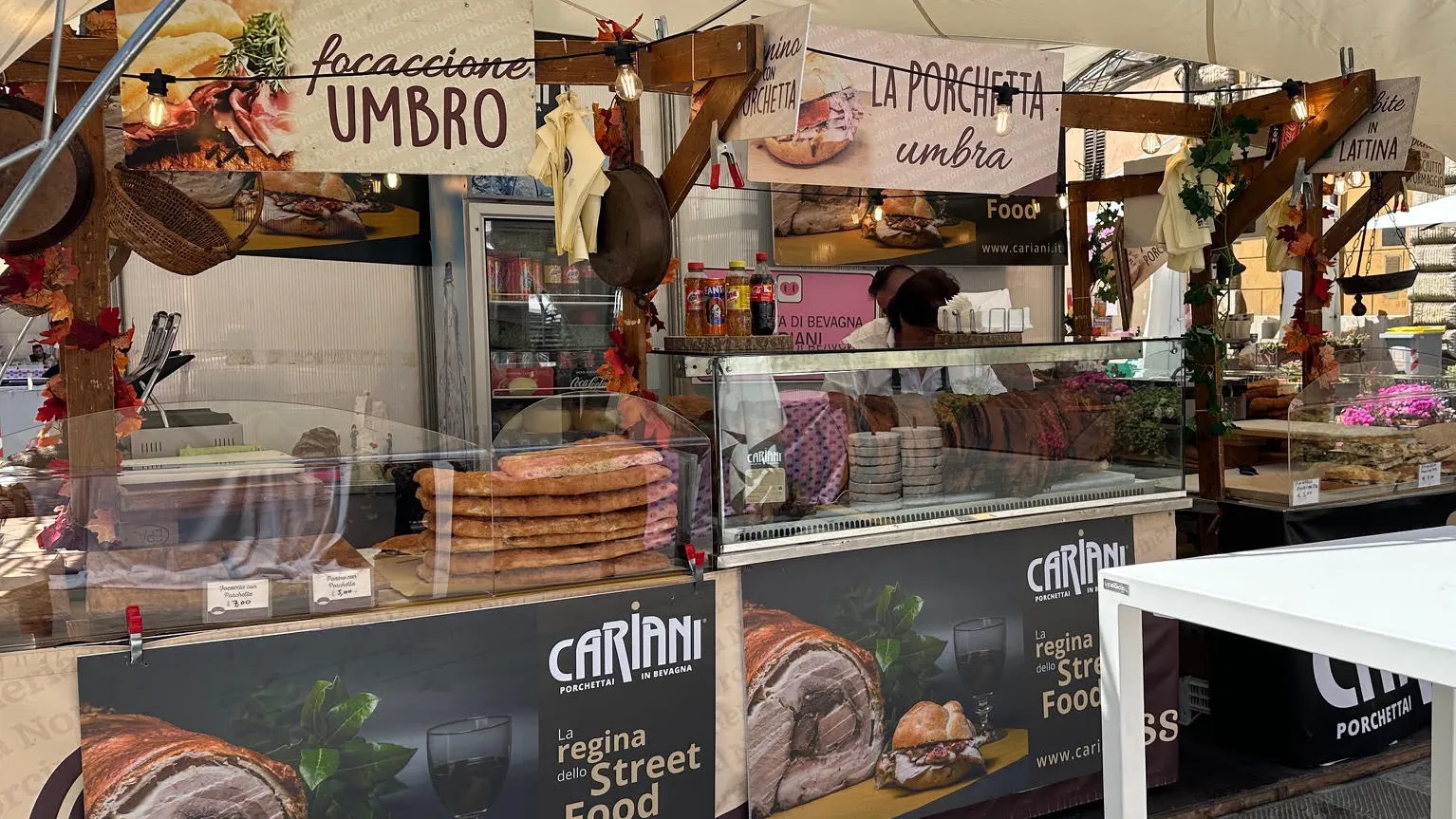 Umbrian pride was out in force at the Todi festival
 The author, second from right, with his porchetta sandwich and merry band of traveling companions
And if pork wasn’t enough, there was plenty of cibo di strada (street food): gelato, focaccia, Aperol spritzes, and one of my favorites, olive all’Ascolana—large green olives stuffed with meat, breaded, and deep-fried.
For anyone too full to eat another bite, the festival offered entertainment with an equally playful spirit.
Hirohiko Shoda, a ramen chef, demonstrated the surprising culinary connections between Umbria and Japan. Food historians presented a lecture titled “Horsetail Honey Ribs, or How to Bewitch Your Salad,” tracing Italian food traditions from medieval superstition to modern kitchens. And for anyone suffering from post-porchetta regret, there was Pokettatherapy—a tongue-in-cheek “food compatibility” session, complete with guided tastings, personalized diagnoses, and a course in Porkmed™ for “those who suffer in silence.”
I’ve eaten plenty of good pork over the years, but I’ve never seen an entire town throw a party for it. After spending an afternoon at the Porchetta Festival, I can see why they do. Porchetta isn’t just lunch—it’s a celebration with a loyal following and, judging by the crowds, a near-religious devotion. Next time I see a pink pig in Italy, I won’t stop to ask questions. I’ll just follow it.