
From family recipes to global influences, a new generation of Philadelphia chefs is reshaping Italian cuisine — one unexpected, deeply personal dish at a time.
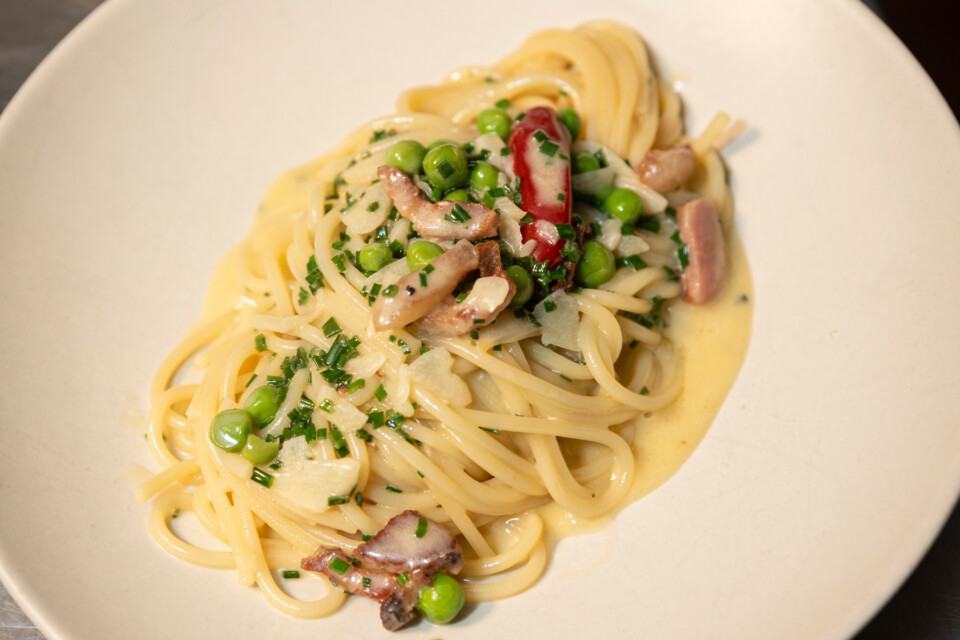
Spaghetti with guanciale, peas, and Calabrian chili from Elma.
Welcome to Philly’s Italian Renaissance. This week, we are diving deep into the evolution of our city’s Italian American food scene — from Marc Vetri, the godfather of this movement, to the chefs blending old-world traditions with their personal whims to create an entirely new cuisine. Check back daily for stories from Philly Mag’s November cover story.
James Nardone serves deep-fried polenta fritters with scarlet crab and horseradish at Elma, his tiny Fishtown BYO. It’s one of the most popular dishes on the menu — something the guests all really love. “It’s basically a savory funnel cake with crab sauce,” he tells me. “There’s not even much that’s very Italian about it.”
The eggplant caponata recipe used by the kitchen at Irwin’s is a hundred years old. It came from chef Michael Vincent Ferreri’s great-grandmother. And the tomato and watermelon crudo on the summer menu was inspired by a trip Ferreri took to Spain, Istanbul, and Cairo. Searching for inspiration, he found out-of-bounds flavors that (through trade, immigration, warfare, and the world just being a far smaller place than sometimes advertised) shaped the course of Sicilian cuisine.
He brought those flavors home to Philly with him. Now they’re on the menu at his Italian restaurant. And when I ask him about Turkish ingredients, Spanish technique, family recipes, and what those things mean in a place like Philly with its million plates of spaghetti and generations-deep Italian food traditions, he says, “I tell people that here [at Irwin’s] we adhere to a centuries-old tradition of cooking from 10 to 5. But right at 5 p.m., we start plating like a modern restaurant.”
At Ambra this past spring, chef Chris D’Ambro served a pasta dish topped with a ramp kimchi. For the summer menu, he did a tuna crudo with corn and fig leaf panna cotta with lime and pickled coriander and chilis from his garden that came off as reminiscent of Thai, but also a terrine of capon, veal cheeks, and chanterelles topped with a mustard oil that his aunt had to smuggle out of Italy for him because you can’t buy it anywhere on this side of the world. “What we do is specific and singular to this little shoebox of a place,” D’Ambro explains. “It’s just … natural.”
All this to say, Philadelphia’s Italian scene is evolving. It isn’t so much the checkered-tablecloth, spaghetti-and-meatballs Italian practiced with such art across generations (and across the entire country). What you see here is a whole different cuisine emerging, built on the traditions of Italy’s diverse regions but filtered through the lens of chefs riffing on the genre. Philadelphia revisionism with an iconoclastic, punk rock soul. A new Italian American canon being driven by an entire cohort of chefs — steeped in the red-sauce traditions of the region, rich with family history and intimate, well-researched, firsthand knowledge earned through travel and experience — fundamentally reshaping what Italian American food looks like and tastes like in a city that, for decades, thought it already knew.
At A Mano, Townsend Wentz cooks from every region of Italy, follows the seasons up and down the coast, uses Spanish ingredients and French technique, puts Greek feta in the panzanella and Basque peppers in the antipasti. Regionality is unimportant to him. “Because Philly is freezing in the winter and boiling in the summer,” he explains. “To try to champion any one region would be a mistake.”
And when I talk to Nardone, he tells me about his parents, his grandparents — Abruzzese on his mom’s side, Calabrese on his dad’s. He tells me about family meals, crowded tables, how everything his grandmothers did in the kitchen was intuitive, practiced across generations; how nothing was measured in grams or kilos, but by what would fit in the empty Locatelli container on the counter. The flavors he learned at those tables? That is what he’s chasing at Elma today. And he doesn’t care how he gets there.
“Other chefs are going to give me shit about this,” he says, “but I don’t use homemade chicken stock anymore. I use College Inn. Because that’s what my family uses. That’s what so many Italian families use. And it isn’t laziness; it’s trying to get that flavor. Nothing else tastes quite the same.”
I am talking to D’Ambro about the balance, the tension between traditional and modern Italian and what that means here, today. His menus are Italian American because they’re biographical, personal, full of food memories and inside jokes filtered through an expert understanding of the centuries-deep traditions of the old country and generations of Italian American experiences. But those additions of French techniques and Thai flavors make it more authentically biographical, because those are all part of D’Ambro’s memories too. But all of that would be hard to fit in a menu description. So he says modern Italian because people understand that. Because then, at least, they understand what it’s not, which gives D’Ambro an awful lot of space to decide for himself what it actually is.
And if there is any one, single common factor in what defines this emerging idea of Philadelphia’s Italian American culinary moment, it’s that right there: space. In these kitchens (and a dozen others like them), chefs are writing menus that don’t simply reject the old or the staid or the narrow but embrace potential. That see (and celebrate) the places where history and biography cross and champion the friction between tradition and experimentation, regionalism and diaspora.
In turning away from the rigidity of expectation, they make room for something new to grow and evolve. A New Italian American cuisine, delicate and just beginning. But the promise of that kind of possibility might be all that’s needed to keep Philly’s Italian food scene fresh and vital for the next generation of chefs and diners.
Published as “Philly’s New Italian American” in the November 2026 issue of Philadelphia magazine.


