

16 Sep 2026
Posted at 08:57
in Feature
Elena Hogg, founder of local culinary company FOOD by Elena, has plans for her garden grapes…
We’re in a seasonal transition period. Sometimes, the change from summer to autumn is almost cruel in its abruptness. This year, however, we seem to be experiencing more of a softly-softly approach. We’ve still got mild temperatures and sunny days, but also some grey skies and dreary rain.
My mealtimes are following suit: I’m enjoying both summery salads and steaming soups, depending on what the view out the window warrants. The expression “having a finger in both pies” (the cold pork one and the hot shepherd’s version) never rang more true.
The grapes in our garden are currently hanging in romantic, still-life painting-esque bunches. Even though they darkened in colour weeks ago, we held our nerve and didn’t harvest them, because I read that grapes become sweeter some considerable time after having the appearance of being ripe. This has proven quite true: a few weeks ago I plucked a single, bloom-dusted grape from the vine and popped it into my mouth only to feel my face tighten up like a drawstring bag, it was so sour. Yesterday, on the other hand, the grape I picked was honey-sweet.
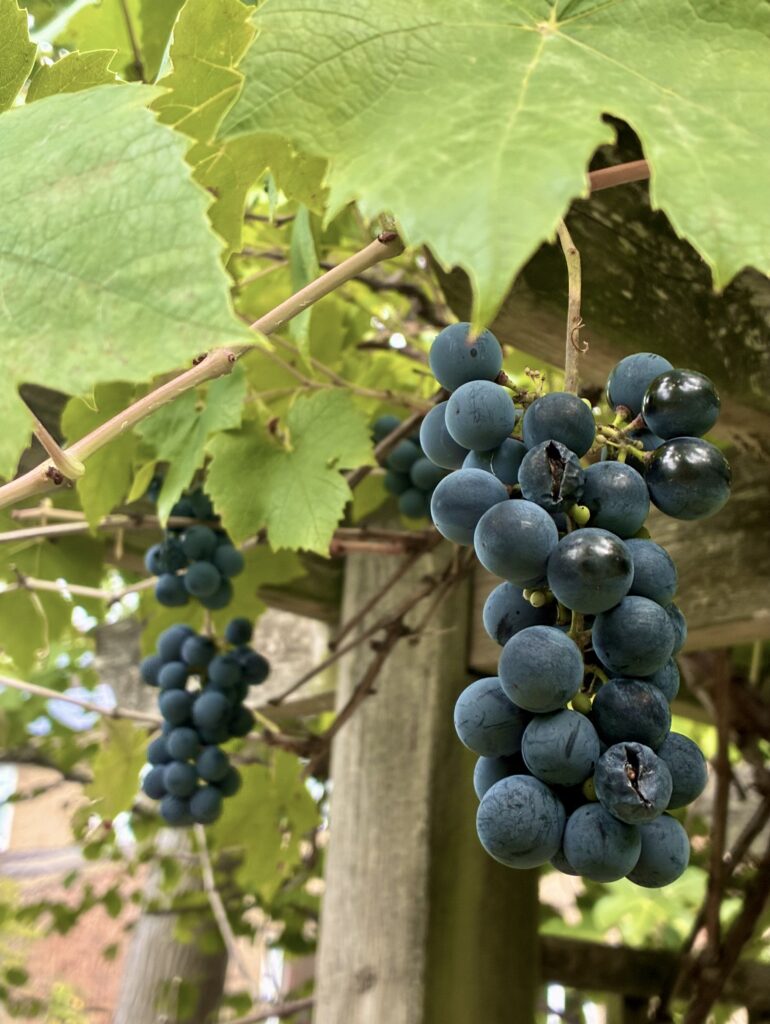 Grapes on the vine
Many years in a row, now, I’ve made grape and rosemary jelly with the garden haul, inspired by one of my oldest friend’s mum, Liz, whose jelly consistently tastes better than mine, no matter how I tweak the recipe.
I’ve tried using more rosemary (too soapy), less sugar (wrong consistency) and have now resigned myself to the mild annual disappointment.
I make it anyway each year, because it’s a great way to use up a fair number of grapes and lasts for years if stored properly.
Even if it’s not as nice as Liz’s, it’s still very tasty and versatile. You can use it as you might regular jam, such as on toast or in porridge. But the herby note means it works really well in place of redcurrant jelly in the making of sauces, or as a condiment with game or pork.
 Grape and rosemary jelly pot
This year, I am tending towards recipes that encapsulate the aforementioned seasonal transition, and grapes are the perfect ingredient for this. They are fruity and sweet, but in a more serious way than tropical or citrus fruits. After all, wine comes from grapes and that’s very grown up.
They have a mustiness that allows them to enter the savoury realm while bringing their sweetness along for the ride.
Their versatility makes them ideal for transitional cooking. For example, on brighter, warmer days, pop some grapes in the freezer. They become like boiled sweets but more dentist-friendly.
If you whizz them briefly in the food processor, you get a refreshing granita which you can top with lime zest that you’ve shaken up with a little caster sugar for a mid-afternoon punch to keep you from slumping.
And for those more overcast days, adding some grapes to your pan-roasted duck breast is a brilliant way to cheer things up. Leave some whole for plating up and crush the rest down into the pan juices. Add a splash of red-wine or sherry vinegar and reduce. Strain if you want to discard the grape skins, or don’t bother if you’re happy with a more rustic jus. It’s delicious either way, really.
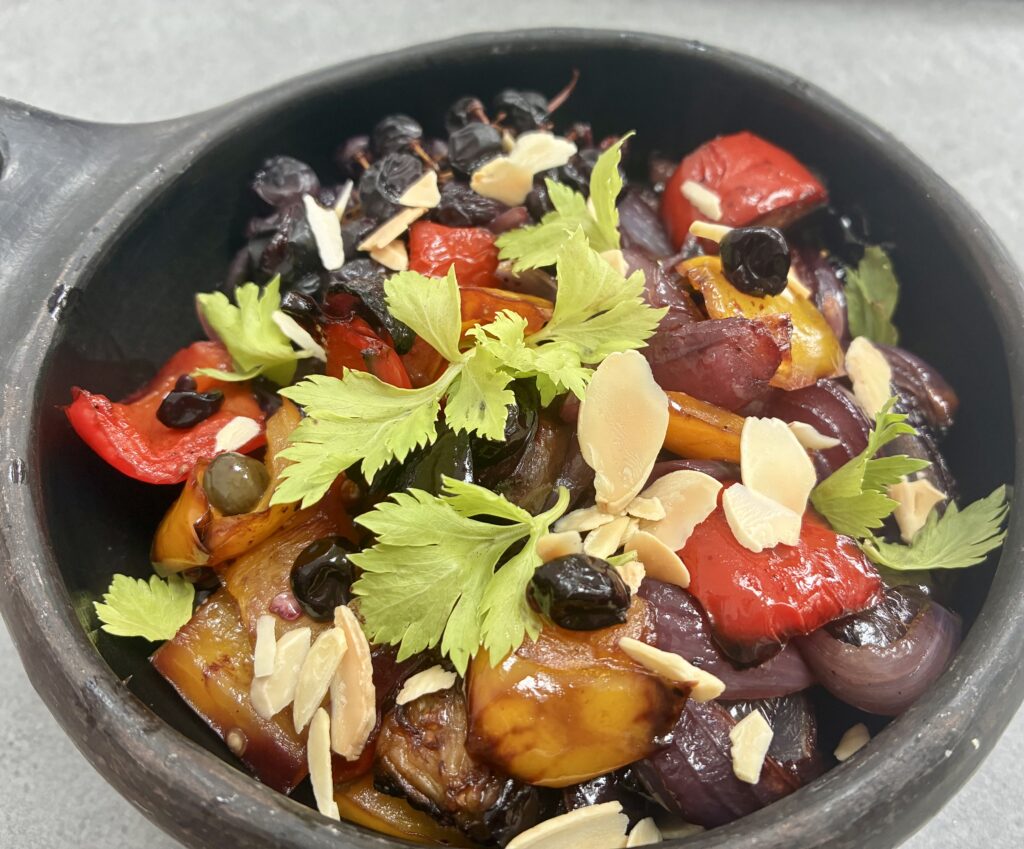 Caponata
And finally, I am pleased as punch to share with you the ultimate seasonal transition dish; one that encompasses both Mediterranean summer vibes and autumnal, heady notes. Caponata.
Caponata is a traditional Sicilian dish based largely on aubergines, tomatoes, onions, celery and capers, but as with all Italian dishes, there are about as many versions as there are grandmothers that once made it. Happily, this gives us carte blanche (or carta bianca) to bastardise the recipe as much as we like and still call it caponata. I tend to leave out celery and bung in bell peppers, and quite often leave out tomatoes because I find they render the dish too pasta-saucy. You could add courgettes, fennel, okra even.
Caponata is Sicily’s answer to sweet-and-sour, or agro-dolce in Italian, achieved by adding vinegar and sugar to the recipe. Capers are a traditional vinegary kick to the dish, but adding olives or any other pickled item would work, and the same applies to the sweet element. Instead of sugar, honey can work, as can raisins or sultanas. Using balsamic vinegar is a winner because it incorporates both sweet and sharp, though it does darken the colour of the finished dish significantly, so be warned.
The cooking method is also interchangeable: cooking caponata on the hob in a pan is typical, but I find roasting the vegetables off in the oven just as effective.
And note that eating it the following day is worth the wait; the flavours have a change to amalgamate and deepen.
This time around, I added our home-grown grapes to the recipe, roasting them in the oven along with the other ingredients. They became jammy and wrinkled in the cooking process and worked beautifully in the dish, perhaps especially because of that wine-y hit they offer to the palate. I threw over some flaked almonds because that’s what I had in the cupboard, but pine nuts or pistachios would be equally delicious, and they add some texture, too.
There’s something about a good bowl of caponata that’s profoundly satisfying, no matter the specific combination of ingredients. I think it’s the sweet-and-sour element that so easily excites the taste buds, and when you add umami pops like olives, parmesan or, say, anchovies to the dish, it really starts to sing loudly.
Each forkful feels complex, taking your mouth on a journey from savoury to sweet via sour and salty. In fact, it puts me in mind of the character Violet Beauregarde from Roald Dahl’s ‘Charlie and the Chocolate Factory’. She’s an avid gum-chewer and, during her visit to the factory, helps herself to a piece of gum designed to emulate a three-course meal as you chew, starting with tomato soup, then moving on to roast beef and, finally, blueberry pie. My bowl of caponata didn’t quite do this, but if I closed my eyes and imagined the grapes were blueberries, I wasn’t far off. I mean, I’m good, but I’m not Wonka.


