
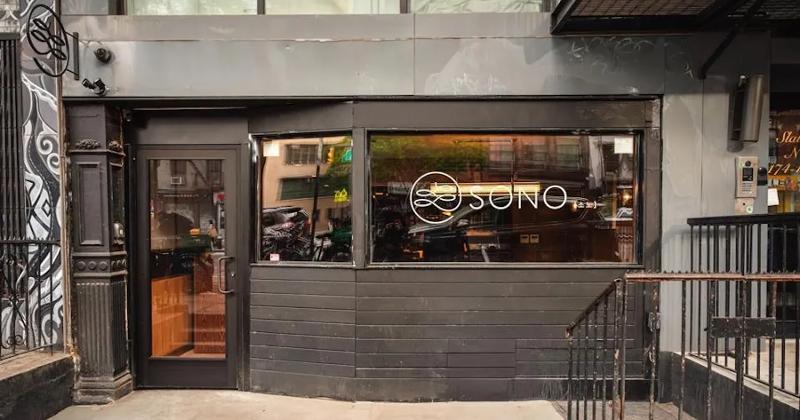
Sono’s menu creates harmony between Italian and Korean culinary traditions. | Photo courtesy of Sono
Fusion cuisine has gotten a bad rap — often for good reason. Some restaurants jumped on what was a popular trend and randomly mashed up ingredients and flavors that never should have been on the same plate.
There were some epic failures, like sushi pizza and spaghetti tacos.
It’s a very different story at Sono, a three-month-old restaurant in New York City’s East Village. Here, Executive Chef Sechul Yang has created a menu where the ingredients and flavors of both Korean and Italian cuisine are balanced and nuanced, creating harmony between two culinary traditions. That’s because Yang was born and raised in South Korea but has risen through the ranks of top Italian restaurants.

Chef Seychul Yang in the open kitchen at Sono. | Photo courtesy of Sono
“I worked for eight years cooking Italian food, primarily in [Danny Meyer’s] Maialino, a beautiful restaurant,” said Yang. “When I was planning this project [Sono], I looked back and asked myself ‘what did I really like as a chef?’ and it was cooking Italian cuisine. I didn’t want to hide myself in South Korea. And there are also a lot of similarities between Korean cuisine and Italian cuisine, not ingredient-wise, but more with the culture. Both are about friends and family sharing food.”
Japanese-Italian fusion has gained traction, popularized by chefs including Robby Felice of Pasta Ramen in Montclair, New Jersey, Tom Intawong of Miso Mozza in Providence, and Eric Fralick of Kinjo in Tampa. The culinary style even has its own name, called either “Wafu” or “Itameshi” cuisine.
But Korean-Italian is less familiar. Earlier this year, celebrity chef Nancy Silverton opened Lapaba, a small Korean-influenced pasta bar in the Koreatown neighborhood in Los Angeles. Sono joined the rarefied category in May, with a menu that is more extensive, covering Antipasti, Primi, Secondi, Contorni, and dessert.

Pasta with bottarga, pollack roe, and nori. | Photo courtesy of Sono
The restaurant calls itself a “Korean Trattoria,” but Yang chose the name Sono from the Italian word for “I am,” because “it’s the cuisine that I do. I’m not trying to mimic Italian cuisine or Korean. I’m just trying to cook what I’m thinking is tasty,” he said.
Many of the dishes are designed to be shared, a practice that is celebrated in both Italian and Korean culture. Hospitality is also an important element of both cultures, and the team goes all out to make guests feel comfortable with the menu. Manager Jeff Fernandez walks diners through the courses, starting with the antipasti.

Picanha di Manzo is flavored with Korean mostarda. | Photo by Pat Cobe
A highlight is the Picanha di Manzo, a carpaccio-style preparation that uses a flavorful picanha beef cut common in Brazilian restaurants, sliced paper thin. “It’s scorched with a torch, topped with grilled corn, and finished with extra-virgin olive oil,” Fernandez said. The Buratta di Stracciatella is an example of fusion at its best. The indulgent soft Italian cheese is topped with house-made Korean chorizo, fresh figs, and drizzles of honey, then served with fresh-baked focaccia. Both of these shareable appetizers are $26.
The five house-made pastas in the primi category ($27-$29) are rich in umami. The signature Spaghetti is a complex dish with a simple name. The pasta is bathed in a buttery saffron sauce and topped with bottarga, myeongnan (pollack roe), and thin shards of nori. Lumache, another primi, has a sauce enhanced with oyster sauce and fish sauce with bits of ‘nduja and is served with a runny egg on top. The diner mixes it all together to create a savory sauce that clings to the pasta. Mafaldine with oxtail and bone marrow is the meatiest and most umami-forward of the selection.

Butter-poached skate with Korean pesto. | Photo by Pat Cobe
Protein is the highlight of the Secondi course. Standouts include Coppa di Maiale Iberico — Iberico Pork Shoulder with Pickled Perilla — featuring cubes of pork cooked on skewers until meltingly tender and contrasted with pickled perilla, a mint variety related to shiso and native to Asia. Pesce Razza is the seafood option — butter poached skate with Korean pesto. Entrées run $37-$42; Wagyu steak is also available at a pricier $62.
For guests who want a tasting menu experience, there’s Sono’s Table ($160 for two diners). Chef Yang curates the multi-course experience with his choice of dishes, and the dinner is served family-style.
“Whenever I was at Maialino cooking, I kept thinking, what if I just put some kimchi sauce on broccoli rabe? Not changing the integrity of the dish but just adding some elements of Korean cuisine,” said Yang. “Somehow it just makes sense in my head.”
And now he is showcasing that thinking at Sono with a menu that represents who he is as a Korean who loves Italian cooking.
Members help make our journalism possible. Become a Restaurant Business member today and unlock exclusive benefits, including unlimited access to all of our content. Sign up here.
Pat plans and executes menu, food and drink stories for Restaurant Business and hosts the weekly Menu Talk podcast. She provides in-depth coverage of chefs, trends and menu innovation.