Bringing Italian tradition to Singapore
Despite decades of cooking in cities far from home, Daniele has never strayed far from his home traditions.
“I stick to my idea of Italian pizzas,” says Daniele. He has found that diners in Singapore appreciate it when chefs hold onto tradition rather than chase trends, and they’re always happy with his suggestions.
You will still find the slightly controversial Hawaiian pizza (from S$17 for 10-inch) available on the menu.
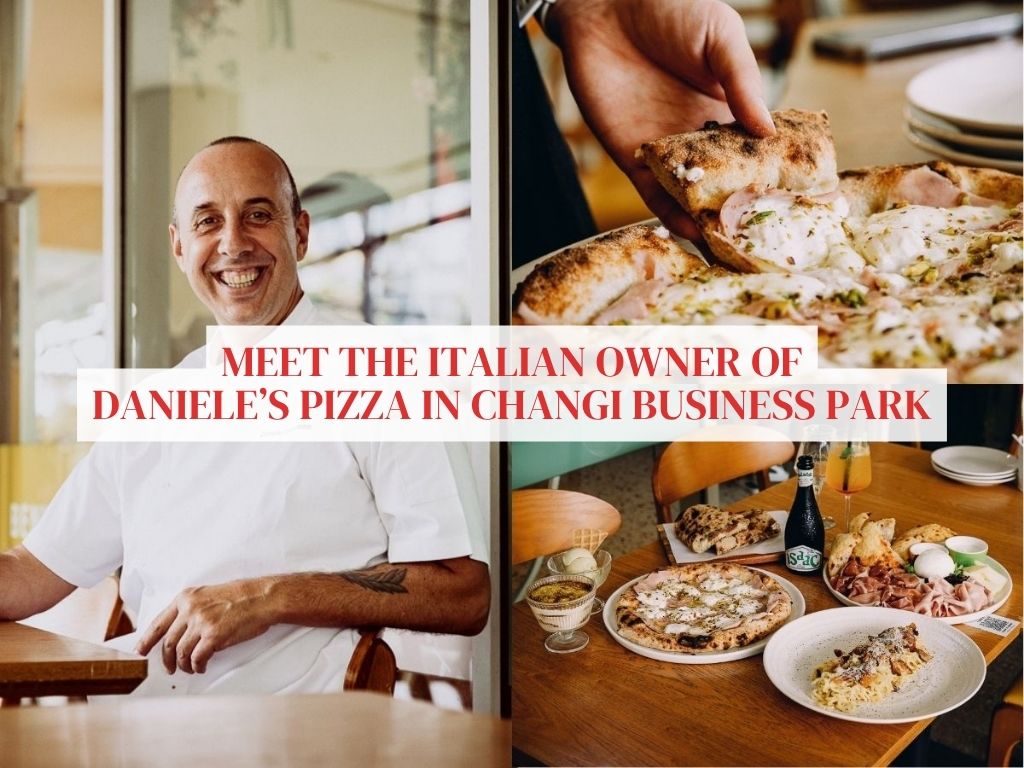
However, Daniele recommends the classics such as the tomato-based parma pizza or the Bologna (from S$17 for 10-inch) — an Italian classic featuring mortadella, pistachios and burrata on a mozzarella cheese base. Do note that the smaller 10-inch pizzas are only available during weekday lunches.
To bring those traditional flavours he envisions to life, Daniele incurs additional costs to import the best ingredients: Cold cuts, olive oil, tomatoes and more are all imported.
Even the flour is far more technical than it appears. Daniele uses a specific Infibra flour from Denti Molino, a family-run Italian milling company founded in 1955.
“They will remove the wheatgerm from the wheat, toast all the germ, and then insert it again into the flour,” Daniele explains, adding that this process is what gives the dough more character, flavour, and nutrients than standard flour would. As a brand ambassador for Denti Molino, he has visited the mill and seen the process firsthand.
“When they were toasting it… the nutty flavour really went all over and I could smell it everywhere. It was unbelievable. All this flavour and aroma, you will find it in your bite.” he says.
For the average person, Singapore’s heat and humidity complicate the pursuit of consistency. The temperature can affect how the dough behaves, and a skilled chef needs to read it by feel rather than rely on a fixed formula, adjusting fermentation time as needed.
And the dough is a huge part of the menu at Daniele’s Pizza. It’s served as a focaccia to accompany dishes such as the ricotta cheese dip (S$18) and zuppa di cozze (sauteed mussels in white wine sauce, S$22), and has the perfect texture. The mussels, in particular, are flown in from Italy three times a week, so they arrive at the table as fresh as possible.
The dough is cooked in a large pizza oven imported specially from Valoriani, a family-run Italian furnace maker with a history dating back to the 1890s.
It’s the centrepiece of the restaurant’s semi-open kitchen, responsible for the lesser-known panuozzi (a type of Italian sandwich made with pizza bread, S$22) as well as its pizzas: pizza rosse (from S$13 for a 10-inch), which is tomato based, and pizza bianche (from S$17 for a 10-inch), which relies on mozzarella instead.
Despite its resemblance to a classic wood-fired oven, it’s actually powered by gas. This was a deliberate choice made by Daniele.
Daniele explains that a pizza spends a maximum of two and a half minutes in the oven — not nearly long enough for the wood’s aroma to make a real difference. Most restaurants today have moved to gas ovens, which produce more consistent results and let diners get their food faster.
True enough, the crust at Daniele’s Pizza remained light and springy well after it had left the oven, despite the extra time needed for photos.
While the restaurant is best known for its pizzas, Daniele is quick to point out that the pastas are just as good. As a Roman, he points to the carbonara (S$26), a Roman speciality. It is made the traditional way with egg yolks, pecorino cheese and guanciale (cured pork cheek) — not pancetta or bacon, as Daniele emphasises.
Dessert follows the same script. Every option is made in-house — from the freshly churned premium Italian gelato (from S$5.50 for a single scoop), and tiramisu (S$12), to the panna cotta (S$10), made with real vanilla pods for a delicious scent and flavour.