


Clarkandcompany/Getty Images
Pasta might seem like a straightforward dish to make, but finding the right sauce-to-pasta ratio can certainly be a challenge. If you add too much sauce, you’re left with a soupy mess. If you don’t add enough, your pasta is likely to dry out and be lacking in flavor, all at the same time. Jasper J. Mirabile Jr., owner and chef at Jasper’s Italian Restaurant and Host of “Live! From Jasper’s Kitchen,” shares how to achieve that perfect balance for a true Italian pasta finish.
According to Chef Mirabile, getting the right ratio of sauce-to-pasta isn’t a one-size-fits-all formula. “This really depends on the sauce and the cut of pasta,” he says. You don’t want your pasta to be swimming in a bowl of sauce, but you also want each piece of pasta to be well-coated — somewhere right in between is the sweet spot.
For home cooks, Chef Mirabile suggests a few starting baselines for different types of sauce. When cooking with tomato sauce, he uses 2 ½ cups of sauce per pound of pasta. For pasta al pesto, he adds 1 ½ cups of pesto for every pound of pasta, adding pasta water to cut the richness. And, if he’s cooking with a cream-based sauce, he’ll use 2 ½ cups cups of sauce for every pound of pasta.
Intuition is key when it comes to cooking pasta like an Italian
Alessio Orru/Shutterstock
During the three years I spent living in Rome, I learned a lot about Italian cooking, customs, and culture, like why you should visit local bakeries first thing in the morning and why eating bread before your meal is an Italian food rule you should never break. However, the most important rule I learned about cooking pasta isn’t really a rule at all: It’s intuition.
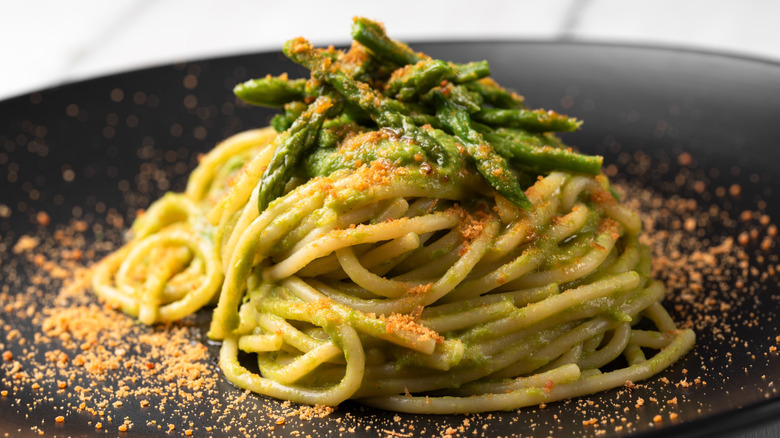
If you order pasta in Italy — or enjoy a home-cooked meal — you’ll find that Italians don’t overload their pasta with sauce. Sauce is treated as a condiment meant to enhance the pasta, not overpower it; in fact, it’s typically referred to as a “condimento” for that very reason.
You’re unlikely to find a home cook precisely measuring their pasta sauce. Measurements are more like guides or starting points. While cooking, Italians are looking for other clues to know if more sauce is necessary to achieve that perfect texture. For instance, the pasta should have a glossy sheen to it, and the sauce should cling to the pasta without pooling at the bottom.
Chef Mirabile relies on his intuition to hit that ideal texture. After transferring his al dente pasta to the saucepan, he says, “I can tell when I toss the pasta in the pan and if I need more or less sauce. It’s one of those situations when cooking where I have to look at it and really see. It’s close to those measurements, but I always use a little bit more when tossing and finishing.”
Your pasta variety matters, too
Fcafotodigital/Getty Images
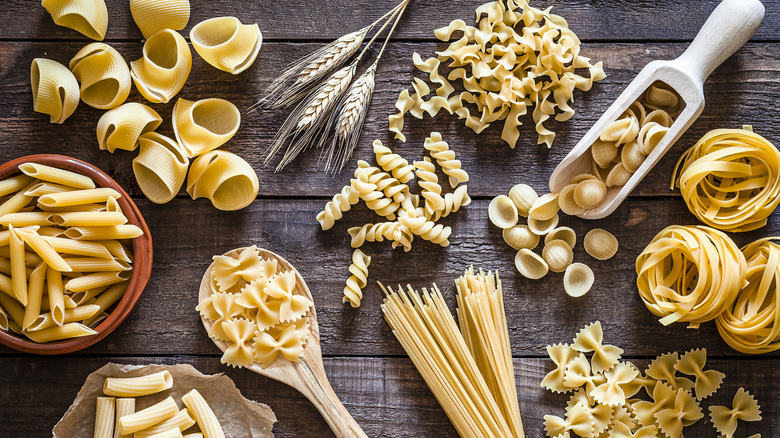
If you’ve added plenty of sauce to your pan but it’s not clinging to the pasta, keep in mind that not all sauces pair with all pastas. “[It depends] on the cut of pasta and if the pasta is 100% semolina, or if it’s a flat pasta or a cut pasta like rigatoni,” says Chef Mirabile.
Tomato sauce is pretty universal and works with virtually any pasta shape, but long pastas generally pair better with oily sauces, like spaghetti aglio e olio, or creamy sauces. Short pastas work best with chunkier or creamy sauces, while thicker pastas — such as a fresh tagliatelle or fettuccine (there’s a difference) — work well with thicker sauces, such as ragù alla Bolognese.
Under Italian law, all dried pasta must be made with 100% semolina flour, which gives it a rougher texture that helps sauce cling to it. Unfortunately, this law doesn’t apply in the U.S., so the pasta you buy at an American supermarket might have some added finer durum wheat powder. This blend is faster and cheaper to produce, but 100% semolina or a bronze-cut pasta is your best bet for optimal cling.
If you’re still having trouble getting your sauce to cling to your pasta, pasta water might be the solution. As you finish the pasta in a saucepan, add a bit of pasta water to the mix while continuing to toss it. You can add up to two cups for every pound of pasta, but start small and add more as needed. The starchy water helps your sauce and pasta bind together, and it also helps thicken it. Plus, you’re continuing to cook the pasta just a little bit, giving you that undeniably Italian al dente bite.