
Sexism in the restaurant industry is a harsh reality Dara Klein knows all too well.
Despite founding one of London’s most-talked about new restaurants, Tiella Trattoria, on Columbia Road in January this year, she still battles ongoing gender bias.
The 36-year-old says she has encountered sexism not only from fellow chefs, but also from customers and suppliers.
“We have an open kitchen and the amount of times that I never get looked at in the eyes and blanked, even though I’m on the pass, reading out the tickets, running the ship, they’ll talk to the male chef on larder,” says the Italian chef, who recently published her debut cookbook La Trattoria.


Her experiences informed an open letter she co-authored with Sally Abe in February, condemning the “pervasive” sexism in the industry and calling for a more “inclusive, equitable and positive” environment.
 (Caitlin Isola)
Signed by a group of 70 female chefs, the letter, first published in The Telegraph in 2025, was written in response to Jason Atherton’s claims in a Times interview that he had not witnessed sexism in restaurants.
“The objective was always just to share an experience and it’s not done with blame and it’s not to finger point,” she says.
“Unfortunately, I was always very, very aware of my gender [in kitchens] and I think a lot of women and non-binary people – and men too – have been made aware of that.
“When you’re working a physical, demanding and stressful job, it can all come to a standstill when somebody makes a comment just to remind you of the fact you’re a woman or talk about your appearance.”
It’s why now Klein’s main aim is to create a “warm and safe environment” for aspiring hospitality workers. More so than cooking, she hopes her legacy is to “inspire people to find this profession as it’s such a brilliant career in so many ways”.
 (caitlin isola)
Klein herself nearly didn’t become a chef. As a child, she “never, ever” had any desire to work in kitchens, even though it was the family business, and didn’t start cooking professionally until she was 28.
She grew up in San Giovanni in Italy’s Emilia-Romagna region before moving to Wellington, New Zealand at the age of six for her father’s work. Her mother, who’d worked in kitchens in Italy, was initially homesick and used cooking as a coping mechanism. It was then a business idea was born.
First, her parents opened a deli in the suburbs, before opening a restaurant, Maria Pia’s, with her mother as head chef. “She was definitely quite tough as a chef, so I always thought you had to rule with an iron fist. But the more I travelled, [the more] I saw there are different ways to run kitchens,” Klein says, adding that her mother comes from a “different generation of chefs”.
Initially wanting to pursue a career as an actor, director or screenwriter, Klein relocated to Australia to study creative writing and film, and later acting at Sydney’s prestigious drama school, The National Institute of Dramatic Art, but soon realised it wasn’t for her.
She then moved to New York to work a front-of-house position at a restaurant where she suffered a “mental health dip” and was advised by her family and doctors to switch to a nine-to-five office job for stability. For five years, she worked in various admin, marketing and social media jobs, but felt unfulfilled.
“I couldn’t really find my thing and, as somebody quite creative and busy, I found that really challenging. I was a bit lost and so I turned back to cooking,” Klein explains.
In 2019, she started working in kitchens in London before opening her much-lauded residency in The Compton Arms in Islington. After multiple offers of investment, she opened her first bricks-and-mortar restaurant, Tiella, earlier this year.
The restaurant focuses on rustic dishes from across Italy, such as chicken milanese, with a particular spotlight on the cuisine of Klein’s home region, Emilia-Romagna, which she says is famed for its “incredibly rich and decadent” cooking.
Klein remains a dedicated student of the different gastronomic traditions across Italy, highlighting Sardinia and Sicily as underrated food regions.
“Sardinia has a fascinating landscape as it’s pastoral but obviously it’s an island, so it’s enclosed with water. A lot of their pasta is fascinating , as well as the way they make cheese and produce their own salumi,” she says.
“There’s something about Sicilian food that really gets me as you see the influence of the various conquests from the Arab World and Northern Africa. They do different things with sweet and sour cooking and their approach to meat and fish is quite unique.”
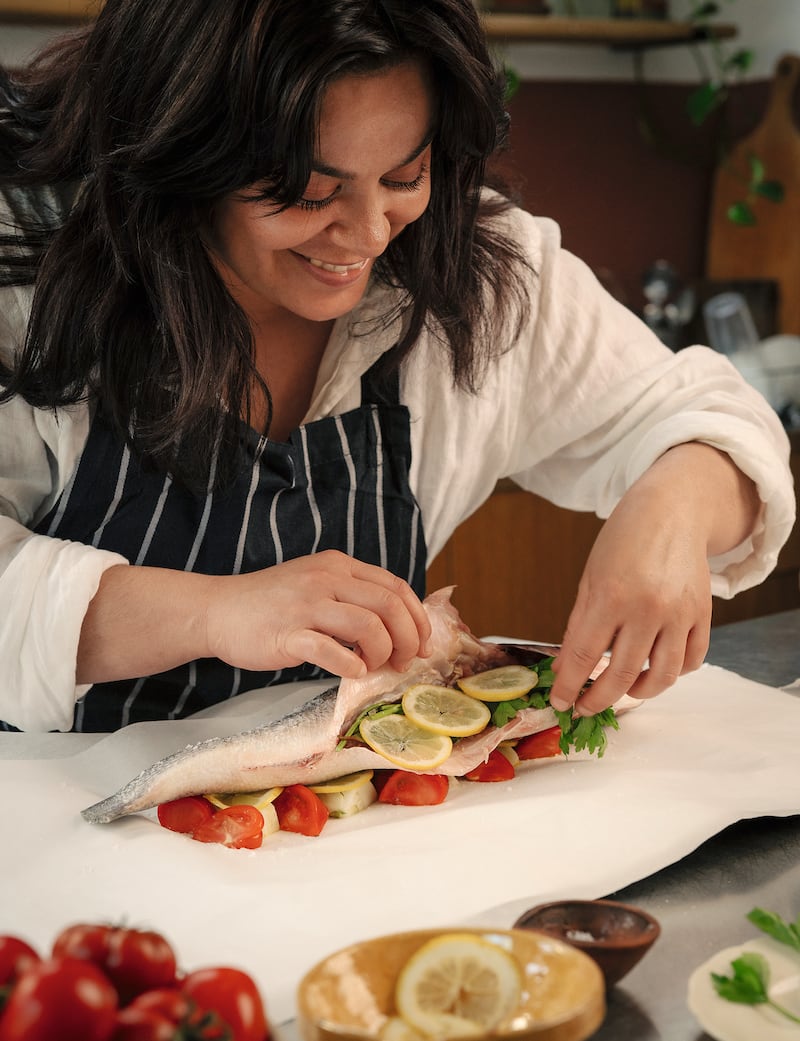 (Caitlin Isola)
But the one Italian dish Klein says overlooked by travellers is pizza rustica, a savoury pie, which is produced in the South, in places like Puglia, Calabria and Sicily.
“Our pies are really different and the one I love is made with a filling of tuna, onion, tomatoes, olives and red onion. They’re usually served at room temperature, so it’s something you’d bring to the beach,” she explains.
As for finding the best restaurants in Italy, Klein has some words of wisdom.
“Stay off social media as the restaurants recommended there are more likely to be tourist traps,” she advises.
“Go as far away from the centre of the city as you possibly can and spend time hitting the pavements, looking around at the restaurants.
“If the signage looks a bit old school, the clientele look Italian and it doesn’t look too flashy, that’s a dead giveaway. If the restaurant has fluorescent-strip lighting, often it’s going to be really good.”
Klein adds while laughing: “Definitely ask locals, but they’re probably not going to give you the good ones!”
 (TBC)
(TBC)
La Trattoria by Dara Klein is published in hardback by Ebury Press, priced £30.00. Photography by Caitlin Isola. Available now.