
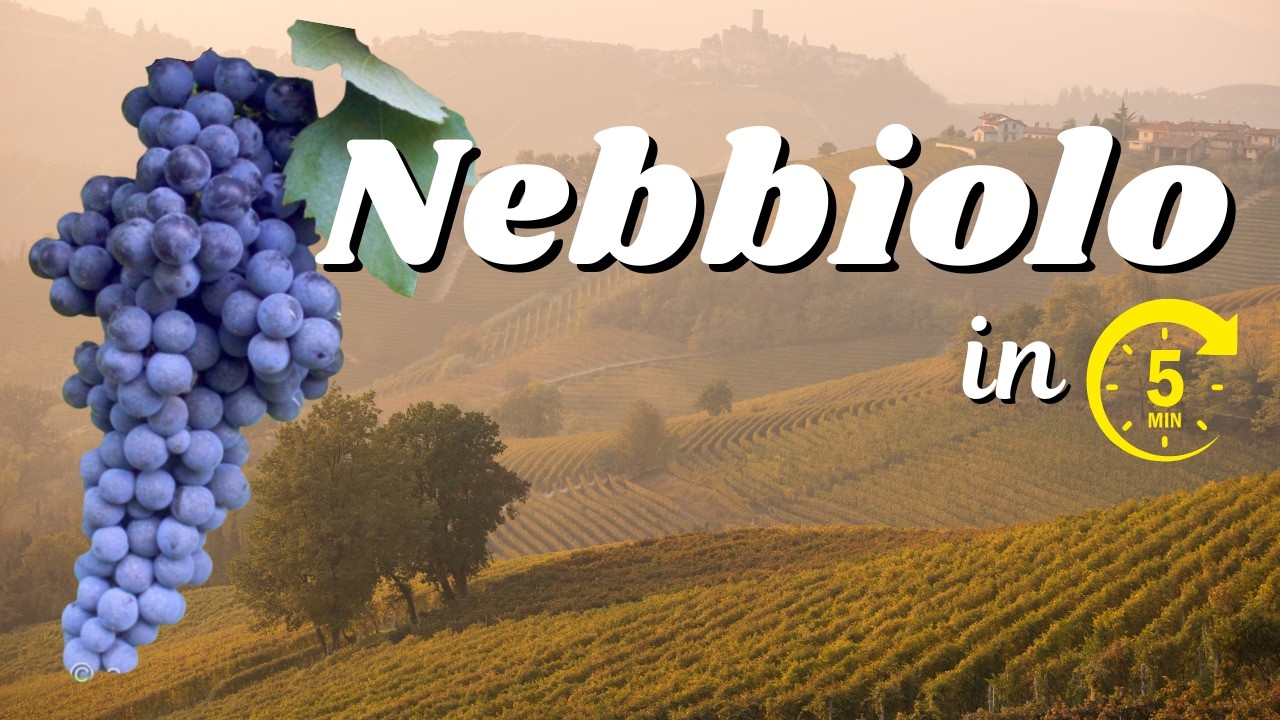
Have you ever tasted a wine that looks as pale and delicate as Pinot Noir, but hits your palate with the powerful structure of a heavyweight champion? Meet Nebbiolo, the undisputed king of northwestern Italy and the grape behind the legendary wines of Barolo and Barbaresco. In this quick 5-minute guide, we’re exploring why this demanding, site-sensitive grape creates some of the most complex, age-worthy, and fascinating red wines in the entire world.
00:00 – The beautiful paradox of Nebbiolo
00:33 – Where the name Nebbiolo comes from
01:16 – Why Nebbiolo is so demanding to grow
01:58 – Tasting notes: Tannins, acidity, and aromas
02:51 – The top Nebbiolo wine regions in Italy
04:39 – The best food pairings for Nebbiolo wines
FREQUENTLY ASKED QUESTIONS
Q: What does Nebbiolo wine taste like?
A: Nebbiolo is famous for its paradoxical sensory profile. It produces lightly colored red wines with a powerful, grippy structure, high tannins, and bright acidity. Its classic aromatic profile is often described as “tar and roses,” with young wines bursting with notes of rose petals, violets, and red cherries.
Q: Why is Nebbiolo so difficult to grow?
A: Nebbiolo is a notoriously demanding and site-sensitive grape variety. It is one of the first grapes to bud in the spring and one of the last to be harvested in the fall, exposing it to spring frosts, summer hail, and autumn rains. To ripen perfectly, it must be planted on the absolute best, south-facing slopes.
Q: What are the different names for the Nebbiolo grape?
A: While Nebbiolo is the official name, it has several regional synonyms in northwestern Italy. It is locally called Spanna in Alto Piemonte, Picotendro in Valle d’Aosta, and Chiavennasca in the Valtellina region of Lombardy.
Q: What are the best food pairings for Nebbiolo wine?
A: Because of its intense combination of high acidity and firm tannins, Nebbiolo pairs best with rich, fatty, and protein-heavy dishes. Traditional Piedmontese pairings include braised beef (brasato al Barolo), rich meat ragùs, and dishes featuring earthy mushrooms or white truffles.
Q: Can Nebbiolo wine be aged?
A: Yes, Nebbiolo is famously built to age and often improves for 10 to 30 years in the bottle. Over time, its youthful fruit and floral aromas evolve into incredibly complex layers of truffle, leather, tobacco, and dried earth.
YOU MIGHT ALSO LIKE
Top 6 Budget Alternatives to Barolo & Barbaresco: https://youtu.be/0jzZuR_ZUJI
Understand BAROLO in 5 minutes: https://youtu.be/LdXkxOaNbvk
The 5-Minute Guide to LANGHE Wines (Barolo, Barbaresco & Nebbiolo Explained): https://youtu.be/ZMhb31HT23E
BAROLO vs BARBARESCO: The REAL Differences (Taste Test): https://youtu.be/qveeY6P7WlQ
BAROLO vs BARBARESCO: The Ultimate Guide to Italy’s King & Queen of Wine: https://youtu.be/mmKRrFXciH8
#Nebbiolo #ItalianWine #Barolo #WineEducation #PiedmontWine #Barbaresco #WineTasting
👇 SUBSCRIBE FOR MORE WINE EDUCATION 👇 www.youtube.com/@UCu4Fa-JgtT9gLpgIgtMrHiA
🥂 ABOUT HOURGLASS OF WINE
We are Jacqueline (an american expat working in the wine industry) and Andrea (a native italian with a serious passion for wine), two certified sommeliers (AIS – Associazione Italiana Sommelier and WSET Level 2 & Level 3 holders) on a mission to make the world of wine accessible, fun, and completely snob-free.
Whether you are a total beginner overwhelmed by the wine aisle, a WSET student, or a seasoned winelover wanting to expand your wine knowledge, you have found your home. We break down the barriers of wine with a dynamic mix of education, entertainment, and travel.
We are based in Alba (Piedmont, Italy), right in the heart of the iconic Langhe wine region – home to the famous Barolo & Barbaresco wines.
2 Comments
It was very interesting learning all of the locals Nebbiolo is produced. I’ve always loved the Langhe productions! Thank you, Jacqueline an Andrea for another fun and learning experience.🎉
Great overview! I’m a Nebbiolo fan, have had it from Italy (every region it’s grown ), Australia, (Yarra Valley, Adelaide Hills) US (Texas, CA). All styles, still, sparkling, appassimento, chinato and recioto. My favorite is still the Barolo I first had, Arnaldo Rivera Undiciomuni, which IMHO has a great QPR.