
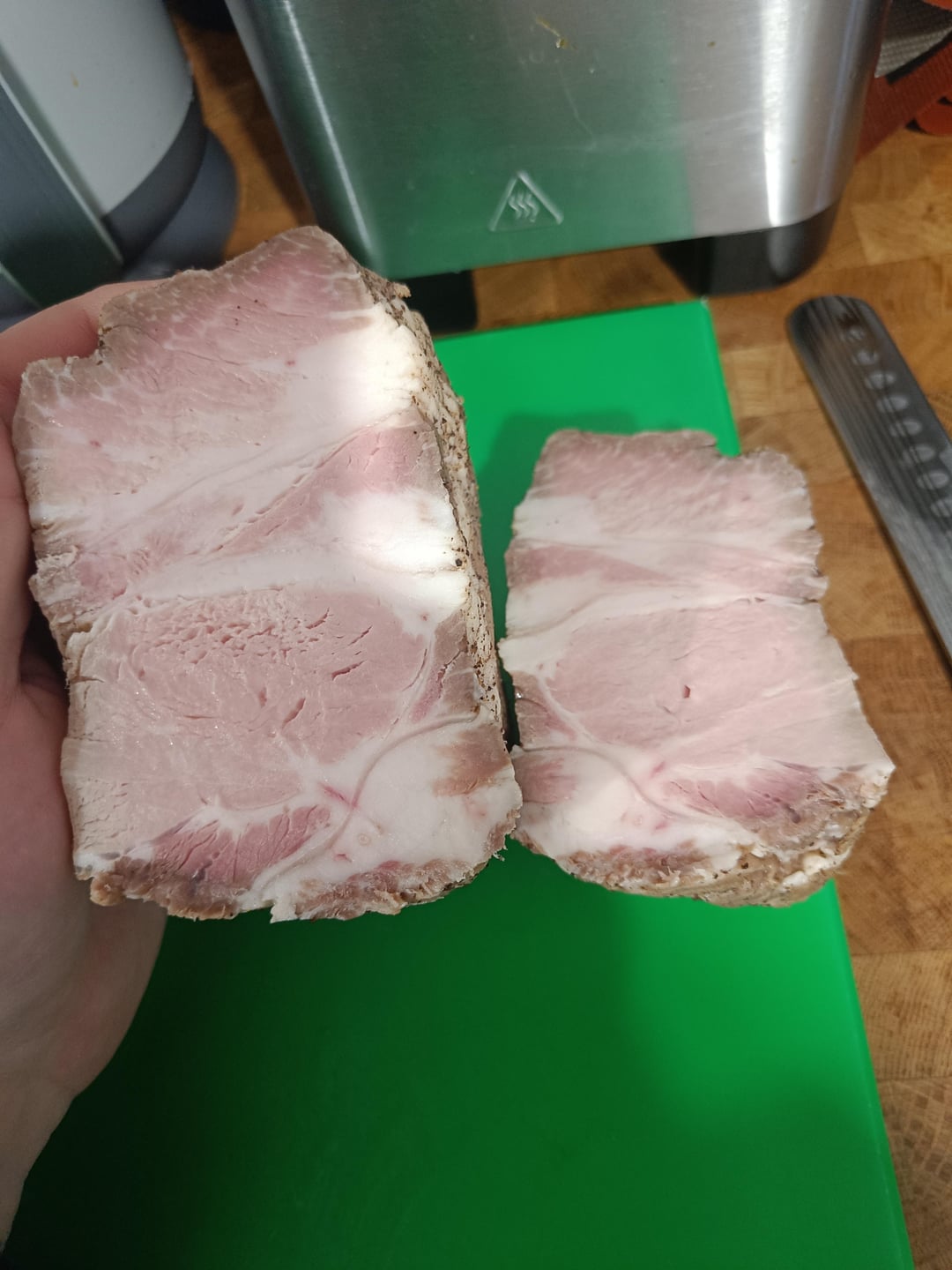
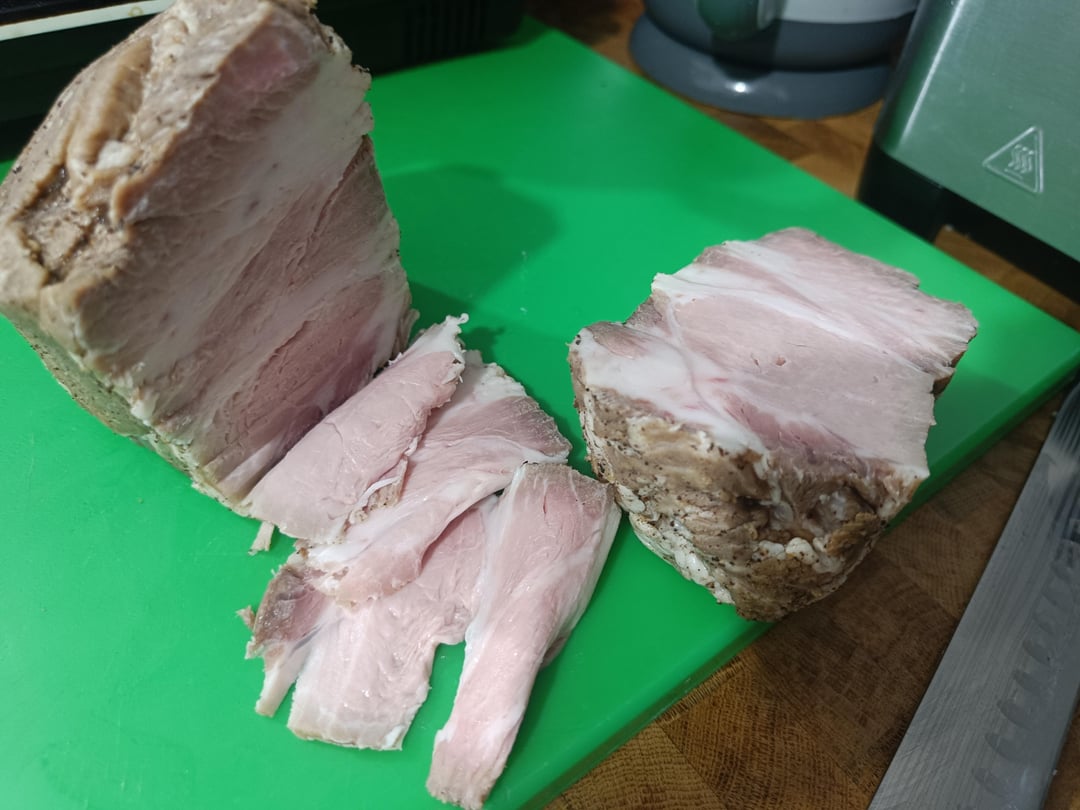
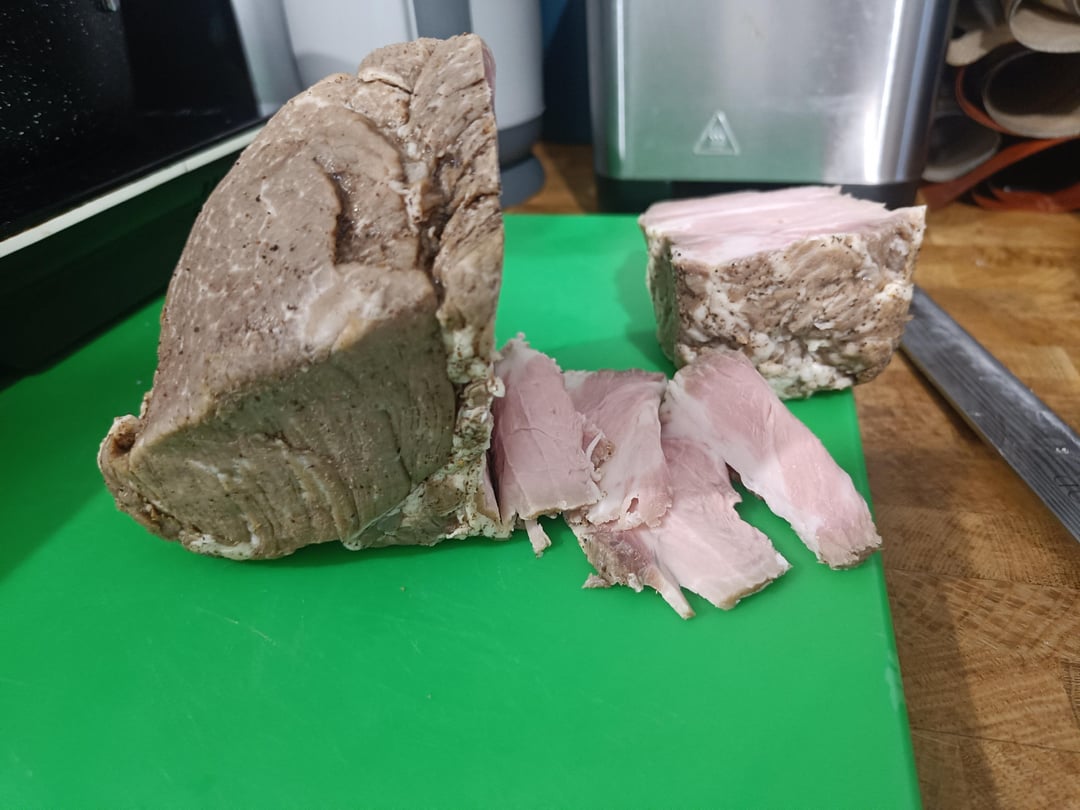
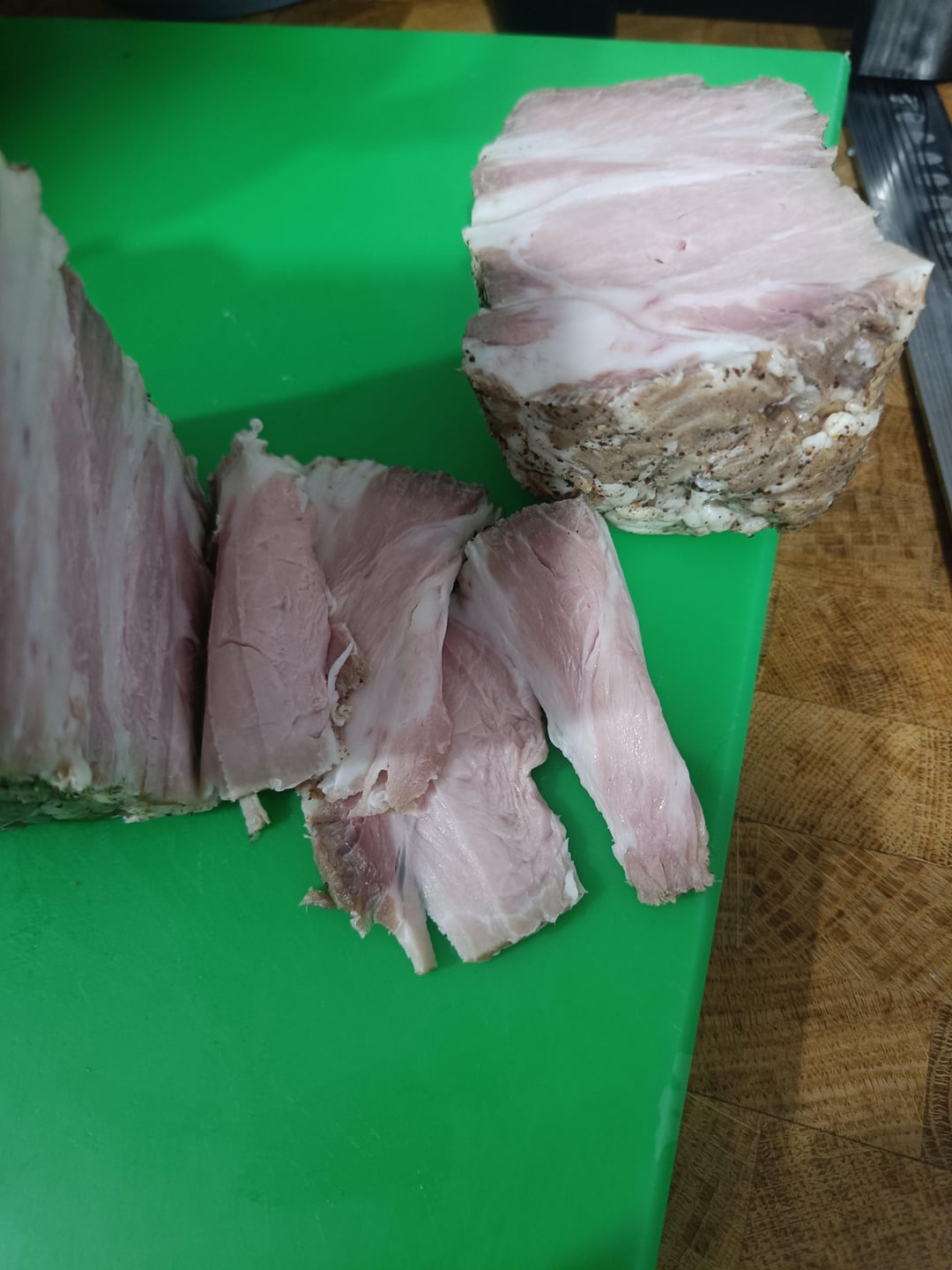
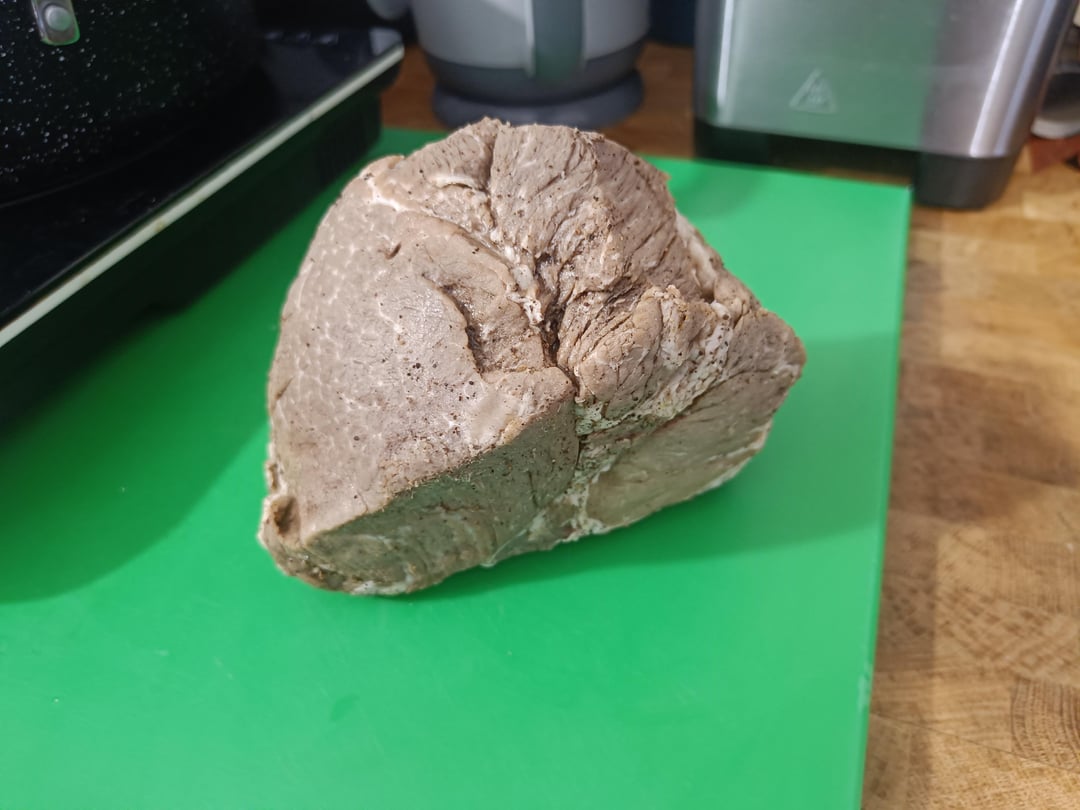
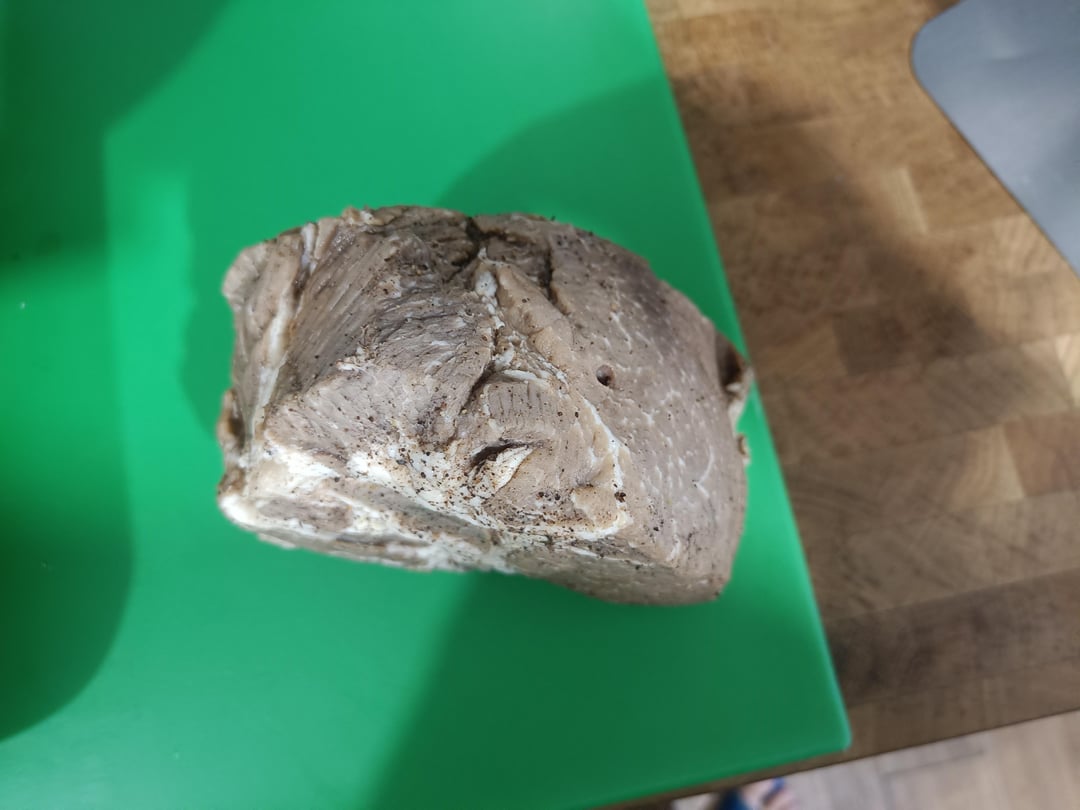
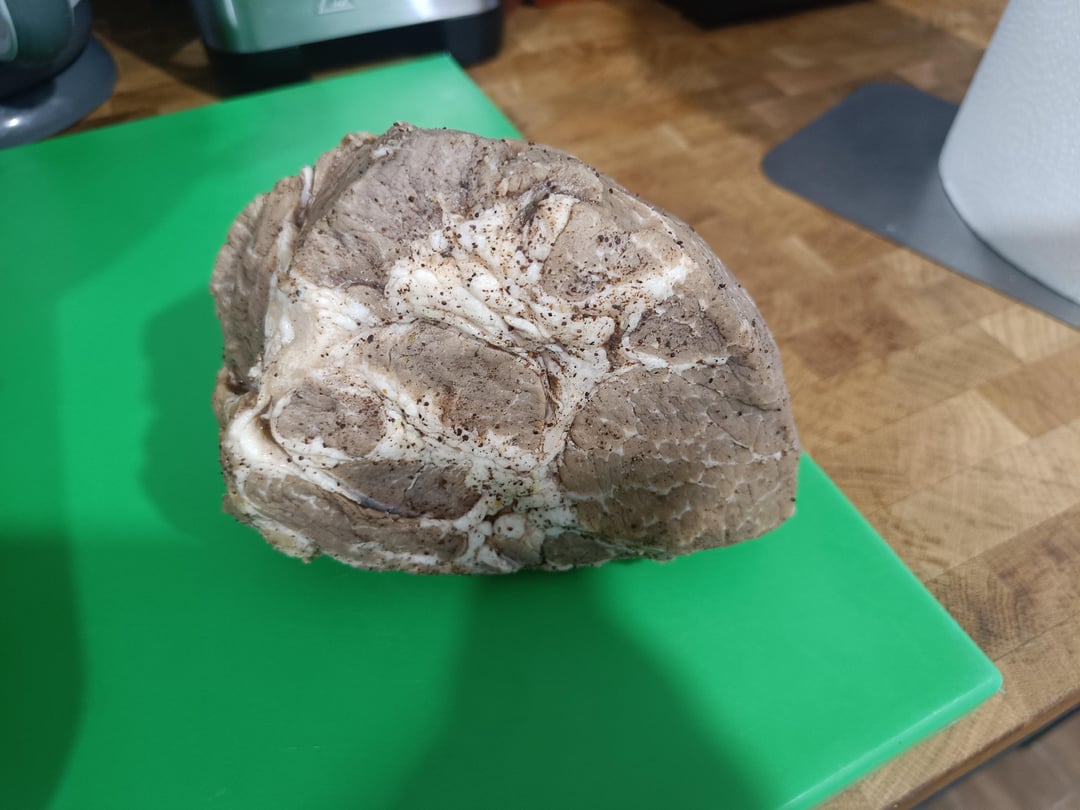
I wanted to use the leg or shoulder, but I didn't have the opportunity to go to the butcher at Eataly, which usually has special cuts. So I took what was available: the coppa.
The marinade is basically water and salt. In my case, for every 500g of water (1kg of meat), I added 73g of salt, pepper, and cinnamon (about 7g in total). It's best to heat the marinade to dissolve all the salt, then let it cool to room temperature.
My method was a little different from the traditional one: I simply placed my piece of coppa in a food plastic bag with the marinade, then squeezed out as much air as I could, placed the bag in another bag, and left it in the refrigerator overnight.
The next morning, I opened the bag to insert a wireless thermometer, then resealed both bags with as little air as possible.
The cooking process was done as follows (if you don't have a wireless thermometer, following these steps should yield the same result):
– use a large pot
Place the ham on a plate, and a plate on top of the ham so that it doesn't interfere with the thermometer probe. Ideally, it should be submerged, perhaps with the opening of the ziplock bag above the water (although when closed, water shouldn't enter the bags).
Heat the water to 72°C.
Turn off the heat, cover, and wait 90 minutes.
Heat the water to 76°C.
Turn off the heat, cover, and wait 1 hour.
Heat the water to 80°C.
Turn off the heat, cover, and wait 30 minutes.
If you've done everything correctly, the wireless thermometer will read around 69-72°C. If you're in the right range, run the bag under cold water until it cools to room temperature. Carefully open the bag to remove the wireless thermometer. If you don't have a wireless thermometer, you can quickly open the bag just to check the internal temperature with the probe of a regular thermometer before running it under cold water. In any case, be careful not to expose it too much to air. Ideally, you shouldn't open the bag at all and cook it sous vide, but I've found a compromise that I think is acceptable to ensure the cooking temperature is correct.
Then leave it in the refrigerator for 24 hours.
Remove all the marinade, dry well, and cut.
If the center is pink as in the photo, you've created a masterpiece.
Note: Since it's homemade and contains no preservatives other than salt, the pink color will oxidize quickly, which shouldn't affect the flavor.
The amount of salt is slightly higher than that of commercially available ham to improve shelf life. It's still excellent, so I don't recommend using less, but if you really want, you can use a little less: about 35g for every 500g of water and 1kg of meat.
I have to admit that coppa was a great fit for this experiment. Although you can tell it's much fattier than a traditional cooked ham, that's not such a bad thing. The flavor is excellent (and I say this as someone who isn't crazy about roasted coppa) and it's hard to distinguish from cooked ham itself. It melts in your mouth.
Today I absolutely have to make bread because I need a sandwich.
With another 1kg piece, I'm trying to make coppa crudo (the equivalent of prosciutto crudo). It will take much longer, but I hope to post this second experiment too.
by LiefLayer