
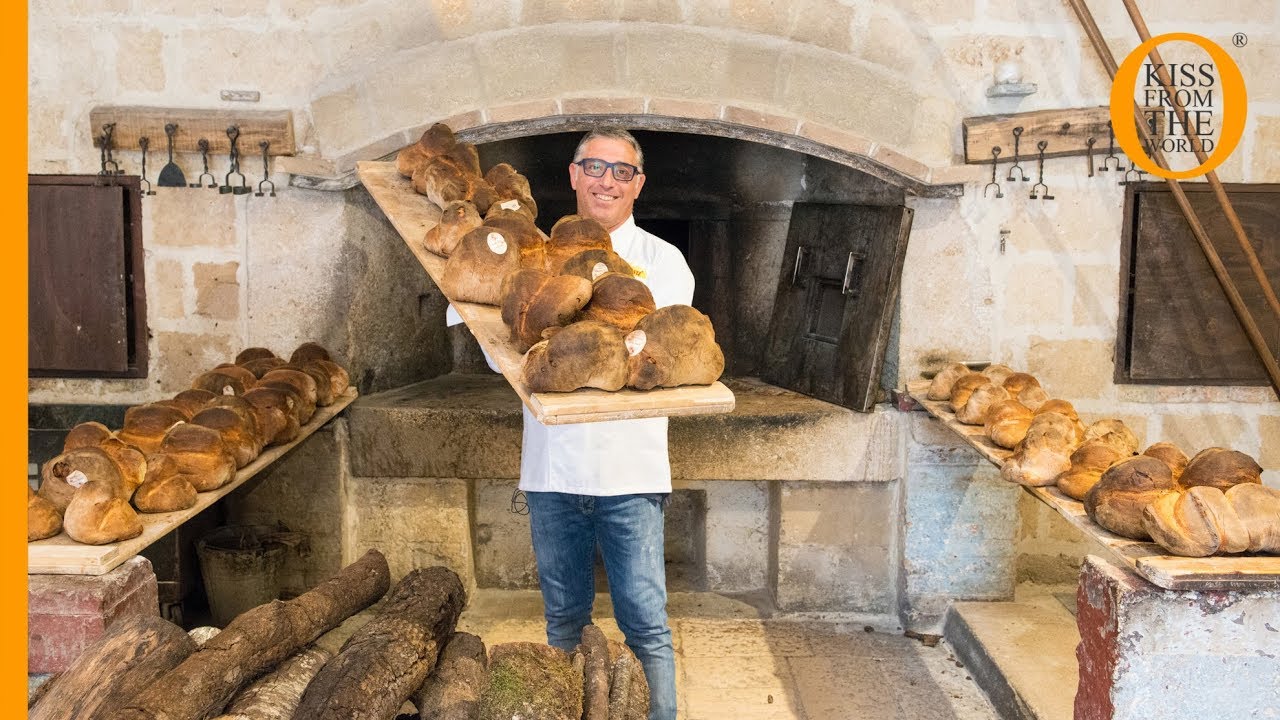
Bread recipes: how to make bread the Altamura way. It’s an authentic Italian bread famous all over the world. Do you like bread? We do. That’s why we’re in Altamura to discover Pugliese bread. They use only local bread flour to bake their fragrant artisan bread. Can you smell it?
❤ SUBSCRIBE & CLICK the 🔔
✉️ BUSINESS INQUIRIES: domenico.pacifico@me.com
❤ SUPPORT OUR VIDEOS HERE:
Our independent journalism wouldn’t be possible without donors like you. Every penny you give helps us create our award-winning, real-life stories. Thank you. You make it happen! Domenico, Giulia, Dea and Noah. One couple, two reporters, two baby – Founders of Kiss From The World Channel.
★ T R A I L E R ★
Today we’re in Altamura. I am Beppe di Gesu’, a bread maker in Altamura. Today we’ll see the process of making Altamura bread, which is a product of protected origin. The grain harvest ended in June, so what we see here is just straw. Let’s go and see how bread is made in Altamura.
Here’s our yellow gold! This is the gold of our territory. A mountain of wheat like this means strong emotions for the people of our territory. We make our Altamura bread from this grain. With this quantity, we could provide enough bread not just for the whole of Puglia but for the whole of Italy! This is durum wheat, which we’ll take to be milled, where it will gradually become ground Altamura semolina. The most important thing is that we only use local wheat when we produce our bread. We use four different types – simeto, appulo, duilio and arcangelo. This is simeto, a locally-indigenous durum wheat, and the one that grows best in this area.
As the wheat is cleaned it is then whetted, and it takes a few hours to sterilize it. After that, this is the result – cleaned and whetted wheat, ready to be milled. This is the same wheat. This is called “B1” – the first milling, the first break. The wheat goes through the mill in a long process.
This is the resulting semolina. This is some wonderful semolina. We’ll use this to make our Altamura bread.
Here we are on the operations level of the mill. It’s called the operations level because we have semolina at different stages of the milling process, such as semi-finished semolina or grain that needs to be re-milled. The different tube angles you see here are all the result of careful study. Nothing is left to chance.
The semolina is ready.
This is the heart of our Altamura bread. The so-called mother yeast is made from local grain and local flour. We do not use any kind of induced leavening, be it natural or chemical. It’s about 80 years old. Within this dough, there are many microorganisms, which we call yeast and lactic acid bacteria. These will ferment the bread, make it rise, and give our bread its unique aroma and flavour.
It’s constantly regenerated. We take our mother yeast and put it in our kneading machine, add our re-milled durum wheat semolina, and water from our local aqueduct. This is a “refreshing” procedure for the yeast, which we repeat three times at intervals of approximately three hours. This is how we obtain the mother yeast that we will use for the final dough mixture.
Here you can see a final dough mixture. From the moment in which we create our mother yeast to the moment that we take our bread out of the oven, approximately 16 hours will have passed.
We’re now going to shape the dough.
We divide the dough into pieces weighing over 600 grams, so the loaves will weigh half a kilo after they have been baked. We always use Altamura flour when working with the dough – even to dust the tables or to dust our hands. In an hour, we will have divided all 250 kilos of dough into loaves that we will bake in our wood-fired oven. We always cover the dough with a cotton cloth. We leave it under the cloth for 30 minutes, where the dough will rise for a second time.
This photo shows our traditions. In the past, the idea of a bread maker was only connected to the baking of bread, because here in Altamura, families would make their own dough at home. This is one of my grandfather’s delivery boys. He would have gone house to house, delivering bread. Every family would have given the bread maker a stamp to be applied to the dough before it was baked so it could be identified.
Read more in “Bread recipes: how to make bread the Altamura way. It’s authentic Italian bread!” from Kiss From The World®
+
★ W H E R E W E S H O T T H E V I D E O ★
Bread recipes: how to make bread the Altamura way. It’s authentic Italian bread!
Country: ITALY
Region: PUGLIA
City: ALTAMURA
GPS: 40°49’51.49″N 16°33’14.01″E
—
#KissFromTheWorld #DomenicoPacifico #PacificoContentProduction