
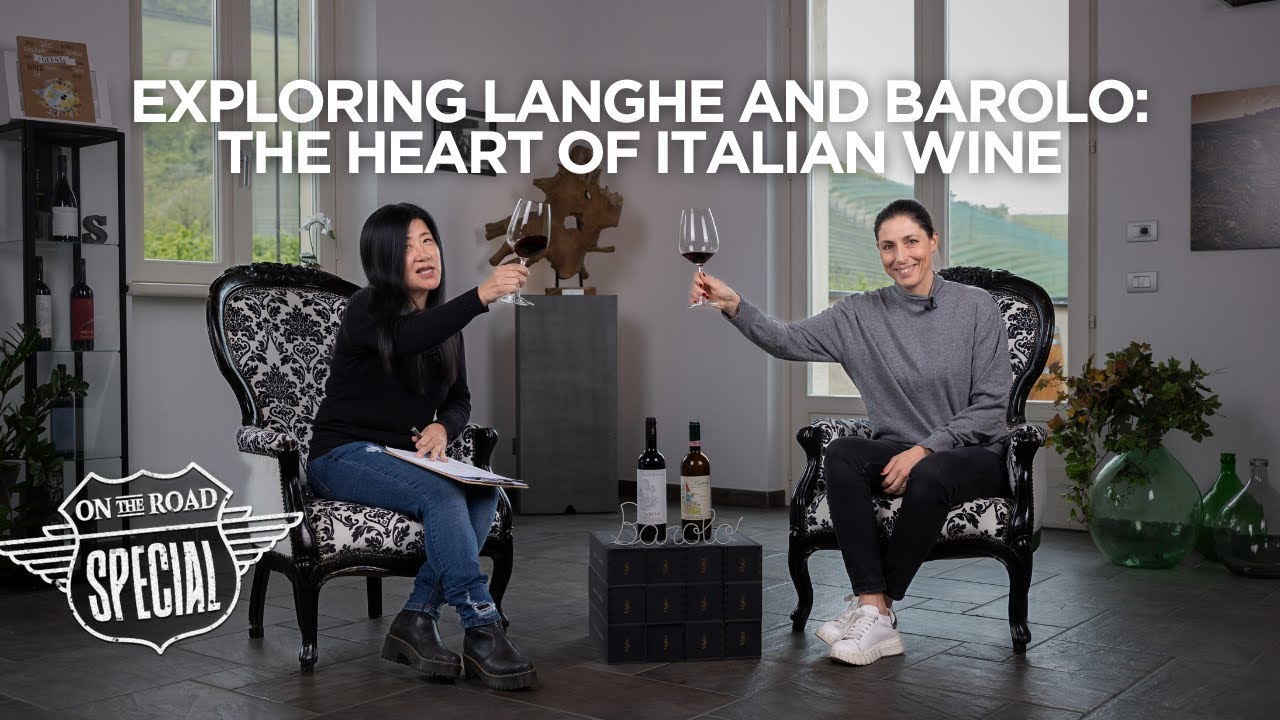
In this On The Road Special Edition, Stevie Kim meets Sara Vezza, the fifth generation of winemaker at the Josetta Saffirio winery in Monforte d’Alba in the Barolo winemaking area.
They discuss the history of the winery, the origins and significance of its name, as well as the territory of the winery and its flagship wines.
Sara also explains the importance of the historic Josetta Saffirio brand as well as the development of the new Sara Vezza line, focussing on sparkling metodo classico wines.
The evolution of the estate and the importance of sustainability with the maintenance of forests and beekeeping is an important aspect of the winery’s commitment to biodiversity. Sara also explains the wider significance of sustainability, from an economic and social perspective, as well as the challenges currently facing the winery.
Stevie also asks about the recent rebranding and “adopt a row of vines” initiative, as well as the concept of “lusso vero” or “real luxury”, of having the time to enjoy life in a meaningful way!
——————————————–
MammaJumboShrimp is a podcast, a book and a wine school – and so much more!!
We love to eat, drink and travel, seeking out the very best that Italy has to offer!
Check out our “On the Road Special Editions” hosted by Stevie Kim, as well as our regular conversations with some of Italy’s most interesting wine personalities and producers.
Find out more at:
www.italianwinepodcast.com
https://www.italianwineacademy.org/
https://justdothework.it/
[Music] Italian wine travel with Stevie [Music] Kim my name is Stevia Kim and welcome to Italian wine podcast on the road and that means we are on our YouTube channel Mama Jamba shrimp today we’re here with SAR Veta in monforte dala and the name of the winery we’re visiting today is called Yetta safo Yetta oraa Yetta so Sarah listen tell us a little bit about yourself and why is the name of the winery y safia when your name is areta we have a very long story uh we have about two centuries of story and uh I the fifth generation but uh until the middle of the80s uh my um grandfather and ancestor they were used just to be uh Vine Growers you know so uh what happened is that uh in around uh the 80s my mother and my father they started to produce wine although they decided to to give the name of Thea to my mother name so this is why the winery is called Yetta safirio which is my mother name um tell us exactly where your Winery is located it’s located in mon for dalba uh which is one of the 11 municipalities producing Baro so actually we are in Pon so in the north part of Italy and in Pon we are in the South part of this region so we are about uh let’s say 1 hour from the sea and 1 hour from the FR border so give us kind of an overview of Yetta safiria you know we have this uh historical brand safo and in the historical brand we have all our classic labels I would say nebiolo Barbera and of course Baro and all the Baro single Vineyards but for from few years I also started to be very curious about the future of uh viticult and for this reason I bought a plot in the high part of alanga about 700 M on the sea level and there I’m starting to produce alang appellation I dedicated a brand to that because eight hectors is a lot like a second estate I would say so it’s still the same uh Winery still the same property but we have two different line and two different brand so the historical traditional brand Yetta safirio f focus on Bara production and the future which is dedicated to the sparkling method Classico with Sara brand right now how many uh bottles are you producing in total today including all the production is around 120,000 bottles okay and when you started how many your first vintage 2002 you said my first vintage I made about 1,000 bottles of wine so I I made a very big job yeah so you’ve it’s it’s it’s evolved in a very significant way exactly but uh the thing I’m most proud of is that I change uh this estate to be just not only small but also to very conventional to a totally sustainable estate so we have today 20 hectors of Vineyard and 16 hectors dedicated to Forest we take care of so we have a forest with bees uh a forest with dedicated a lot of time to be you know a natural uh resera so that uh animals can stay healthy there and we have a truffle trees uh Forest so we are really investing a lot of time and efforts to balance the actors we have dedicated to the vineyard to balance with the forest with the woods so you know uh sustainability is kind of a big word today right so for you s what how how do you define sustainability especially um in terms of your Winery well we have different shapes uh of sustainability for sure the environment impact so we decided to be organic from 2004 for my health problem so I decided to go uh in that direction because I could not go anymore in the vineyard because of chemical products to be organic to be uh to have a invest in biodiversity but on the other side you have also to uh think about all the rest means the economic impact uh the relation you have with your employees uh with all the with the neighbors and uh so also the social impact so what are some of the challenges that you face um being a wine maker today in this area the most challenging thing is uh you know to be supported by the other colleagues and to work in team with other colleagues you know sometimes I feel that uh I am a little bit I would say alone because it’s difficult that people understand why you decided to be organic they think that it’s just a fashion you know or why you decide to have a a sort of Orchard for the baby roots to to replace it’s very difficult that people understand your decision for me today is the most difficult part of my job I want to talk a little bit about we see the two labels here right and you are you a you’re pivoting you’re at a critical moment in your wine business because in the past we always saw this yummi yeah the the The Gnome yeah which is kind of you know a representative of um your label right your persona they have been our mascot for about 40 years y so that’s been it’s been a long time it has been a long time but what happened is that few years ago I started to prod produce swne also under my brand and one year ago uh we enter in a holding uh run by renor Roso so uh it was something that was in my heart you know to change the labels because uh even if it it’s something that is so fancy fairy tale very easy to you know recognize on the other side I wanted something more elegant and classic and uh so be part of this new project also uh push me to go more in that direction so we decided to change the the the labels in yet so it’s it’s very very different it’s very different definitely it is this is a very so tell us a little bit about the the evolution from the Nome to what it seems what is it this is a Orchid wild or yeah the Wild Orchid and I think that is a very good um why wild translation of the philosophy we have I mean this Bond because the Wild Orchid is a you know very very endemic of the of a specific area so it grows only there and it’s so sensitive to the climate change to the characteristic of the soil to the biodiversity so uh I I think that uh it’s not the gnome that disappear but the gnome change is wild or the Wild Orchid yeah but the wine making hasn’t changed right what’s inside hasn’t changed no the wine making didn’t change but every year we try to do better and better you know so um what I’ve learned in the years is that we really need to know all the characteristic of that single plot uh of the soil of the microclimate of the toir in general and uh just to enage all this characteristic during the wine making process so you know we spoke about um one thing when we were downstairs and you were talking about the luo Vera which translates into um I suppose real luxury would you would you like to share with their audience what you mean by that yeah I think that today the uh the real uh luxury is to have the time to enjoy life in a authentic way so that means for me when people come at the winery and I can welcome them you know take them in the vineard and and help them to understand all the work all the incredible and intense work all over the year that I’ve done and I can understand that drinking my wine they really feel all this energy in my wine so in my wine so a very authentic experience we really welcome about 2,000 people a year so we have a lot of incoming at the winery because and what what do they do what do you what do you how do you define Hospitality they uh they enjoy the testing they enjoy the Sellar tour they come uh in the vineyard we have these ambitious project called adop Ro adop what does it mean to adopt it a row of they adopt a row for one year and they have uh of course the wine coming from that row and enjoy uh the experience coming for the Harvest for instance or coming for the pruning they really are part of the team when they come for the events and uh we have so much fun and I’ve seen that in the Years many of them go on uh and so we have relation that last four years together with these abult and it’s I’m very proud proud of that congratulations Sarah and hope to see you back soon okay it’s a wrap Chin Chin with Italian wine people [Music]
1 Comment
lovely library 🍷