
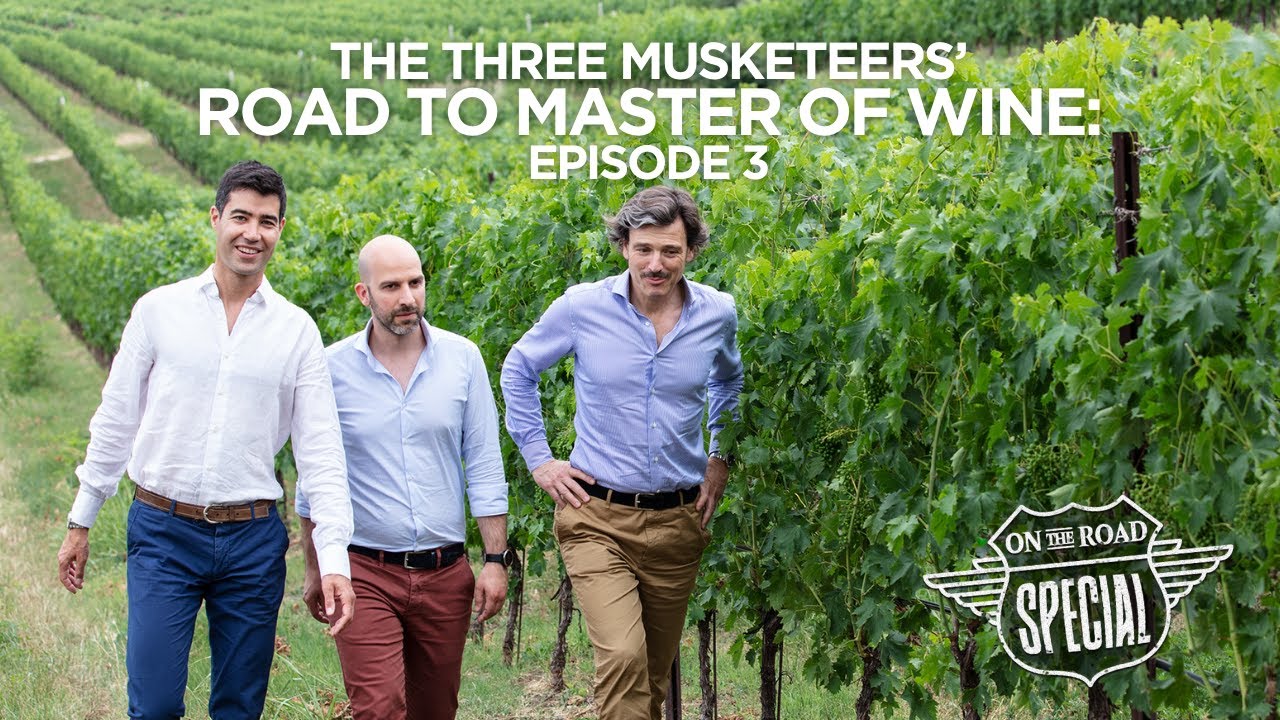
In this On The Road Special Edition, Stevie Kim sits down with Andrea Lonardi MW, Gabriele Gorelli MW and Pietro Russo MW, experts in the field of Italian wine who embarked on the difficult and grueling journey to achieve the prestigious title of Master of Wine.
They discuss the physical, mental and practical demands of becoming a Master of Wine, the areas of competence, and the importance of collaboration and teamwork. They also consider the particular challenges of the MW exam compared to other wine qualifications, and the satisfaction of achieving such a prestigious award. Describing their story can be of inspiration not only for other professionals engaged in the study of wine, but also for anyone who has an ambitious goal and is looking for an effective approach to achieve it. What matters in this story is not so much the goal, but how the protagonists chose to approach the journey. These same choices earned the three protagonists the nickname “The Three Musketeers of wine”: let us discover together the meaning of their personal “One for all, all for one.”
The Institute of Masters of Wine (IMW) is a membership organisation with an exceptional international reputation. For 70 years, its members – the Masters of Wine (MWs) – have been at the forefront of leadership and expertise in the world of wine. MWs must prove their comprehensive understanding of wine by passing the MW exam, recognised worldwide for its rigour and exacting standards. Today, there are 417 Masters of Wine based in 31 countries. The membership encompasses winemakers, sommeliers, buyers, journalists, shippers, consultants, academics, educators and more.
P.S.: these interviews have been recorder on June 2022.
ITA
In questa edizione speciale di On The Road, Stevie Kim intervista Andrea Lonardi MW, Gabriele Gorelli MW e Pietro Russo MW, esperti nel campo del vino italiano che hanno deciso di intraprendere il difficile ed estenuante percorso per conseguire il prestigioso titolo di Master of Wine.
Insieme, discutono delle esigenze fisiche, mentali e pratiche per diventare Master of Wine, delle competenza richieste e dell’importanza del lavoro di squadra. Considerano anche le particolari sfide che l’esame MW porta con sé rispetto ad altre qualifiche enologiche, e la soddisfazione di ottenere un riconoscimento così prestigioso. Descrivere la loro storia può essere d’ispirazione non solo per altri professionisti impegnati nello studio del vino, ma anche per chiunque abbia davanti a sé un obiettivo ambizioso e stia cercando un metodo per raggiungerlo. Quello che conta in questo racconto, infatti, non è tanto la meta, bensì il come i protagonisti abbiano scelto di affrontare il tragitto. Queste stesse scelte hanno valso ai tre protagonisti il soprannome di “I tre moschettieri del vino”: scopriamo allora insieme il significato del loro personale “Uno per tutti, tutti per uno”.
L’Institute of Masters of Wine (IMW) è un’organizzazione associativa con un’eccezionale reputazione internazionale. Da 70 anni, i suoi membri – i Master of Wine (MW) – sono all’avanguardia per leadership e competenza nel mondo del vino. Chi intende diventare MW deve dimostrare di avere una conoscenza completa del vino superando l’esame MW, riconosciuto in tutto il mondo per il suo rigore e i suoi standard esigenti. Oggi ci sono 417 Masters of Wine in 31 paesi. I membri comprendono enologi, sommelier, buyer, giornalisti, importatori, consulenti, accademici, educatori e altri ancora.
P.S.: queste interviste sono state registrate in giugno 2022.
——————————————–
MammaJumboShrimp is a podcast, a book and a wine school – and so much more!!
We love to eat, drink and travel, seeking out the very best that Italy has to offer!
Check out our “On the Road Special Editions” hosted by Stevie Kim, as well as our regular conversations with some of Italy’s most interesting wine personalities and producers.
Find out more at:
www.italianwinepodcast.com
https://www.italianwineacademy.org/
https://justdothework.it/
Why unity is strength. It is important to say the combination of skills was there but competences did not gathered immediately. It was not as the day we met at Masi at the Introductory masterclass of The Institute of Masters of Wine we organized ourselves immediately and worked together. It was not like that.
We did the first year, Stage One, the first exam as lone wolves. We only met twice not because we organized together but because Jane Hunt MW organized a mock preparatory exam and we met there. Team history “The Three Musketeers” Ok, let’s see how we arrived in London. We met March 2014 in Bure,
Valpolicella. Then, I did the symposium where I met other students and MWs. I believe with did not meet until November of the same year at Tignanello with Jane Hunt MW who did a mock exam there and there Andrea got the Torrontes, an Argentinian grape variety. My first time with Torrontes, mine too.
But he said, “This is Torrontes”. This is the grape variety which caused me a mental crash at the exam. This explains the mental condition at the exam. In total freedom, fearless, with no tension you identify the strangest grape variety. Then, at the exam, once you drink it you recognize it among thousands
Then at the exam instead it became a watershed and made you lose your mind. We did a couple of course days in London together when it was still in exhibition road. Then, in January 2015, in Rust for a week there, where we got to know better, initially with Pietro.
We have the same age, maybe that’s why. In that moment we felt the difference in generations and I believe today also. When we met he had my age today 40 years old. We always felt that difference during the journey. That is negative for the seniors. Then in June, the Stage One exam. Between
January and June we called each other four to five times. At the exam we arrived as a scattered group. After the exam the result, unhoped for the three of us, was “pass”. Then, for different reasons but similar, we decided not to do Stage Two in 2016. Because, after the first exam, we realized
That we were far away from having that regularity, that rhythm, that pace that is needed for the Stage Two exam. In 2016, we did not take a gap year. We did bootcamps, we did the seminary and flew to London many times for the course days. We tried to maintain a rhythm.
We started to organize bootcamps. The first was in March 2016 in Livorno with Yiannis. It was good to be divided before being united. In January 2016, I did a seminary in Napa and you went to Bordeaux? Bordeaux. The same year there was an early bird seminar in Adelaide in Australia.
I did that by myself. And you went to Odney. No, I went to Napa. We always divided and then reunited with different experiences, different peers and different know-hows. I clearly remember a call from Andrea and Anastasia while at the airport in Rome waiting for my flight to Australia and they, in November
With the exam in June, were already preparing the exam. “What are you doing?” “Which wines should we get?” “How do we organize?” We really got closer there and set up a study group. And that became a reality already in January 2017 when we started with bootcamps and the goal was to organize
One every month and call a MW once a month to come to Sicily, Tuscany or Veneto to organize a bootcamp and give something back like visits to wine cellars and tastings of local wines. It was give and take operation. Then in 2018, Pietro and I went to Bordeaux. We started these series
Of bootcamps with different MWs. In May, we felt the need of being like London students, who have a strong advantage compared to others as they live in cosmopolitan city especially for the availability of wine. You want to try a number of Chilean Pinot Noirs you can do that. From the €5 one
Until €300 remaining always from Chile and this can be done only in London. We recognized that and said, “We need a place in London”. In London we realized also how important other aspects were for the MW. We understood the importance of being prepared, the studying, being organized, and team work. We then understood
How important physical preparation was. In London, we started doing yoga on a daily basis. We went almost everyday to do yoga. We understood how important meal planning was. We then realized how important mental preparation was to do the exam. And only during to that week the group was born
As you see it now. We realized what it meant to try the exam, shut down phones, isolate from the world to reach a level of preparation and concentration adequate to the exam. There was a mixture of things that made everything unique. One aware of this understood that he could not go solo.
They started to say, “If he makes us sit down, help us organize and get more structured, we can go somewhere”. There the value group was born. I came to you in June. We did the one with Maj, Maj Tjemsland, that’s true. We did the very first weekend where we realized
It was not possible to study in Italy with Italian wines. We found on the table wines from Chile and Argentina from a wine shop in Palermo that had Casillero del Diablo, priced at €4 from 6-7 years ago. It was difficult to think at those wines as representative. We started from there June 2016.
With Pietro the relationship was let’s say smoother. We were in and did what we thought should be done to carry on but we completely lacked discipline, structure, vision, and pace that he brought. What was beautiful about him, he now pretends to lack knowledge, which he has plenty and used specifically when needed.
The spark that gave birth to the team A spark is not a physical place but the result of the Spanish at the 2016 exam. In 2015, we met a group from Spain, guided by two people, who were a study group like ours, Jonas and Fernando Mora MW. We met them
In Rust in 2015. They passed Stage One, they were already incredible war machines. In 2016, they do not stop and get ready for the exam and we indirectly saw how they prepared for the exam. They went to the exam in 2016 and passed on first attempt. Jonas did not pass the theory part
But passed in 2017. But Fernando, who started with us, end of 2017 became a MW. There we understood we could make it but we needed dedication and the fact that none of us was doing things by itself. Because if you’re alone you can avoid doing things and get easily distracted
And no one will warn you. That does not happen if you’re part of a group and if the group is made up of three and not two it is even more difficult. There will always be someone pulling the strings, maybe in turns. There will always be someone who feels more motivated
Pushing the others. There could be someone in a difficult moment and two others ready to cheer him up. It’s always a positive dynamic. And there, with a little unconsciousness and method we understood that we could have been a team like Jonas and Fernando. The team to the test during the retreat in London
When we arrived some of us had already processed the work and others were absorbed and drawn in, like me, I was completely unconscious of what was lying ahead. What surprised me was the harmony we had from the beginning in respecting timing deadlines and everyone’s commitments. It was like a theatre play
With everyone enjoying it. where Andrea was the leader of the group. The fact of having a vision of what we needed to do made me feel guided with a sense of tranquillity and security in his person to face an exam that with the course handouts gave you a sense of discouragement and loss.
He was our light and guide. And personality-wise it went well. And this was the keystone in London. There are different leaderships involved. I don’t believe there is only one leadership in this group. There are three different leaderships: Gabriele’s qualitative leadership with his curiosity. He is the true wine man.
He is the one with the deepest pleasure for wine, the purest and similar to the English. He is detached from any influence from wine production. When we need a qualitative leadership he knows the producer and the places to visit because that one does this or that. There are different kinds of leadership
In different parts of the journey. When we got on the plane, and we were already in Verona from days to go to London and I usually fall asleep at take-off and that’s what happened. He took out his notebook and started drawing his planning chart and when landed he said,
“This is how it will work from tomorrow”. I agree with Pietro. When you know that tomorrow, it will be like this, you do it. It’s like military discipline where you agree to a certain rhythm during the day and it’s ok like this. I would have never been able to respect that.
This is the key to everything. We realized that we are deeply complementary. We left and spent a morning to see the exam venue because he said, “It’s important to see the exam venue”. And in Malaga, last year, we did the same thing and we probably passed the exam thanks to this. We systematically
Repeated that. The exam needs to be visualized. During Stage One I dived into it and didn’t see or hear anything during those 2,15 hours especially in the practical part. I dived into it and was completely isolated. What was absurd was that, and it was in Blackfriars where the used to do WSET exam,
Was that I visualized the room for the exam as it really was and that was fundamental to me. because I felt at home as I had already been there. Going back to the room, that was so alienating, that feeling at home in a place where you have to spend the next four days,
From 9 a.m. until 5 p.m., it was fundamental to see the room, the desk, how the chair was placed and the background. They look like insignificant details, in reality they played an important role.