
Ever wanted to know how salami is made?
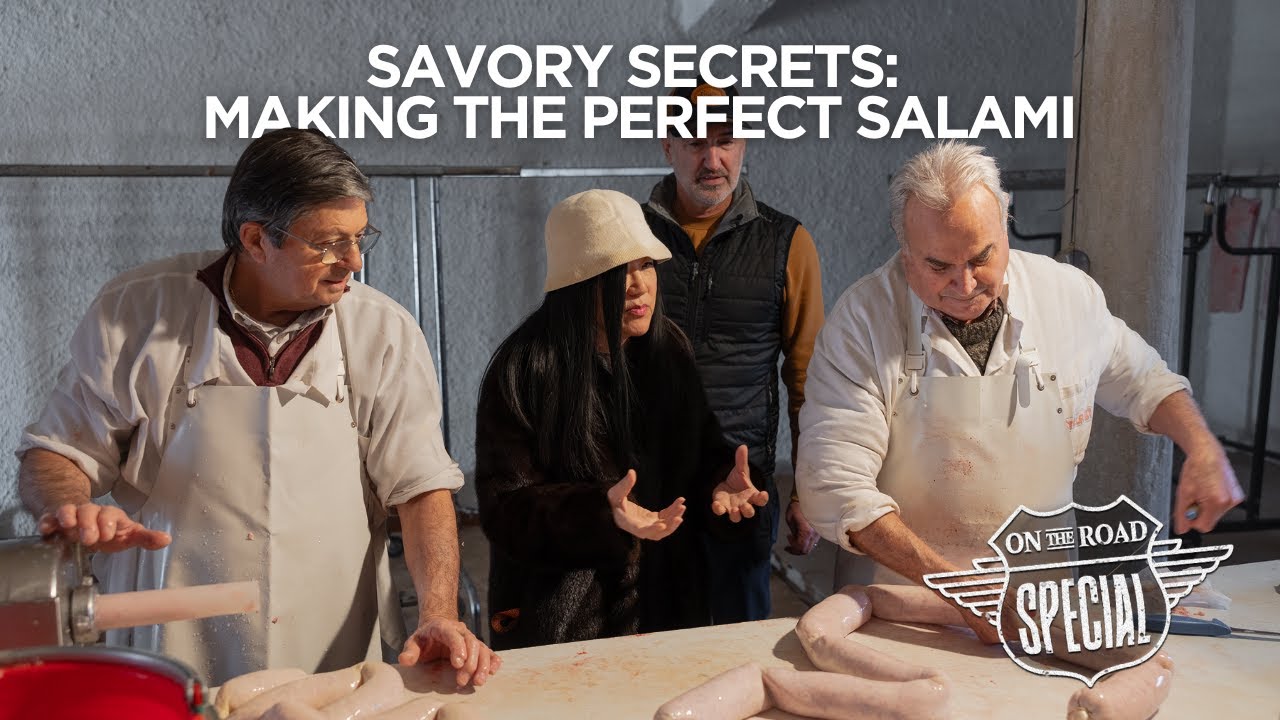
In this On The Road Special Edition, Stevie Kim learns the secrets behind making the perfect salami at the famous Cantina Buglioni in Valpolicella near Verona.
Discover the process, known in the local Veronese dialect as “femo su il porco”, of making the perfect salami, from butchering the pork to maturing the finished salami. Learn about the ingredients that go into the salami, including the preparation of the cow’s intestine used as a natural casing, as well as the special blend of herbs and spices that go into the mix.
Finally, discover the perfect way to enjoy salami and the best wine to accompany it!
——————————————–
Fino out more about Cantina Buglioni at: https://buglioni.it
——————————————–
MammaJumboShrimp is a podcast, a book and a wine school – and so much more!!
We love to eat, drink and travel, seeking out the very best that Italy has to offer!
Check out our “On the Road Special Editions” hosted by Stevie Kim, as well as our regular conversations with some of Italy’s most interesting wine personalities and producers.
Find out more at:
www.italianwinepodcast.com
https://www.italianwineacademy.org/
https://justdothework.it/
We’re doing 2.5 kgs not more. I would say so. But it is 2.5 for how much? Oh wow! There’s something on the table! Help! Today, what are we making? We’re making… We’re making salami. Salami! So, with you father there’s this myth in Verona, that you are making this…
OMG I see an ear there… That you are making this salami. Today, only for you, we will dedicate the whole day to making pork salami. And how is this process called? In our local dialect we say… “Let’s do the pork!” Okay! Let’s go! So, tell us, here… So, obviously, we first
Butcher the pork. Then, after butchering, we cut the parts and by cutting them we mince them, in this process where we mince the whole paste, so that it turns into the “heart” of our salami, so, our salami paste. So, now we have divided it into the salami paste here to the right,
The noble part and here to the left the part used for the “cotechini” (rind sausage), so, a less noble part. Ok, so, “cotechini” is a less noble part. How long have you been doing this? We started approximately over 10 years ago. Give me some numbers here. How many are you producing?
We process roughly 6, 7 to 8 porks each ear. It depends… And how many salamis? A lot of salamis. Ok, we don’t have a precise number. I will be more precise later, I need to count them. The number is coming soon. These are the cow intestines, right? Yes, that’s right.
That we use for the “cotechino”. We are talking about animal intestines, non synthetic. And for our salamis, our “soppressa” (a large salami), we use the cecum intestine which is larger and it allows for a larger diameter. So, Dino shared a secret with me. Inside the cotechino we add… we add a few spices.
No, that’s not what you told me. What he said earlier was not right. He did not tell me this before. Ok, never mind. It’s a few spices, it’s a mix of cloves, cinnamon, nutmeg. It’s a blend. We are doing 2.5 kgs, not more. I would say so. But 2.5 kgs for…
Oh, wow! There’s something on the table. Help! What’s that? It’s the pork rind for the cotechino. We start from here. So, tell us what’s happening here. They are taking the “budello”, which has reached the temperature of… What is “budello”? “Budello” is the cow intestines. Ok, let’s move on to the… the filling process.
Dino, here we are. Have you seen this? Yes. So, this cotechino needs a lot of intestines. That’s right. How early do you need to order them? So, for these, there’s a warehouse where they come from. There’s a warehouse for “budelli” (intestines)? There’s an intestine importer. An intestine importer. That’s right. “Insaccamento”,
“Insaccatura” (sausage filling process), how do you say that? “Insaccamento… soppressa”. So, what is the difference between the intestines? So, these are large intestines. There’s an end to it. Right. That is a different intestine and there’s only one for each cow. So, each cow has got one and you get one salami.
Ok, got it. So, a hundred “budelli”, a hundred cows. Wow. And then he makes a further… Here is where we tie the salami. That one was the closing. Here we tie the salami really well. He’s making holes. Yes, to drain the water. That is why we hang them to let water
And humidity out. The process is the same as for the “cotechini”, only the intestines dimension changes. So, there’s a much larger diameter. This allows longer aging. Even up to two years. Is there anything else to say, Dino? I’m going to eat. There’s nothing left than going to cook. Let’s take a picture
Of us all. Today’s snack is toasted bread with salami paste, shaped as a meatball and a good glass of wine. Bring on the glasses! It’s a parenthesis. That’s right. Thank you Stevie. Cheers! Let’s go! You eat. I’ll pretend to. I’m eating. Ok, go.