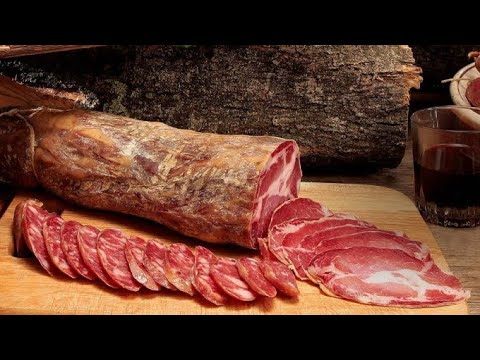
Coppa – dry-cured Italian pork neck sausage 55,054 views Different types of meat are preferred in every Italian province, but pig neck and shoulder tenderloins are popular in all regions. They make a traditional product – Coppa (Coppa). The bright red color and marble-white veins on the cut create a truly bewitching sight. Spices for it vary depending on the place of production. For example, in Piacenza (Piacenza) nutmeg, cinnamon and cloves predominate, in Parma (Parma) the meat is saltier, and in Calabria (Calabria) hot chili peppers are welcome. Interestingly, the diversity of Koppa is not only in taste. Our article will help you to reveal all the secrets of the Italian delicacy and find out the recipe for its preparation. Contents [hide] What is Coppa Production Varieties Coppa di Parma IGP Capocollo di Calabria DOP Coppa Piacentina DOP Recipe at home Calorie content and benefits Price What is Coppa Coppa is a traditional Italian product made from meat from the neck and shoulder (up to 4th or 5th rib) pigs. It is cooked whole, not crushed, placed in a natural casing. It looks like prosciutto, but their production has some differences. The origin of the koppa has not been fully determined. Although the first documentary evidence dates back to the 17th-18th centuries, historians suggest that the preparation of the product goes in parallel with the breeding of pigs in Italy. Koppa/kappokola dried pork neck It is noteworthy that not only the taste, but also the name of the delicacy changes from region to region. In most of the republic, it is called koppa or capocollo (capocollo). The last name is the sum of the words “capo” (head) and “collo” (neck). Regional names sound different. So, in Campania it is capicollo, in Tuscany it is finocchiata, in Lazio it is lonza, in Marche and Abruzzo it is lonzino. Production In the first stage of production, the koppas select and prepare the meat. It is cut, freed from bones and carefully separated from the surface fat, the total thickness of which for certain species should not exceed 3-4 mm. This is followed by seasonings and an ambassador. Some types of products are first rubbed with spices (garlic, various herbs, spices, red or white wine). Their choice depends on the region of production. Then the meat is salted, carefully rubbing, as if massaging. After 4-8 days, the product is washed from salt, placed in a natural casing, tied with twine and sent for maturation, the period of which is regulated for each variety. The Koppa variety is valued for its delicate aroma and delicate, slightly oily texture. The taste of the product varies depending on the variety, of which there are quite a lot. Despite the great diversity, only 3 types of koppa have the DOP category and 1 – IGP. But, it is worth noting that at once 10 varieties are classified as “Foodstuffs of traditional Italian cuisine”. These are: capocollo and capocollo di Martina Franca from Apulia (Puglia); capocollo from Basilicata, Campania, Molise and Umbria; lonza from Lazio; coppa Maccarana from Lombardy (Lombardia); capocollo tipico senese from Tuscany; coppa, lonza, lonzino from Marche and Abruzzo. Undoubtedly, products with a quality category are considered the best on the meat products market. In the Coppa family, these are: Capocollo di Calabria DOP (Capocollo di Calabria), Coppa Piacentina DOP (Coppa Piacentina), Coppa di Parma IGP (Coppa di Parma).