
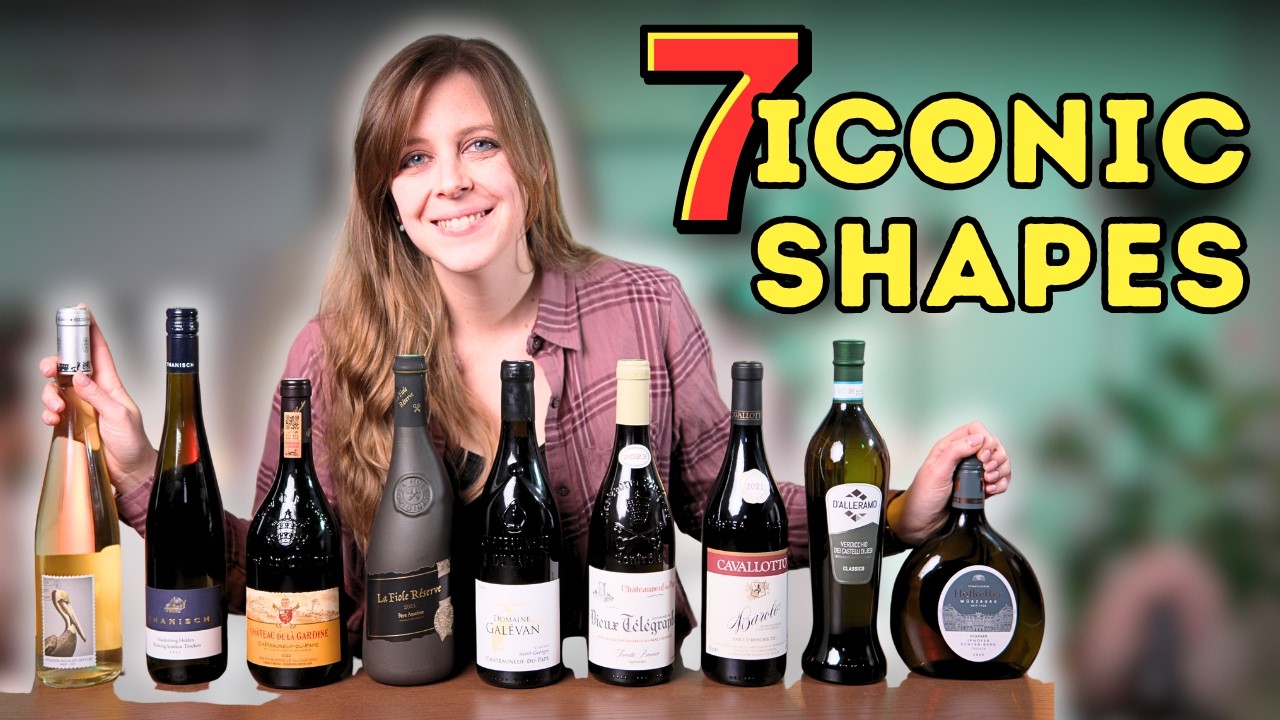
Discover the fascinating history and hidden meanings behind the most iconic and unusual wine bottle shapes in the world! From the classic Châteauneuf-du-Pape crest to Germany’s quirky Bocksbeutel, learn why your favorite wines look the way they do and the traditions that shaped them.
We usually spend all our time focusing on the wine inside the glass, but the outside tells a brilliant story, too. In this video, Jacqueline explores traditional wine bottles that stand out on the shelf and the history behind their designs. We’ll dive into the elegant Verdicchio Anfora, the Piedmontese Albeisa used for premium Barolo and Barbaresco, and the slender Flûte d’Alsace. Whether it’s about practicality on uneven ground or a stroke of 1950s marketing genius, these classic bottle shapes are a beautiful piece of wine culture.
FAQ – Wine questions from this video
* Why is the Bocksbeutel wine bottle flat? Historically derived from field flasks, this German bottle was deliberately made flat so it wouldn’t roll away on uneven ground. Today, it is legally protected and used for high-quality Franconian wines like Silvaner and Riesling.
* What is the Sophia Loren wine bottle? This is the nickname given to the Anfora bottle used for Verdicchio dei Castelli di Jesi. Designed in 1953 by architect Antonio Maiocchi, its elegant, voluptuous curves helped launch Verdicchio to global success.
* Which bottle shape is used for Barolo and Barbaresco? Many producers in Piedmont use the Albeisa bottle. It features pronounced shoulders and has the word “Albeisa” embossed four times around the glass, serving as a symbol of nobility for wines from the Alba region.
* Why do Châteauneuf-du-Pape bottles have a crest? Created in 1937, the embossed papal tiara and crossed keys guarantee the wine’s authenticity. It references the historical Papacy of Avignon and gives the Châteauneuf-du-Pape AOC a strong, recognizable visual identity.
* What is the Flûte d’Alsace? It is a tall, slender bottle with softly tapered shoulders. Since 1971, French regulations legally require this “Rhenish-style” bottle for Alsace AOC still white wines, visually signaling elegance and aromatic intensity.
Chapters:
00:00 – Intro: Why wine bottle shapes matter
00:58 – The Bocksbeutel (Franken, Germany)
03:23 – The Anfora (Verdicchio dei Castelli di Jesi)
05:37 – The Albeisa (Barolo, Barbaresco & Piedmont)
08:00 – Châteauneuf-du-Pape & The Papal Crest
10:32 – The Flûte d’Alsace & German Flute
12:30 – Displaying your wine bottles & Outro
Related videos on this channel:
Châteauneuf-du-Pape Masterclass: The Ultimate Guide to Southern Rhône Wine (+ Tasting) – deep dive into the wine inside the papal bottles! https://youtu.be/10o9v_vdQs0
Everything You Need to Know About GERMANY (for WSET Level 3) – Part 2 – explore the regions where the Bocksbeutel and German Flute are used! https://youtu.be/xcU7HutG7CY
BAROLO Wine Guide: The “King of Wines” Explained in 5 Minutes – learn more about the noble wine housed in the Albeisa bottle. https://youtu.be/LdXkxOaNbvk
Subscribe to Hourglass of Wine for more approachable and engaging wine education! Let us know your favorite bottle shape in the comments below.
#winebottles #wineeducation #hourglassofwine #winetasting #chateauneufdupape #barolo #winelover
👇 SUBSCRIBE FOR MORE WINE EDUCATION 👇 www.youtube.com/@UCu4Fa-JgtT9gLpgIgtMrHiA
🥂 ABOUT HOURGLASS OF WINE
We are Jacqueline (an american expat working in the wine industry) and Andrea (a native italian with a serious passion for wine), two certified sommeliers (AIS – Associazione Italiana Sommelier and WSET Level 2 & Level 3 holders) on a mission to make the world of wine accessible, fun, and completely snob-free.
Whether you are a total beginner overwhelmed by the wine aisle, a WSET student, or a seasoned winelover wanting to expand your wine knowledge, you have found your home. We break down the barriers of wine with a dynamic mix of education, entertainment, and travel.
We are based in Alba (Piedmont, Italy), right in the heart of the iconic Langhe wine region – home to the famous Barolo & Barbaresco wines.
3 Comments
Fun.
Cool video. Lots of cool shapes out there. Thank you!
Excellent video! Extremely informative. New subscriber here!