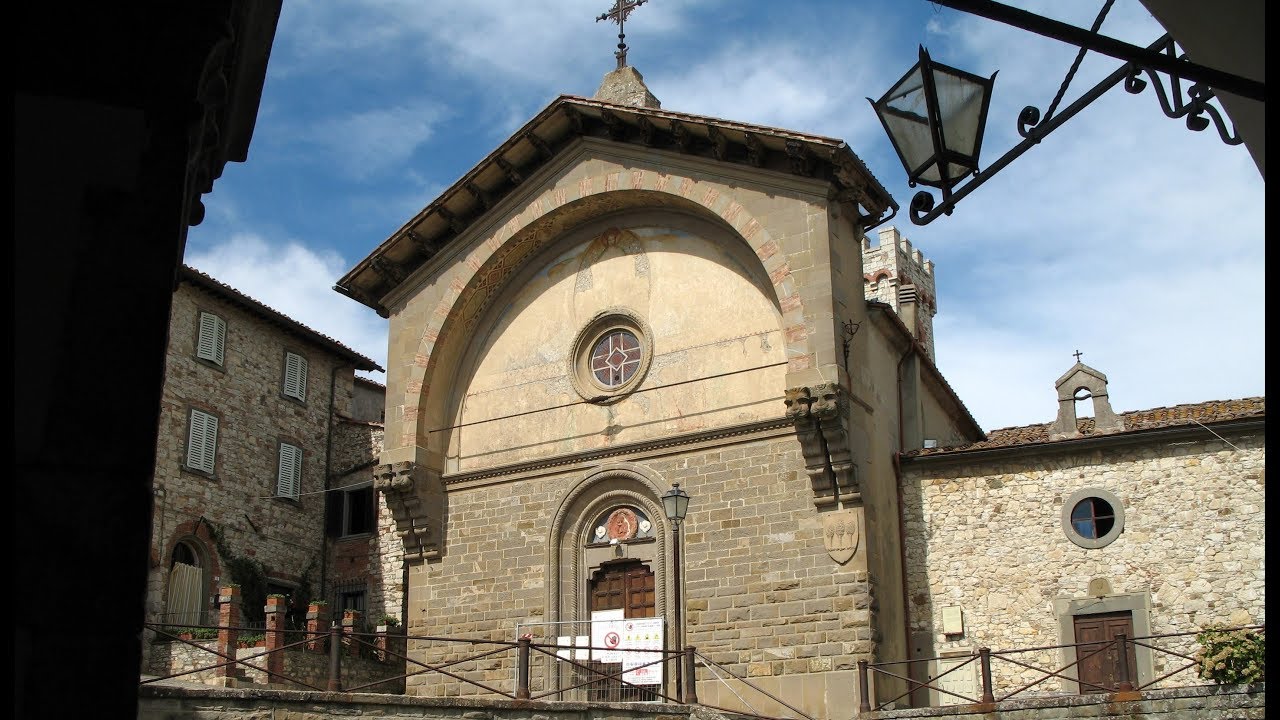
The Proposition of St. Nicholas is the main Catholic place of worship in Radda in Chianti, in the province of Siena. The church is located in front of the Palazzo del Podestà, in an elevated position and to access it you have to climb a staircase from Via Roma. The first evidence dates back to 1260 when it is mentioned in the Book of Montaperti together with the church of San Cassiano and Santa Cristina di Radda, churches administered by a single rector. In the lists of tithes of 1276 and 1303 it appears as a suffragan of the Pieve di San Giusto in Salcio. In the cadastral reports of 1427, the rector of the church mentions the expenses incurred for the feasts of San Clemente and San Paolo, not owners of the church. In the seventeenth century the oratory of Santa Maria del Prato was united with it, this union lasted until 1708 when the oratory was sold to the Franciscan friars to establish a convent there. In 1660 it was elevated to a priory while in 1616 the niche for the baptismal font was built. From a pastoral visit carried out in 1784, it appears that the church of San Biagio in Vercenni had been annexed to it. In 1899 it was elevated to the title of Propositura. During the Second World War the church, like the historic center of Radda, was considerably damaged so much that if it were not for the reports drawn up on the occasion of pastoral visits and ecclesiastical inventories it would be very difficult to trace the appearance that the church must have had between 15th and 16th centuries. The most impactful intervention was suffered by the facade which in 1926 was redone in the neo-Romanesque style by Adolfo Coppedè, on that occasion the square below was also redone with the construction of the public fountain from which the water flows from a lion’s mouth; in the Coppedè project there is also a pencil drawing showing the facade before the intervention. Previously, in 1837, the bell tower had been restored; the original bell tower had been demolished and rebuilt in the eighteenth century while the current bell tower was built in the fifties by leaning on one of the towers of the ancient castle of Radda. The last restoration works on the church factory date back to 1969 when the apse was restored and the new presbytery was built and another intervention was carried out in 1997 with the consolidation of the bell tower and the installation of a device to ring the hours.