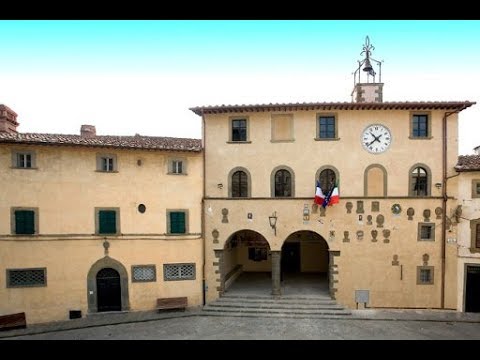
June 28, 2008 will be a date to remember for Radda in Chianti and its inhabitants. After seven years, Palazzo del Podestà officially reopens to the public, the historic seat of the Municipality since 1865 and an example of minor Florentine architecture of the fifteenth century. The restoration and functional recovery of the building, which began in 2001, have been carried out up to and including in order to give Radda in Chianti a significant part of its history and to give citizens and tourists the opportunity to visit unpublished spaces that have never been public. The ancient prisons and exhibition spaces, with the original structural features in vaults and exposed stone walls, therefore qualify a building that is located in the heart of one of the most beautiful villages in Chianti. “We are really proud – commented Luisa Zambon, mayor of Radda in Chianti during the presentation to the press – to deliver the completely renovated Palazzo to the Raddesi and guests. An important work, which has required significant funding and which now gives us a real jewel: in addition to the eighteenth-century prisons, which have hosted the municipal warehouses for decades, today we can offer very valuable exhibition spaces, which will host exhibitions valuable throughout the year “. “It is with great pleasure – closed the mayor – that we inaugurate the opening of these spaces with the exhibition” To the moon “by Marco Borgianni, a friend of Radda and a great artist”. Satisfaction also from Gabriello Mancini, president of the Mps Foundation: “From the Foundation there is a great sensitivity – said Mancini – for the recovery and enhancement of the historical and artistic heritage of our territory, in the case of the Town Hall of Radda in Chianti, one of the most beautiful in the province of Siena, we are particularly pleased to see a quality renovation that combines beauty with the functionality of the political and administrative life of the municipality “. Throughout history the Palazzo del Podestà has been rebuilt and enlarged several times. In August 1478 the Aragonese-pontifical troops, commanded by the Duke of Calabria, destroyed the Castle of Radda and with it the house of the Podestà. Its headquarters were then temporarily transferred to Gaiole and only after many years, the podestà was able to return to reside in Radda in Chianti inside a newly built building. The original fifteenth-century building was restored in 1551 with maintenance work on the roof and terrace. The current structure, however, is due to the works that took place around 1770. On that occasion the volume of the building was enlarged with the addition of the second floor, the wing of the prisons, the courtyard and the house of the jailer were built . The renovation works were visited by Grand Duke Pietro Leopoldo, who appreciated the execution and the quality of the work. In 1873 the clock built in Rocca San Casciano by Agostino Cavina was inserted in the body of the facade. The palace housed the headquarters of the Podesteria until 1772 and the Vicariate Regio until 1848. Subsequently, until 1865, there was a Tuscan Magistrate’s Court and subsequently until 1917 a Magistrate’s Court of the Kingdom of Italy. For more than four centuries the palace was therefore the place devoted to the administration of justice for the Chianti communities. And it is precisely in the subsoil that today, thanks to the restoration and redevelopment work, five cells of the eighteenth century can be visited, four of which were used, until the middle of the last century, for the detention of men and one for women.