
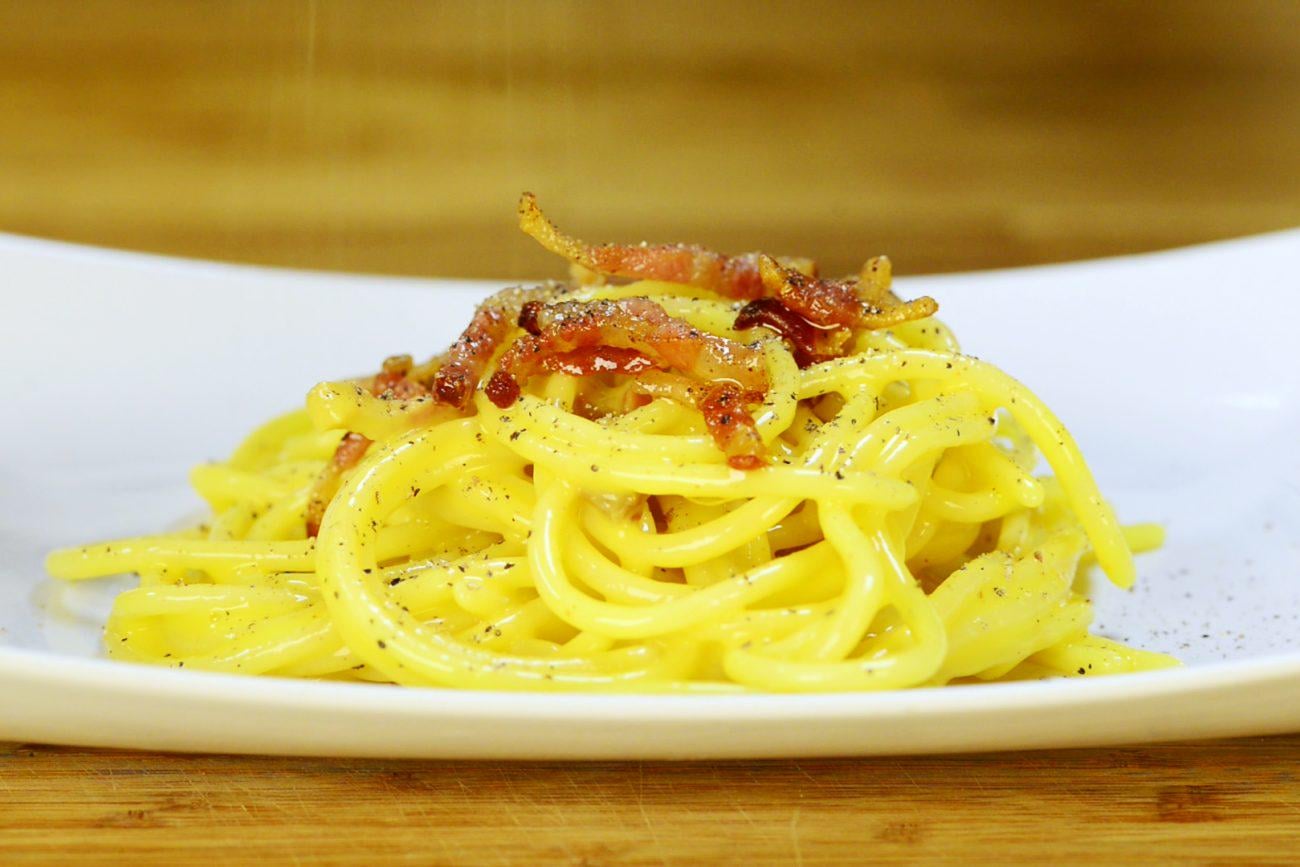
Let's keep it going. Here are some excerpts to Chapter 4. Please check the link for the full text (in Italian).
At the start of the new millennium, carbonara was completely different from the original 1950s recipe. By then, the replacement of guanciale and pecorino with pancetta and parmesan was practically complete. But for today's carbonara to emerge, something still had to happen.
As we saw in the previous chapter , the peak use of cream was recorded in the 1980s, disappearing in the 1990s with the final twists, when the recipe for carbonara was differentiated from that for carbonara with cream, as in Nuvoletti's 1996 recipe book. This marriage, which began in 1960, did not survive the advent of the new millennium.
The disappearance of cream has affected not only carbonara, but virtually all cuisine, with the exception of desserts, where its use has been scaled back. Generally, the thick, fatty, and overly sweet sauces that had reached their peak with scampi cocktails, fillets with green peppercorns, and pennette alla vodka are giving way to lighter, fresher sauces that enhance the flavor of the main ingredient. Sometimes they disappear entirely in favor of a single drizzle of oil (perhaps highly prized) in a cuisine that works by subtraction, but places enormous emphasis on the quality of raw materials. " More market, less cuisine " was the mantra of those years, which took shape in the fine dining industry and later spilled over into the kitchens of all Italians. If today you find fourteen types of salt, twenty-eight extra virgin olive oils, and bronze-drawn Senatore Cappelli durum wheat pasta dried in the shade for seventy-two hours and packaged by hand in the supermarket, you owe it (for better or worse) to that gastronomic revolution.
This shift in perspective has deep roots, and Gualtiero Marchesi is unanimously recognized for bringing a new approach to gastronomy to our country. Thanks to him, the French revolution of nouvelle cuisine took root in the Italian gastronomic landscape from the opening of his Milanese restaurant in 1977. This pioneered the so-called " New Italian Cuisine ," which prioritizes the quality of ingredients, technique , and presentation . It's a bit amusing to consider that the great chef's carbonara boasts the highest amount of cream in the entire Italian culinary landscape, but even if it may seem contradictory, his revolution has changed the way we conceive of fine dining. It goes without saying that the superstar chefs who invade our television screens today owe him something—a lot, in fact.
by Lubberworts
1 Comment
>…On the other hand, the trend that began in the 1980s, extolling the values of local tradition and authenticity, has led to a process of ” **purism** ” in preparation, effectively eliminating everything that doesn’t fit the triad of guanciale, pecorino, and egg. Anything that even slightly deviates from this (very new) orthodoxy is subjected to fierce criticism, and cream, unsurprisingly, has been the favorite target of the priests of this new gastronomic religion.
>The **”ideal” carbonara** sought by purists has obviously never existed, fragmented into a myriad of distinct recipes and marked by an evolution that has distorted its composition over the course of its half-century of existence. But as we know, when history fails to aid ideology, ideology gives history a nudge. The result is clear, and one need only browse cooking websites to find constant references to the **”real,” “authentic,” and “original” carbonara** , all based on a mythical idea of this dish that has no real historical basis.
>The logic is as simple as it is fanciful, and is based on a conception of the past as a fundamentally rural and autarchic economy. Carbonara, having originated in Rome, should have used exclusively the region’s typical products, namely pecorino cheese and guanciale (cured pork cheek). The most rigid proponents of this belief imagine humble and hard-working shepherds (or charcoal burners) leaving home with mess tins brimming with spaghetti topped with a few humble but wholesome ingredients, such as cheese from transhumance sheep, eggs collected still warm from the henhouse, and pigs slaughtered in December. In some cases, a dip in reality reawakens the idea that carbonara was born at the end of the war with powdered eggs and American bacon, but legend has it that immediately afterward, local specialties and nothing else were used, as if the postwar capital were an isolated medieval village.
>The invention of this tradition was accompanied by the emergence of an absolutely uncompromising attitude toward the recipe’s composition, bordering on intolerance, against anyone who dared propose an alternative version to the sacred triad. Pancetta and parmesan cheese not only disappeared from the plate, but also suffered a veritable *damnatio memoriae* , condemning them to oblivion even in the history of the recipe.