
Get Nebula with 40% off annual subscription with my link: https://go.nebula.tv/realtimehistory
Watch 16 Days in Berlin: https://nebula.tv/videos/16-days-in-berlin-01-prologue-the-beginning-of-the-end
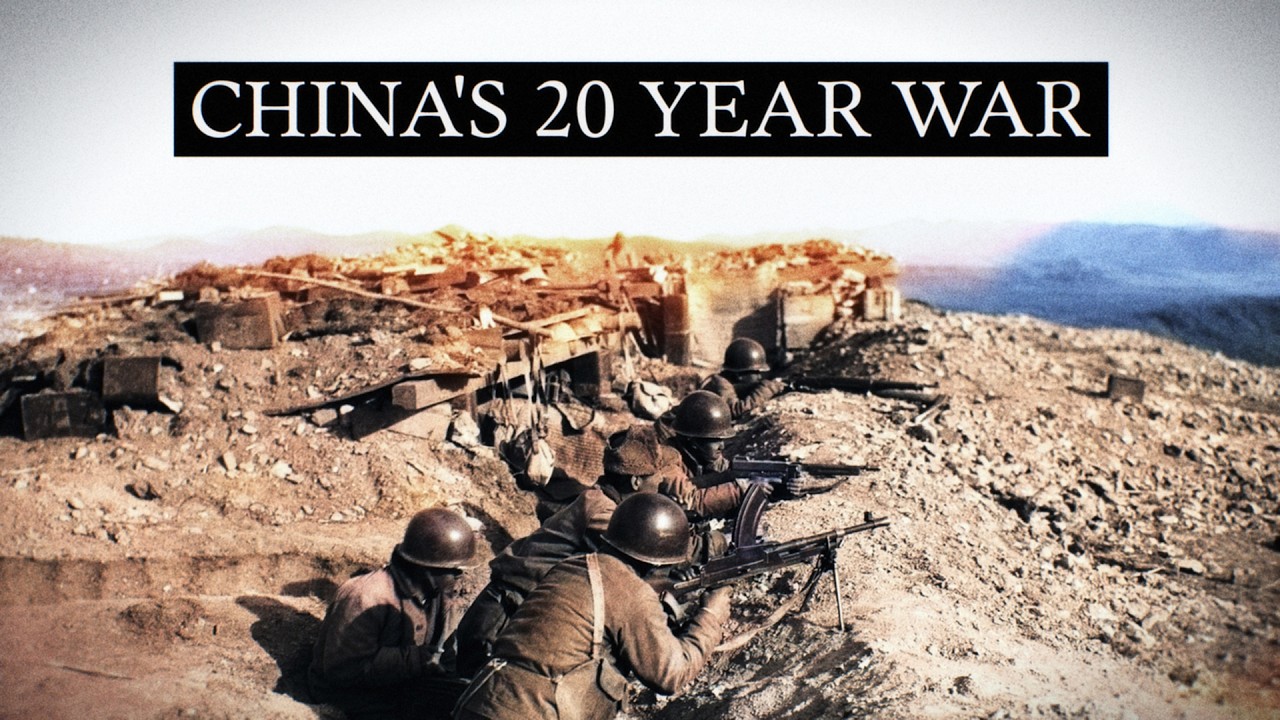
China was constantly at war from the late 1920s to the early 1950s, including becoming one of the largest fronts of the Second World War. The Japanese invasion and followed by the resumption of the Chinese Civil War between nationalists and communists would have huge global ramifications. But to understand how the wars for China began, we need to go a little further back to a time of great Chinese vulnerability.
» SUPPORT US
https://patreon.com/realtimehistory
https://nebula.tv/realtimehistory
CHAPTERS
00:00 Chinese Civil War 1927-1937
25:05 Japanese Invasion 1937
45:05 Battle of Wuhan 1938
01:07:44 Road to Pearl Harbor 1939-41
01:28:15 Chinese Front 1942-1943
01:49:43 2nd Sino-Japanese War 1944-1945
02:14:19 Chinese Civil War 1945-1949
» THANK YOU TO OUR CO-PRODUCERS
Rose Flaglor, Reed Spilmann, Jim Frame, Erik Ritter, Cardboard, Ken Brownfield, David Garfinkle, Raymond Martin, Konstantin Bredyuk, Lisa Anderson, Brad Durbin, Jeremy K Jones, Murray Godfrey, John Ozment, Stephen Parker, Mavrides, Kristina Colburn, Stefan Jackowski, Cardboard, William Kincade, William Wallace, Daniel L Garza, Chris Daley, Malcolm Swan, Christoph Wolf, Simen Røste, Jim F Barlow, Taylor Allen, Adam Smith, James Giliberto, Albert B. Knapp MD, Tobias Wildenblanck, Richard L Benkin, Marco Kuhnert, Matt Barnes, Ramon Rijkhoek, Jan, Scott Deederly, gsporie, Kekoa, Bruce G. Hearns, Hans Broberg, Fogeltje
» SELECT BIBLIOGRAPHY
Mitter, Rana. China’s War with Japan 1937-1945: The Struggle for Survival. Penguin, 2013.
Paine, Sarah C. M. The Wars for Asia, 1911-1949. Cambridge University Press, 2012.
Frank, Richard. Tower of Skulls: A History of the Asia-Pacific War: July 1937 – May 1942. W.W. Norton & Company, 2021.
Van de Ven, Hans. “Campaigns in China 1937-1945” in John Ferris and Evan Mawdsley, eds. The Cambridge HIstory of the Second World War, vol I: Fighting the War. Cambridge UP, 2015.
Dorn, Frank, The Sino-Japanese War: From Marco Polo Bridge to Pearl Harbor, 1937-41, (New York, NY : MacMillan Publishing Co., Inc, 1974)
Henshaw, Jonathan, Smith, Craig A. & Smith, Norman (eds), Translating the Occupation: The Japanese Invasion of China, 1931-45, (Vancouver : UBC Press, 2021)
Hsu Long-hsuen & Chang Ming-kai, History of The Sino-Japanese War (1937-1945), (Taipei : Chung Wu Publishing Co., 1971)
»CREDITS
Presented by: Jesse Alexander
Written by: Jesse Alexander, Mark Newton
Director: Toni Steller
Editing: Toni Steller, Philipp Appelt
Motion Design: Toni Steller
Mixing, Mastering & Sound Design: http://above-zero.com
Research by: Jesse Alexander, Mark Newton
Fact checking: Florian Wittig, Mark Newton
Executive Producer: Florian Wittig
Channel Design: Simon Buckmaster
Contains licensed material by getty images, picture alliance, and Reuters
Maps: MapTiler/OpenStreetMap Contributors & GEOlayers3
Music Library: Epidemic Sound
All photos and film in our documentaries are authentic historical footage. We do not use generative AI to create new assets. However, we may use AI tools to upscale or clean up certain assets without distorting or compromising the original image.
All rights reserved – Real Time History GmbH 2025
40 Comments
Get Nebula with 40% off annual subscription with my link: https://go.nebula.tv/realtimehistory
Watch 16 Days in Berlin: https://nebula.tv/videos/16-days-in-berlin-01-prologue-the-beginning-of-the-end
General Cash My Check is so good 😂😂😂
No one does videos like this on Youtube of such quality except you guys.
I wish you continued upwards momentum.
This is my favorite history show🎉
The Japanese put the Chinese on Death Ground. Once that happened, it was inevitable…
So refreshing after trying to watch some AI Bull s..t
Real time History upload means a good day to take a rest and grab some food while watching this Masterpiece documentary
When you see China now. We understand every drop of blood spilt in those Wars was worth it
YES! 3 hours!!!
I am addicted to these documentaries. Nothing else compares.
Hideki Tojo held só many full-time jobs at once! One could almost say he was the Marco Rubio of Imperial Japan
Almost three hours. Wow.
This channel is amazing please upload more stories
I'm riding my mountain bike in Southern California listening to this!
Many people say China was better before the CCP. I would highly disagree. My grandma was born in 1928 in southern China.
Incredible we get this quality for free. Thank you so much!
the japanese were in a bad part of their history. but moderate your contempt. this is humanity in action.
usa has its off-days too. research 'mylai.' the yanks would have you believe that was a one-off, but in fact it was standard operating procedure.
That long march is just insane looking at the map. Cannot comprehend the hopelessness and the vindication that followed after the war. Crazy.
Great work! Thank you guys!
Slight correction at 11:39, it was Hebei province not Hubei that was de-militarized under the terms of the Tanggu Truce. Hubei is much further to the south, next to Sichuan province.
Pronunciation of Chinese names is great as usual though.
Superpower is a strong word for what China is let's be honest
WDF
Love learning about Chinese history
W
again… mostly are real and truth, but there are some false and inaccurate bullshit inside….
Best time to chill and watch, nothing better😅🎉
And now you know we dropped those nukes on Japan
Ch*na is not a superpower
This is by far the most compelling documentary on the Chinese Civil War, which began in the early 1920s and concluded in late 1949. It vividly portrays both the early successes and the ultimate downfall of the Kuomintang government under Chiang Kai-shek.
The film highlights how, despite U.S. backing, Chiang spent his entire reign fighting the communists—ironically, the very group that had once supported him against the warlords. Rather than embracing this alliance, he turned on them, orchestrating brutal massacres by the thousands and relentlessly seeking their destruction. Yet, despite all his efforts, they ultimately triumphed over him.
Looking back, one cannot help but wonder: how might China have evolved if Chiang had chosen to keep the communists in his government and pursued the sweeping reforms the country so desperately needed?
China’s Civil War and the Japanese invasion between 1927 and 1949 was one of the most turbulent and transformative periods in modern Chinese history. The nation was torn between the Nationalists and Communists, all while facing the devastating Japanese invasion that caused immense suffering and destruction. This struggle not only shaped China’s eventual path under Communist rule but also highlighted the resilience of its people in the face of foreign aggression and internal conflict. A truly pivotal chapter that determined the course of East Asian and world history.
27:57 that’s so deranged
I wish I could someday find out which soundtracks youre using.
Global? They are a regional power with global aspersions! Careful they do not choke on them
Watching this and thinking about how how China got to where it is now has blown my mind and given me a new found appreciation for Mao
Thanks for sharing 👍👍👍
a century ago all of sub-saharan africa had a more optimistic economic development future than mainland east asia
Thank you for another excellent, educational video. The death tolls in some of these Chinese wars are mind-bogglingly catastrophic. Hopefully, we won't have to see such terrible, bloody wars again.
God be with you out there, everybody. ✝️
Thank you!
Thank you!
Thanks for producing and making available one of the least covered and longest campaigns of the 20th century to the English speaking audience. I myself can't read much Chinese, but my grandfather was on the losing KMT side in one of the artillery units and survived the war…his spirits broken. He was one of the luckier ones who escaped to Hong Kong soon after 1949. Much of his extended family decided to escape later when the hardships of Mao's Cultural Revolution came in the 1960's.