
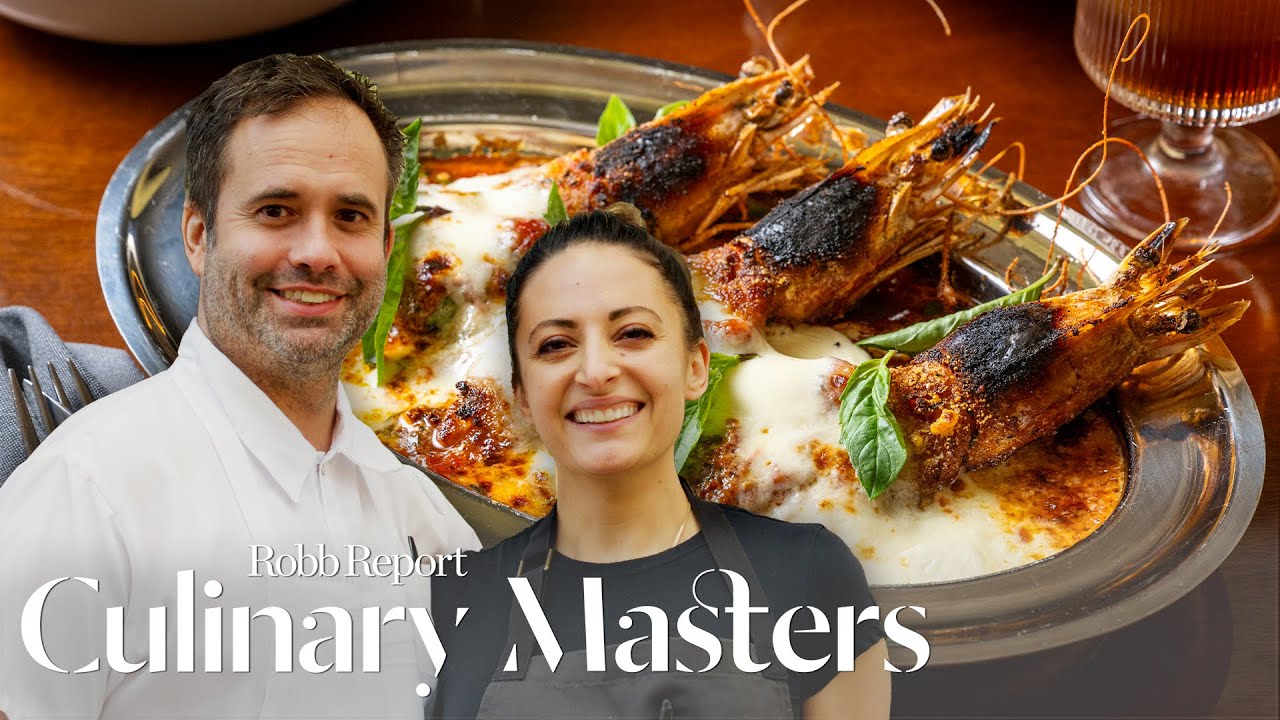
Chefs Angie Rito and Scott Tacinelli have created one of New York’s toughest tables with their West Village hit Don Angie. For the new San Sabino, it looks like there’s no sophomore slump in the offing for the husband-wife duo.
Opening next door to Don Angie, San Sabino is a continuation of the chef making an ode to the Italian America food they ate growing up, which for Tacinelli was in New Jersey and Rito in Ohio. But what differentiates this new restaurant is a focus on seafood, as well as coastal American cities where there’s an Italian diaspora such as San Francisco and New Orleans.
An early winner on their new menu is a shrimp parm that is more nostalgic for Tacinelli than Rito, as Angie admits to having never heard of shrimp parm growing up in Cleveland. In this latest episode of Culinary Masters, the duo show how they make their take on a northeast classic, but then also show how they make some key changes that make it distinctly their own—from Thai basil to a sweet and spicy arrabbiata that’s punchier and more dynamic than the marinara you might be used to. It’s an excellent dish and reason enough to go to San Sabino—that is, if you can secure a table.
Check more of Robb Report Here:
Subscribe: https://www.youtube.com/channel/UCad9XfyHa3dikbSSLyOiguQ
Website: https://robbreport.com
Instagram: https://www.instagram.com/robbreport/
Twitter: https://twitter.com/RobbReport
Facebook: https://www.facebook.com/robbreport/
Don’t miss the food event of the year. Register for Robb Report’s Culinary Masters now https://robbreport.swoogo.com/culinarymasters2024. Or, for more information on Robb Report experiences, visit RR1.
Scott Tacinelli and Angie Rito of the new San Sabino
in the West Village, thank you so much for having
me. Thanks for coming in. So what are we going
to be making together today? So today we’re
going to make shrimp parm. Just like my grandma
made. Did your grandma make shrimp parm? That’s what
I was going to ask you Angie, did you have
shrimp parm growing up? I absolutely did not.
I’m from the Midwest, so this is the phenomenon
I wasn’t familiar with until I moved to the East Coast.
I’m guessing when you were getting this
growing up you did not have beautiful shrimp
like this, can you talk a little bit about these? Yes, so
these are u5 head-on shrimp. So u5 means there’s
approximately five shrimp to a pound okay, so
that could range you know anywhere from from to
six or something like that. So they’re almost
a quarter of a pound each. Jeez. When you use these really
big shrimp and we butterfly them from the back,
and then we’ll we’ll bread them, we stick them
with like a little stick so they stay straight
when we cook them. They take on like a real meaty
texture because there is so much meat. How do you
get started with like the breading here? Yeah, so
it’s pretty much a typical breading process. So we
actually season them with like a garlic salt
first—so it’s just granulated garlic and kosher
salt—and then we carefully just dip it in flour
and then we just shake it off. Because you just want
one thin layer of flour, you don’t want it to be
caked on. Kind of like that. And then just in
just an egg wash there. Just an egg wash, yes.
Very, very traditional breading. We actually make
our own breading and we dry all of our own herbs
for the breading that’s one thing we’ve been
doing for a long time because it really makes
a difference—Angie’s grandmother taught her that. And you’re saying like in the breading here there’s
like a little bit of did you say rice that was
like crunched up in here? It’s rice that’s been
cooked and then dehydrated and we pulverize. It
sounds kind of crazy, but it does add like a
crispy texture to it that it doesn’t get soft
when you add the the sauce and the cheese and
everything else it kind of still kind of like
holds its own. With San Sabino, is it like much
more seafood focused than like what people
expected Don Angie? Yeah, so this restaurant
overall it’s it’s very much our same style
that we have at Don Angie which is like our
sort of take on Italian American cuisine, but
leaning more toward the seafood. We kind of have
a few nods to like American coastal cities that
that happen to have like large Italian immigrant
communities: New Orleans or San Francisco. After
we’re done breading it, we take each shrimp and
put them on a skewer, a bamboo skewer, and we push it all the way on all the way up into the head.
Yeah, shrimp when you when you cook it, it like
retracts so this keeps it nice and straight. Then
what’s the next step in the process? So then
we’re going to deep fry the whole thing. Okay, yeah
and the head and everything. About how long do
you let that go in the prior there so till it’s
golden brown, um like lightly golden brown, which
is like, honestly, about 45 seconds. So it’s a
pretty quick process. Once it’s like golden brown
here it’s going to be like ever so slightly under
inside but then once you add the cheese and the
sauce and you put it in the salamander it goes in
there for like you know one and a half, two minutes, it it’ll be like perfectly cooked through out.
Angie, you were saying like like these
bread crumbs are like nostalgic to you? Yeah,
I mean it’s like reminds me of my grandma, you
know, she always had like a big batch of like
homemade breadcrumbs that she made with bread that she dried out herself, herbs that she
dried out herself. My grandma would have
the same kind of it’s always in like the
breadcrumbs were always in the cabinet in like
some like repurposed plastic container that was
like an old like ricotta cheese container or
something. I was going to say that. That they’ve had for like 20
years, you know what I’m talking about? Yeah. Because they
didn’t ever buy like an actual container for
it, it was just repurpose there’s anything you
got for free. So you’re talking about like your
grandparents, were they just both like a big
inspiration for you to get into cooking in
the first place? I mean this restaurant is named
after Scott’s grandfather, I don’t know if you
want to speak to that. Oh, wow, okay. Yeah, so well
my grandfather is—well, his father—was from the
town of Sansa which is in Salerno. Well, the patron
saint of the town was Saint Sabino a lot of the men
on the town were named Sabino my grandfather’s
birthday was also on the feast day of Saint Sabino
which was— His name is was Sabino. Sabino, yeah, so that was the inspiration behind the name of the
restaurant. So you’re just finishing the last
one up pulling it from the oil. Yep, going to dump
it out. You get it onto some paper to kind of
take a little bit of the—to absorb some of the
oil. But it is really crispy. And then we’re just
going to carefully pull out the sticks that
we put in and then this is the fun part—
assembling it. So we make a tomato sauce here
at the restaurant that is—we call it like a spicy
arrabbiata sauce. It has a lot of sliced garlic in it
as well as a little bit of rice wine vinegar.
Okay. And it’s the San Marzano tomatoes that
we use we use a little bit of extra olive
oil in a too and a lot of caban chilies and
then Angie just added a little bit of chopped
Thai basil, which almost has like a little bit
of like a licorice-y kind of taste to it, but it
goes really good with the rice wine vinegar and
stuff. Why use the a Thai basil instead of just
like a traditional basil. I think the flavor of
traditional basil is a little more delicate, like
this is like a super punchy, intense sauce and I
think this basil is like a little more intense
than a typical like Italian basil so it just
plays well with all the ingredients. You can see
all the sliced garlic that’s in it. Yeah that’s beautiful.
So then we’re going to place the shrimp in
and it’s cool because they kind of are flat now.
Then you do like a last little— We do we don’t
put it over the entire thing, we just kind of put
it on the middle of the shrimp, this way when you
put the cheese and everything on it and it broils
in the oven, you get like crispy like ends of
the shrimp and stuff like that. So this is
stracchino cheese. It’s not mozzarella cheese it’s
um that typically what you would see on this
type of thing this is like a soft cows milk
cheese and it’s really, really tangy
and it melts really nice, like a really not
funky brie or something like that, right, maybe?
It’s super creamy, tangy, it’s really delicate.
And then we’re going to do a very generous
sprinkle of 24-month Parmigiano Reggiano, as well as
Pecorino Toscano like 120-day Pecorino Toscano.
Not Pecorino Romano, Pecorino Romano is great cheese
it’s just very, very salty. This is not nearly as
salty. It’s more earthy. So we’re going to take it
into the kitchen and put it under the salamander.
Awesome.
It’s going to go in for
about a minute to a minute and a half.
Yeah I think it’s good.
So these are just—just came out of the the
broiler, just like a quick like blast to really get
it melty. Yeah, so we finish it with a little bit of
fresh lemon juice just to kind of cut through any
of the fat and stuff, but also, you know, seafood
and lemon is kind of like a match. So it goes
really well with the shrimp. And then a little bit
of just Thai basil. Those—and you can see like the
nice like char on the head that it’s got now. Yep
and that’s it. Yeah that’s it. Now we eat it.
There’s like a little bit of like sweetness
to the arrabbiata that’s like really really nice.
We call it like sweet and sour because it has
like that rice vinegar in there but then we
also like sweeten it up—it’s like a little
more punchy and like interesting than just
like a plain old marinara sauce. I love like that
sweetness to it and then also just that little
bit of heat you get on the back end from the
Calabrian chilies, it’s like super nice. So my
father’s mother was from Naples and amazing cook,
like the best cook I’ve ever met in my life, but
a purist in like an Italian sense
and I would tell her about some of
the flavor combinations and ingredients we were
using at the restaurant and she was just like, "No,
you can’t do that like that’s not allowed!" You
know, she couldn’t she couldn’t understand
the you know the amount of rule breaking
we do here. But when it’s this
good it doesn’t matter so it’s like go
ahead break the rules, it’s great. We’re just
yeah, we’re cooking Italian American cuisine,
you know. We’re not saying this is Italian Italian
cuisine. Well, thank you guys so much
it’s great. Thank you. Thanks for coming in.
8 Comments
That was very good. I plan to bookmark both restaurants and score a reservation when in New York.
🦐+🥫+🧀
The dish is like an Italian that got lost in Thailand on a trip and fall in love with the spicy 🌶
Love the cookbook from DonAngie..
Absolutely disgusting!
Was there for dinner over the weekend – incredible food!
Can't wait to visit and try this dish!
don angie gang 💪🏼💪🏼