
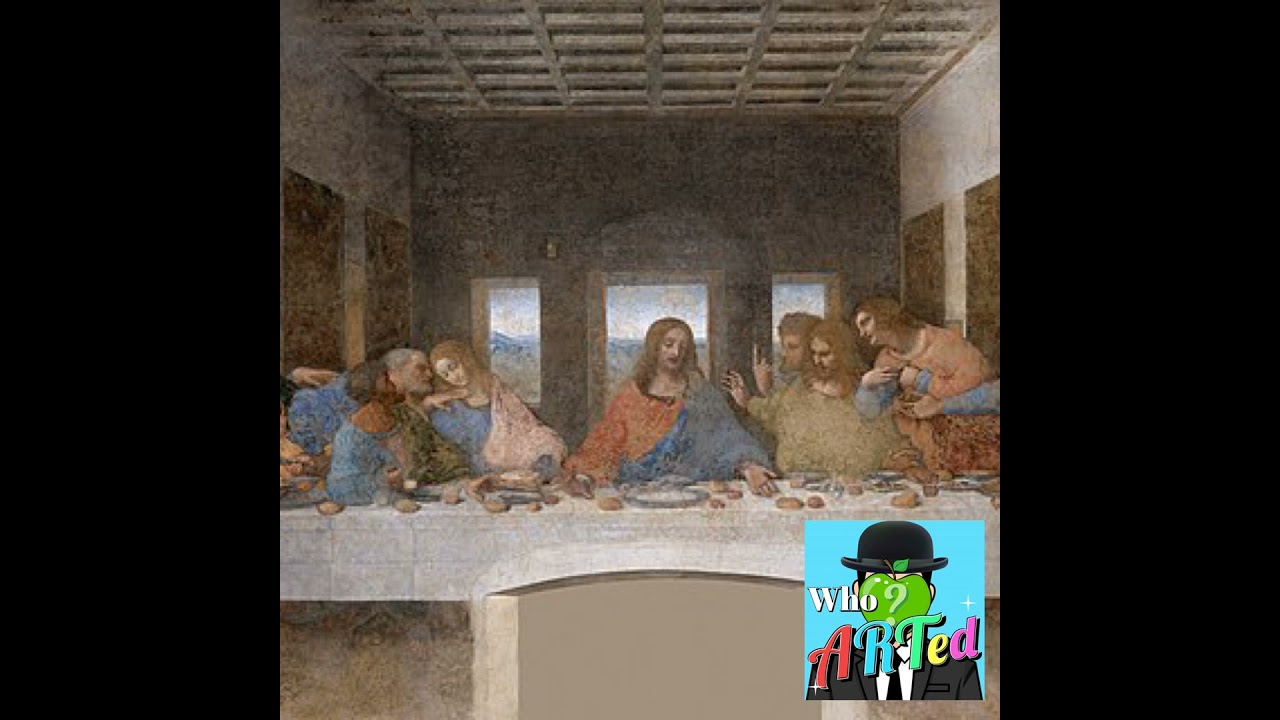
One Leonardo da Vinci’s most famous works is not housed in a museum. It is in the Convent of Santa Maria in Milan Italy. It seems totally fitting for a depiction of the last supper was painted on the wall in the convent’s dining hall. Visitors today are often surprised by how enormous the work it. The People are life sized on this massive 15 by 29 foot painting. Another surprising fact is that while people flock to see Leonardo’s work on the wall of the convent, very little if any of what we see there today was actually painted by Leonardo.
Who ARTed is an Airwave Media (http://www.airwavemedia.com) Podcast.
Connect with me:
Website (https://www.whoartedpodcast.com) | Twitter (http://twitter.com/whoartedpodcast) | Instagram (http://instagram.com/whoartedpodcast) | Tiktok (https://www.tiktok.com/@whoartedpodcast?is_from_webapp=1&sender_device=pc)
Support the show:
Merch from TeePublic (https://www.teepublic.com/user/who-arted) | Buy me a coffee (https://ko-fi.com/whoarted)
As always you can find images of the work being discussed at www.WhoARTedPodcast.com (http://www.whoartedpodcast.com/) and of course, please leave a rating or review on your favorite podcast app. You might hear it read out on the show.
Learn more about your ad choices. Visit megaphone.fm/adchoices (https://megaphone.fm/adchoices)
You’re listening to an airwave media podcast one of Leonardo da Vinci’s most famous works is not housed in a museum it’s in the convent of Santa Maria in Milan Italy it seems totally fitting that a depiction of the last supper was painted on the wall in the convent’s
Dining hall visitors today are often surprised by how enormous the work is the people are life-sized on this massive 15x 29 ft painting another surprising fact is that while people flock to see Leonardo’s work on the wall of the convent very little if any of what we
See there today was actually painted by Leonardo da Vinci feel like who art Ed try who arst Mr wood art me either way it works so many that a great start welcome to who arted where we explore Visual Arts in an audio medium I’m your host Kyle Wood and and for this week’s
Funf fact Friday mini episode we’re going to be focusing on Leonardo da Vinci’s Last Supper Da Vinci’s Last Supper painting is well known throughout the world and referenced in numerous works of popular culture including the famous novel turned movie The Da Vinci Code as with anything famous there seems
To be a number of incredible theories popping up directly proportionate to its Fame well there may not be a global conspiracy there is some symbolism in the work but we can get into that later first let’s talk about how it was made Leonardo da Vinci painted the Last Supper from 1495 to
1498 while many people think it’s a fresco Leonardo didn’t work that fast frescos are painted in wet plaster and they must be completed before the plaster sets Leonardo da Vinci was well known for taking a long time to complete his work this one took 3 years and that was
Relatively quick for him some would say he may have had ADHD and while we cannot diagnose him 500 years later we do know that he tended to procrastinate he moved from Project to project as different ideas captured his attention and he struggled to finish his work his slow
Process meant that Leonardo could not really work in that wet plaster which would permanently seal the pigment into the wall instead the scientifically minded artist decided to experiment he used tempera and oil paint layered on the surface and sadly this experiment was a bit of a failure while it no doubt
Looked brilliant when it was created Leonardo’s painting began to flake Off the Wall within a few years for centuries there were heavy-handed Restorations damage due to flooding mold even a bomb hitting the building during World War II while the painting itself wasn’t hit the roof was partially blown off and while
Outdoor dining may be delightful when the weather cooperates it’s not ideal for the Last Supper an intensive 20-year restoration was completed in 1999 and while they did tremendous work removing layers of grime and bringing out a lot of the details that were previously not seen it was controversial
As little of Leonardo’s brush work remains at this point I would say that the value of the artwork is not in whose hand held the brush but the way the work resonates with the viewer so I’m personally all for any restoration efforts that help us to see the image
Better now with that history behind us let’s consider what we see in the Last Supper The Last Supper is a depiction of the story of Jesus meeting with his Apostles just before the crucifixion or I guess just before he was captured by the Romans put on trial and then
Crucified Jesus is the central figure surrounded by his disciples who are all at the table as he tells them that he knows someone there has betrayed him it’s a high drama moment played out beautifully in an age before film or reality television pictures were the only means of bringing these stories to
Life I’ve always heard people talk about how literacy rates were low back in the day and the church would commission artists to illustrate these important biblical stories as a means of educating people but it’s kind of hard to imagine anyone in the convent sitting there having their lunch then looking up at
The painting and having that sort of moment of realization like oh that’s what I’ve dedicated my life to I suppose maybe it served as a reminder keeping the the Bible sort of front of mind at all times but I also think some level the symbolism embedded
In the work is more to reach those already well-versed in the story The thoughtful depiction of each figure signals that Leonardo was a clever man and it makes the audience feel clever for understanding the references so now let’s get into some of those references first of all Jesus as I said
Was the central figure in this which obviously would make sense the new New Testament really is all about the life of Jesus and his teachings and so it would it would make sense for him to be literally Central in this picture Leonardo da Vinci actually hammered a
Nail into the wall and tied a string to it to capture the linear perspective and create a realistic sense of depth in the piece when you look at it it feels as if you could walk right into that space and Jesus is the central figure right over
The vanishing point so all of those guidelines in the linear perspective serve to lead the viewer’s eye right to him Thomas is standing to Jesus’s right with an index finger pointed upward people debate the intention of this some people say he’s pointing up towards the heavens um maybe it’s gesturing sort of
Talking with his hands but a lot of people look at this as sort of an Easter egg for those in the know Thomas was the figure who was said to have needed to probe Jesus’s wounds to confirm his identity so that finger up in the air is
Sort of referencing the finger that he put into the holes in the resurrected Jesus to confirm that it was in fact him coming back from the dead another interesting bit of symbolism we see is with Judas now Judas was the figure who betrayed Jesus giving him up to the
Romans and we we see he appears to have a little a sack maybe the the pieces of silver that he collected as a bounty but also we see he spilled the salt and spilling the salt is sort of a a reference that actually works on two levels the symbolism some people would
Would point out spilling salt as a an omen of bad luck and that could be signifying judas’s bad luck for being the one who has to have that infamy and has to carry out that role as the betrayer but also there is a neere Eastern expression betraying the salt
And that is meant to be betraying uh one’s master and so like I said the spilled salt is a symbol doing sort of double duty within this depiction now while Leonardo da Vinci’s painting of The Last Supper is is sadly faded quite significantly over time we
Do have some nice Clues as to what it looked like in its original form mostly because there are older works that are oil on canvas painted by other artists like Andrea Solari um who painted his version of leonardis work in 1520 and there are newer interpretations made by modern and contemporary artists
Like Salvador Del and Andy Warhol there was even an artist Vic munes who made his out of chocolate syrup so I guess that was sort of a last supper and dessert pretty sweet this concludes this week’s episode of who arted part of the airwave media podcast network if you found this tolerable
Please leave a rating review on your favorite podcast app you can find images of the work being discussed this week and every week on social media at who arted podcast on Twitter Instagram and Tik Tok and of course on the website Who EDP podcast.com podcast done