
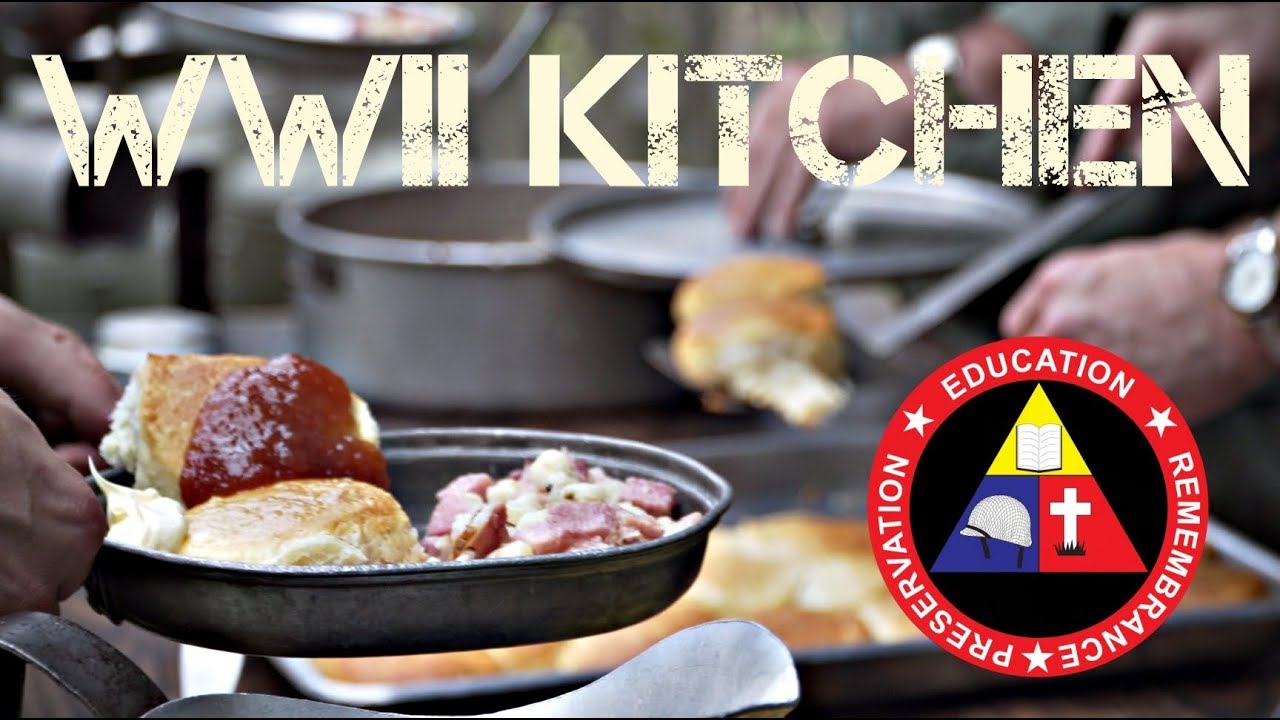
The GI Field Kitchen during WWII was part of the Company HQ, designed to serve 150-180 men. They intended to serve 2 hot meals per day: Breakfast & Supper, with Dinner (Lunch) as a combat ration. They were equipped with stoves, water heaters and mermite cans to deliver the hot food to the troops.
While sound in theory, often times in reality the kitchens had to make do with less equipment and were forced to adapt to the situations in which they were forced to operate. Despite this, mess staff did their best to keep the fighting man’s body and morale fed.
Filmed at Rockford WWII Days 2018
Special thanks to Nick Yi Photography: https://www.nickyi.com/
Facebook: https://www.facebook.com/TriStateLivingHistoryAssociation/
Website: https://www.tslha.org/
Donation info. https://support.google.com/youtube/?p=donate_FAQ
Print Sources:
TM 10-405 (Apr 24, 1942) – The Army Cook
TM 10-406 (Nov 22, 1943) – Cooking Dehydrated Foods
TM 10-400 (Nov, 1944) – Stoves, Ranges, Ovens, and Cooking Outfits
TM 10-701 (Dec, 1945) – Range, Field M-1937
T/O 7-17 (Sept 1, 1942): http://www.hardscrabblefarm.com/ww2/
Footage Sources:
The Battle of San Pietro – John Huston (1945)
TF 10-1237 – Rations in the Combat Zone Part 1 – Fighting Food
TF 10-1215 – Rations in the Combat Zone Part 2 – Unit Messing
TF 10-2454 – Unit Messing in the Field
TF 10-1202 – Baking in the Field Part 1 – The M1942 Field Baking Unit
MISC 1282 – Quartermaster Activities in the European Theater
Picture Sources:
185th Field Artillery, 34th ID from the H. Smith collection: http://34thinfantry.com/photos.html#
This is a world war two filled kitchen it is a company sized mess in other words it is designed to serve 150 to 180 men the field kitchen was actually part of the company organization part of the company headquarters although in reality it was more often put together with the
Next headquarters level the battalion level in other words you would have three of these kitchens operating together the reason being is that most company headquarters were simply too close to the front for the safe operation of the kitchen it also made it easier for supply it was easier to get
The trucks with the food the water and so forth to the kitchen so that they could prepare it and it really didn’t impact their efficiency at all because they could still take it forward when they needed to the heart of the operation would be the EM 1937 range
Stove with an M in 1937 range stove which is powered by gasoline you could cook anything that did not require refrigeration you can do roasts you can bake you can do pies pancakes bacon anything that you can do in a modern kitchen you can do on one of these range
Stoves now the food that was prepared tended to be fairly straightforward remember you are preparing for a large number of people the other limiting factor was the food that was available virtually all of the food that was served in these field kitchens had to be shipped from the United States which
Meant for the most part it was either dehydrated or canned the cooks were intended to serve two meals a day supper after dark breakfast before daylight if you’re in daylight you’re visible you become a prime target for artillery hrus dinner or it as the army called it we’d
Call it lunch was actually supposed to be one of the combat rations either a K or a C and this plan of serving two hot meals a day and one cold meal a day actually worked out more often than most people unfortunately it never worked out as
Well as Laura’s often as most people would prefer and in fact there are and were times when troops spent days sometimes weeks at a time eating nothing but combat rations and unfortunately those are also the stories you hear most about now the field kitchens serve a number of purposes one it’s not just
Nutrition keeping soldiers healthy keeping them fit for combat it was also a very important morale thing if you’ve ever spent any time living outside you realize just how important and how good a hot meal makes you feel when you get one now once the food is prepared you
Have to get it through the troops in the front how you keep it hot your use of myrrh might cans the myrrh might can is essentially a five gallon thermos you can either put the food directly into the myrrh might can or each one will take three inserts you can put the food
In load them up and it will keep the food hot for several hours you would then load it into a truck take it forward as close to the line as you could get unload set up and then you would pull the troops a few at a time off of the
Line if it was very quiet the cooks could actually go from position to position to do feed troops although that did not happen very often while every soldier was issued a mess kit in combat most of them did not carry a mess kit for a variety of reasons one is just one
More thing you have to carry too they do rattle they do make noise and can give away your position third and perhaps most important is that there’s no adequate cleaning facilities on the frontline so it becomes a health and safety issue in practice the cooks would bring the mess kits forward with the
Food serve the troops recollect the mess kits take them back and clean them up as part of their kitchen cleanup you’re going to need to hot water and lots of it the way you do that is with the immersion heaters the immersion heater is essentially a 30 gallon garbage can
With a gasoline-powered here with that heater you can basically boil water in one of those trash cans in about 25 30 minutes now obviously there’s two things the kitchen needs besides food you’re going to need gasoline you are going to need water now most kitchens had a water trailer that
They could haul or if they did not have that they had a cargo trailer that when you would load the gasoline water in five-gallon cans and that would also be typically where you carried your food now this is sort of an ideal setup for a field kitchen not every field kitchen
Looked like this number one while you were issued three range stoves three immersion heaters as many more mites as you needed in reality some kitchens operated with fewer grace toast some operated with more some had more immersion heaters some had less they wouldn’t necessarily set up under the
Fly they set up in a building a barn any place they could find shelter in many cases it was possible to take the three range stove line them up in the back of a two and a half ton truck permanently attached them and have a mobile kitchen
So the field kitchen tended to vary with the circumstances and the situation and the needs of the cooks in the unit at the time
50 Comments
seeing that much stainless steel utensils, purpose built equipment, and "make it work" mentality makes me really really nostalgic for my boy scout days ^_^
0:14
Can someone identify what that is? Looks like bacon with corn? Would love to recreate this because it looks so good.
ITS A TOWING FIELD KITCHEN FOR EVERYONE NOT JUST FOR MILITARS.
This Video makes me hungry.
They should draft Ronald McDonald
WWII Field kitchen? You mean currently still in service just with different food?
Those devices at 3:59 were still being used when I went through boot camp in 1990!
i hope they weren't using leaded gasoline in these during ww2…
Nice to know that we (US) stuff built in the 1930's was designed so well that it's still part of the TO&E fifty years later. Remembered fondly from my time in the 101st in the '80s.
Хороший солдат – сытый солдат
Mm, what were you guys cooking at the beginning, I wanna make that myself!
Our kitchen looked just like this in the army in 1977, So did the lunch kit. Not sure what they do now.
Did they use a field manual book for the recipes?
Army cooks are all the hardest working, most dedicated, and bravest soldiers I knew in my 21 years as a combat medic!!
Not all heroes shoot rifles. Some heroes feed the the heroes shooting the bad guy.
WW2 looks better what they serve us today lol true red aka people behind the lines who are better vs us who was the front lines. But people who was in the Rear cry the loudest
Now we’re really cooking with gas 😂
I've always known my grandfather was a cook for his unit somewhere in France but had no idea what that meant. Recently I have been researching his unit. One of the separation documents I have states he was "…first cook" "supervising 8-23 cooks and helpers", and "cut meat and did baking" during WWII but he passed away when I was about 9 and I never heard any stories. I've been doing my own research. He was in the 1308th Engineer Regiment and left for overseas heading to France in May 1944 and returning home in May 1945. I have photos and a few letters but would love to find some kind of documentation on the movements of his unit, like they have for the Civil War Battles. I have recently discovered his unit was involved in building Bailey Bridges but I don't know where. Finding this YouTube video was like opening a Christmas present. Thank you.
Korean war field kitchens weren't all that different.
The same sort of field kitchen the AACC was still using well into the 90's 😆😆 love the choofers
For a soldier to fight a soldier need to eat
Things haven't changed much
6 minutes only???
Goddamn.. So much fantastic information in short amount of time.
Loved it.
I never realized why my grandparents always ate so much homony and eggs and now I see why
Not mentioned about the distance from the front, but wouldn't the smell of the cooking food also give them away if they were too near the Front?
Looks good to me! I was in NATO exercises during the Cold War in West Germany. They gave us first generation MREs at the time. Not exactly great food! One was some type of Biscuit and gravy that turned into something like dog food. Always could eat the cheese and crackers though! Other than that I starved. Great way to lose weight.
Nice video. My Combat Engineer unit used this into the late 1980’s & my Military Police HQ units had cooks assigned until the late 1990’s
The hot food was always in the rear with the the gear and the trash. hardly did the fighting troops eat hot food. you never saw a skinny clerk or general!
I can’t stress how important quality food is to Servicemen. Even in 2023 it’s demoralising to have a bad day only for the military to serve you utter garbage you wouldn’t feed to a dog. To anyone in the UK military… pay as you dine (privatised catering contracts ) needs to go, the contractors are not fit for purpose.
I went into the Army in 1975, this equipment was basically what we used in the field.
In this video he talks about field kitchens in the ARMY field operations, and I did that during Vietnam, so let's talk, VIETNAM VETERAN, we gave them c rations,don't believe me ask your father i know because I was there now they have mres different, but I know what they are, DOD doesn't play games, protect the troops
Hell I know OEF/Afghanistan is far away from WW2 but still I'd eat foot bread or Naan with beef before I'd eat an MRE
I bet they cant make 60sec rice in 58 sec like my boi
you can never doubt the importance of hot chow
What is the meal they’re preparing? It looks like they’re frying hominy and ham on a flat top, I’ve never tried frying hominy
Really interesting. Thanks for sharing ❤.
Many an eyebrow or moustache has fallen victim to the venerable immersion heater…
Thank you for the video.
This is the true American dream and true American food fuel
The amount of times I have watched this is unhealthy
And now people are wondering about their genders. Great.
What were they serving in the opening scene? It looks pretty good actually
thank god for spam
it never stops amazing me how the fighting seems like so little of actual war activities. logistics, feeding, driving, moving troops and materials, clothing, hiking from place to place…that seems like the majority of the activity, while the actual fighting seems rather sporadic.
it's so strange. maybe being there was a different experience.
5:27 wow, is that Colonel Potter from MASH wearing Radar's hat? 😀
Not enough about what they ate
The stoves being fueled with gasoline is pretty funny to me, because even in the modern day the Finnish Defence Force uses wood-fired equipment in their field kitchens 😀
This was fascinating
would love to see more recipes that would be cooked in a field kitchen
Long as i have 1 good big breakfast. I'am good for all day. But it has to have MEAT. Like Steak, Brisket, Ham, Pork Chop, Bacon👉👉 some thing like that. No oatmeal, French Toast, Pan Cake.. Light things like that. With in 2 hours i would be hungry again 🙄🙄