
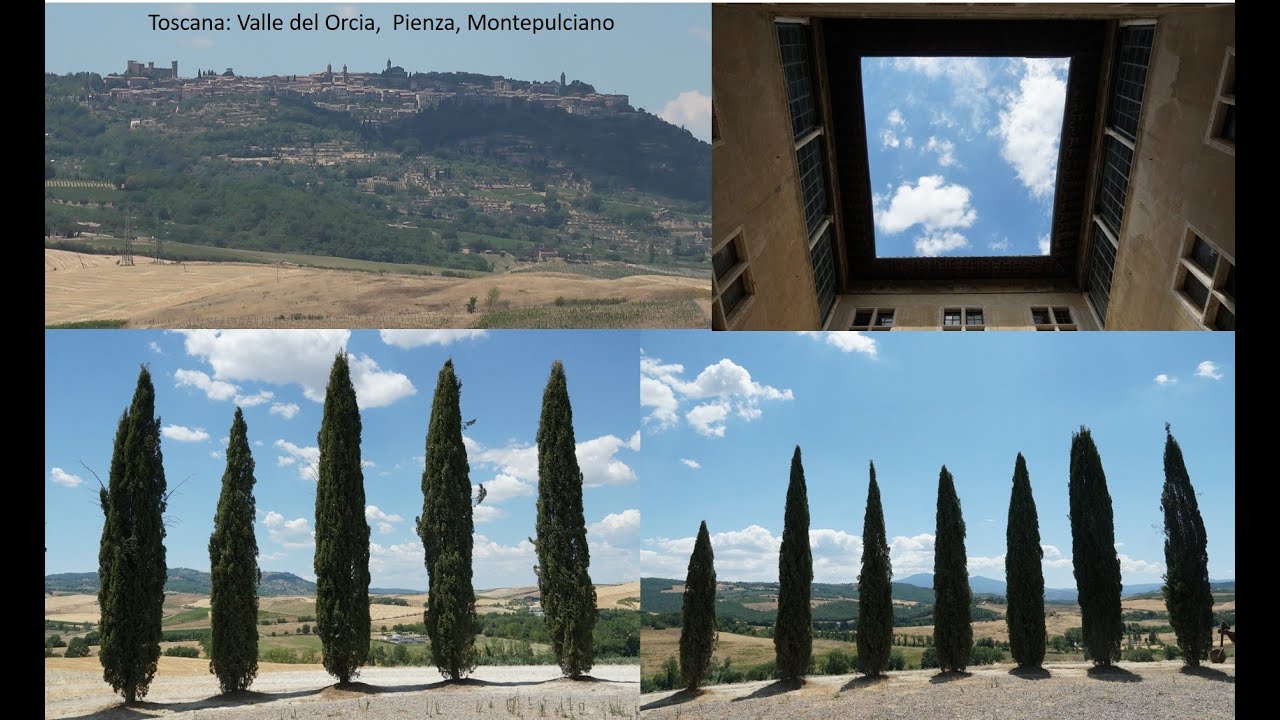
The Val d’Orcia or Valdorcia (Italian pronunciation: [ˌvalˈdortʃa]) is a region of Tuscany, central Italy, which extends from the hills south of Siena to Monte Amiata. Its gentle, cultivated hills are occasionally broken by gullies and by picturesque towns and villages such as Pienza (rebuilt as an “ideal town” in the 15th century under the patronage of Pope Pius II), Radicofani (home to the notorious brigand-hero Ghino di Tacco) and Montalcino (the Brunello di Montalcino is counted among the most prestigious of Italian wines). Its landscape has been depicted in works of art from Renaissance painting to modern photography. The Val d’Orcia was added to the UNESCO list of World Heritage Sites in 2004.
Pienza (Italian pronunciation: [piˈɛntsa]) is a town and comune in the province of Siena, Tuscany, in the historical region of Val d’Orcia. Situated between the towns of Montepulciano and Montalcino, it is considered the “touchstone of Renaissance urbanism”.
In 1996, UNESCO declared Pineza a World Heritage Site, and in 2004 the entire valley, the Val d’Orcia, was included on the list of UNESCO’s World Cultural Landscapes.
Before the village was renamed Pienza its name was Corsignano. It is first mentioned in documents from the 9th century. Around 1300 parts of the village became property of the Piccolomini family. After Enghelberto d’Ugo Piccolomini had received the fief of Montertari in Val d’Orcia from the emperor Frederick II in 1220. In the 13th century Franciscans settled down in Corsignano.In 1405 Aeneas Silvius Piccolomini (Italian: Enea Silvio Piccolomini) was born in Corsignano, a Renaissance humanist born into an exiled Sienese family, who later became Pope Pius II. Once he became Pope, Piccolomini had the entire village rebuilt as an ideal Renaissance town and renamed it Pienza (“city of Pius”). Intended as a retreat from Rome, it represents the first application of humanist urban planning concepts, creating an impetus for planning that was adopted in other Italian towns and cities and eventually spread to other European centers.
Overall, we visited 27 world UNESCO Heritage sites in about 28 days in Italy in July 2022. Therefore since I visited 12 other UNESCO heritage sites in Italy before, there are 39 UNESCO Heritage sites in Italy that I have seen ( out of 58 sites in Italy, the largest number of UNESCO World Heritage sites in one country)
Other videos from the trip
St Angelo Castle Rome Panorama, Castel Sant’Angelo
The Galleria Borghese, Rome
Palermo the largest city of Sicily The Palatine Chapel UNESCO World Heritage; Палермо
Agrigento, Valley of the Ancient Greek Temples in Sicily, UNESCO world Heritage in Italy https://youtu.be/72UOlTJUkRU
Syracuse hometown of Archimedes, World UNESCO Heritage in Sicily, Сиракузы город Архимеда
Catania: the second largest city of Sicily after Palermo: Baroque Cathedral and city center.
The Trulli of Alberobello, World UNESCO Heritage site near Bari Italy
Other video among 320+ video from the most of 81 visited countries and the most of 275+ visited UNESCO World Heritage sites
The youngest kids to climb Elbrus, 5642m, 18500 ft : Bukasov siblings born in Kharkiv Ukraine & USA https://youtu.be/IkkEa930h4E
Couple of Nazarbayev University (Kazakhstan) professors climbed Kilimanjaro, 5895 m; Килиманджаро
The Best of Vietnam: Saigon, Hoi An, Hue, Sapa, Hanoi, Halong Bay, Trà Nang, Da Lat, 6 UNESCO https://youtu.be/H6dkHmQtwUE
Istambul, Topkapi Palace, Harem, UNESCO World Heritage
Mangistau, Kazakhstan: Kyzilkup, Bokty, Boszhira, Torysh Кызылкуп, Торыш, Босжира, Бокты https://youtu.be/GvZMjS9ane4
Best of the USA South West: Grand Canyon, Bryce Canyon , Arches, Canyonlands National Parks
Day 9 Munich: Asamkirche, Wieskirche, The Alte Pinakothek, and Regensburg/ Мюнхен Старая Пинакотека
7 National Parks in Kazakhstan: Altyn Emel,Bayanaul, Burabay, Charin,Ile Alatau, Kolsai Lakes,
На вершине Пика Ленина, 7134м, Киргизия-Таджикистан. Lenin Peak Summit, 7134m, Kyrgyztan-Tajikistan)