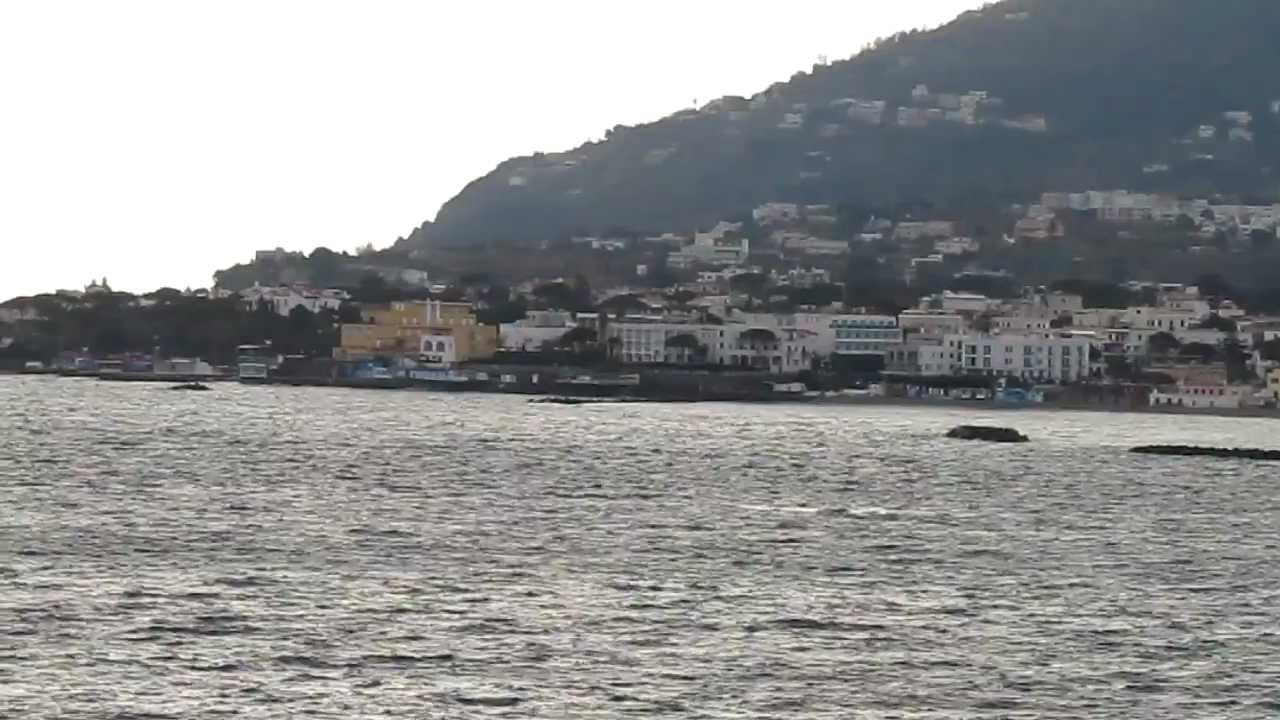
Ischia is a volcanic island in the Tyrrhenian Sea. It lies at the northern end of the Gulf of Naples, about 30 kilometres (19 miles) from the city of Naples. It is the largest of the Phlegrean Islands. Roughly trapezoidal, it measures approximately 10 km (6 miles) east to west and 7 km (4 miles) north to south and has about 34 km (21 miles) of coastline and a surface area of 46.3 square kilometres (17.9 sq mi). It is almost entirely mountainous, the highest peak being Mount Epomeo at 788 metres (2,585 feet). The island has a population of over 60,000 people. Ischia is the name of the main comune of the island. The other comuni of the island are Barano d’Ischia, Casamicciola Terme, Forio, Lacco Ameno and Serrara Fontana. The main industry is tourism, centering on thermal spas that cater mostly to European (especially German) and Asian tourists eager to enjoy the fruits of the island’s natural volcanic activity, its hot springs, and its volcanic mud. The roughly trapezoidal island is formed by a complex volcano immediately SW of the Campi Flegrei area at the western side of the Bay of Naples. The eruption of the trachytic Green Tuff ignimbrite about 56,000 years ago was followed by caldera formation. The highest point of the island, Monte Epomeo (788 m), is a volcanic horst consisting of a Green Tuff ignimbrite deposit that was submerged after its eruption and then uplifted. Volcanism on the island has been significantly affected by tectonism that formed a series of horsts and grabens; at least 800 m (2,624.67 ft) of uplift has formed as a result of resurgent doming during the past 33,000 years. Many small monogenetic volcanoes were formed around the uplifted block. Volcanism during the Holocene produced a series of pumiceous tephras, tuff rings, lava domes, and lava flows. The latest eruption of Ischia, in 1302, produced a spatter cone and the Arso lava flow, which reached the NE coast. The island of Ischia is home to the eponymous Denominazione di origine controllata (DOC) that produces both red and white wines though white wines account for nearly 80% of the island’s wine production. Vineyards planted within the 179 hectares (440 acres) boundaries of the DOC tend to be on volcanic soils with high pumice, phosphorus and potassium content. The white wines of the island are composed primarily of Forastera (at least 65% according to DOC regulation) and Biancolella (up to 20%) with up to 15% of other local grape varieties such as Arilla and San Lunardo. Grapes are limited to a harvest yield of no more than 10 tonnes/ha with a finished minimum alcohol level of at least 11%. For wines labeled as Bianco Superiore, the yield is further restricted to a maximum of 8 tonnes/ha with a minimum alcohol level of 12%. Only certain subareas of the Ischia DOC can produce Bianco Superiore with the blend needing to contain 50% Forastera, 40% Biancolella and 10% San Lunardo. Red wines produced under the Ischia DOC are composed of 50% Guarnaccia, 40% Piedirosso (known under the local synonym of Per’e Palummo) and 10% Barbera. Like the white wines, red grapes destined for DOC production are limited to a harvest yield of no more than 10 tonnes/ha though the minimum finished alcohol level is higher at 11.5% ABV. The sharp increase of the population between 1950 and 1980 and the growing inflow of tourists (in 2010 over 4 million tourists visited the island for at least one day) have increased the anthropic pressure on the island. Significant acreage of land previously used for agriculture has been developed for the construction of houses and residential structures. Most of this development has taken place without any planning and building permission. As at the end of 2011 the island lacked the most basic system for sewage treatment; sewage is sent directly to the sea. In 2004 one of the five communities of the island commenced civil works to build a sewage treatment plant but since then the construction has not been completed and it is currently stopped. On 14 June 2007 there was a breakage in one of the four high‑voltage underwater cables forming the power line maintained by Enel S.p.A although never authorized by Italian authorities between Cuma on the Campania coast and Lacco Ameno on the island of Ischia. Inside each cable there is an 18 mm‑diameter channel filled with oil under high pressure. The breakage of the Enel cable resulted in the spillage of oil into the sea and into other environmental matrices with the consequent pollution by polychlorobiphenyls (PCBs, the use of which was banned by the Italian authorities as long ago as 1984), polycyclic aromatic hydrocarbons (PAHs) and linear alkyl benzenes (aromatic hydrocarbons) in the ‘Regno di Nettuno’, a marine protected area, and the largest ecosystem in the Mediterranean Sea, designated as a ‘priority habitat’ in Annex I to the Habitats Directive (92/43/EEC) and comprising oceanic posidonia beds.