
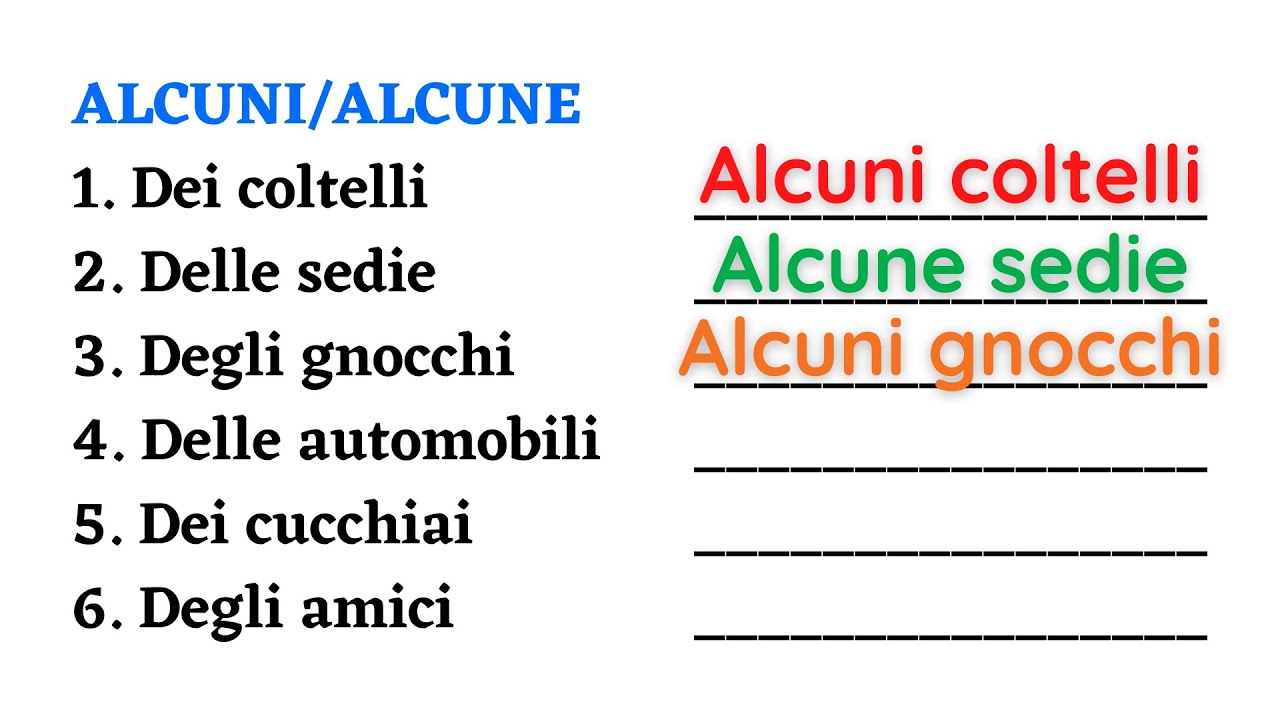
Italian language, italian class, learn italian, italian verbs, learn italian for beginners, how to use, indefinite adjectives, alcuni, alcune, qualche, un po’ di, A1, A2, grammar class, #learnitalian, aprende italiano, italian grammar, italian language, italian lessons, indicative, subjunctive, learning italian, passato prossimo, تعلم الايطالية, a2 italian, italian b1, apprendre italien, aprender italiano, fill in the blanks, how to learn italian, italian language course, italian learning, italian online class free, italian prepositions, italian pronouns.
Indefinites (Indefiniti) is the name given to a class of adjectives and pronouns that are not specified or quantified as members of their class. Examples in English include some, something, someone, every, all, everything, everyone, and anything.
The adjective form is similar to the pronoun form but not identical, and the respective adjective and pronoun are used in different situations. The adjective appears with a noun (e.g. some bread, every day), whereas the pronoun takes the place of a noun and can stand alone as the subject or object of the sentence (e.g. Everything is fine, I know someone who can help.)
As you can see, there are three different ways to express some: qualche, alcuni/e, and di + article, (called the partitive). Read on to understand how to distinguish them.
Qualche can only be used with singular nouns. Its ending does not change. Qualche libro means some books, even though libro appears in its singular form.
Alcuni/e is only used with plural nouns and it has two forms: alcuni for masculine nouns, (like libri), and alcune for feminine nouns, (like ragazze). Qualche and alcuni/e mean precisely the same thing. Just be sure you have agreement between nouns and adjectives: (sing. noun – qualche; plural noun – alcuni).
Both qualche and alcuni can only be used with nouns you can count (e.g. friends, books, etc.). When using uncountable nouns, (including many foods like milk, butter, wine, meat) and abstract nouns such as time and love, you must use the partitive di + article (e.g. del latte, del burro, del vino, della carne, del tempo libero, della pazienza, etc.).
✽ You may use di + article with countable nouns too, but only in the plural (e.g. degli amici, dei libri, etc.)
Ogni and tutti both mean every or all, and the distinction between them is similar to the one mentioned above.
Ogni is reserved for singular nouns (e.g. ogni sera), and it is invariable, meaning its ending does not change.
Tutti/e is used with plural nouns and ends in -i before a masculine noun (e.g. tutti i giorni) and -e before a feminine noun (e.g. tutte le sere). Note that with tutti and all of its forms, the definite articles (e.g. i, gli, le) are used after it, unlike with ogni: (Ogni studente but tutti gli studenti).
✽ Tutto in the singular form is used with singular nouns to mean all or the whole (e.g. tutto il giorno = the whole day, all day long; tutta l’acqua = all the water, etc.). Its endings change (-o or -a), to agree with the noun in gender.
Qualsiasi and qualunque are invariable (their endings don’t change), and they can be used interchangeably to mean any in the sense of “Any day is good for me”: Qualsiasi giorno va bene per me.
When you wish to express any as in “Do you have any Italian friends” or “I don’t have any money,” you do not use qualsiasi or any other adjective. Simply use the plural noun + adjective: Hai amici italiani? / Non ho amici italiani.
Mastering this section involves, in part, understanding the concept (e.g. difference between singular and plural, countable and uncountable, etc.) and, in part, learning new vocabulary. Remember, when studying these new words, to make sure you don’t confuse the adjectives and pronouns. Qualche and qualcosa may look very similar, but the first is an adjective (and must be used with a noun), while the second is a pronoun and can stand alone in a sentence.
Die Sprache der Natur, Learn italian, Italian grammar, Italian exercises, Learn italian free, Learning Italian, Italian language, Italian lessons, Learn Italian, Speak italian, Learn italian in italian, How to learn italian, Italiano per stranieri, Italienisch lernen, Aprender italiano, Italiano, Imparare, Italiano, Learn, Italian, Aprender, Apprendre l’italien, Italian language.