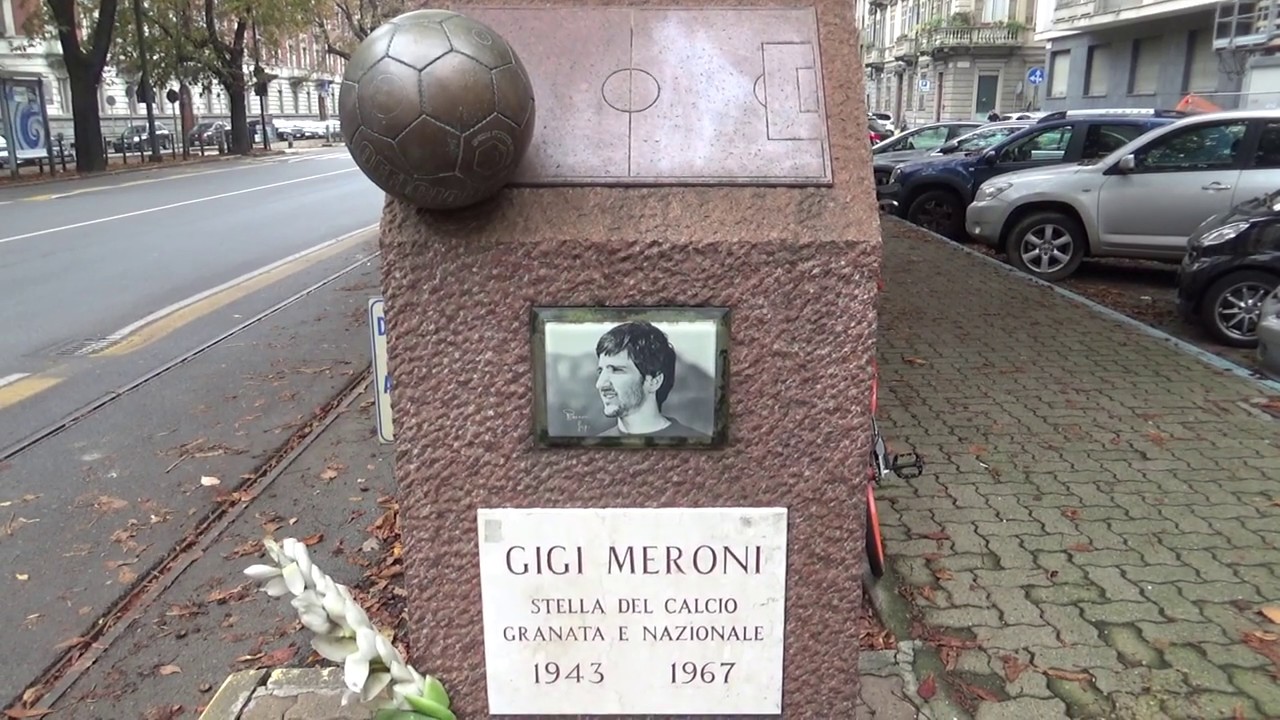
Luigi Meroni, known as Gigi (Como, 24 February 1943 – Turin, 15 October 1967), he was an Italian footballer, with a role in the wing. He died at the age of 24 – shortly after the end of a match between the Turin team he was playing in and Sampdoria hit by a car while crossing Corso Re Umberto, in Turin, together with his great friend and teammate Fabrizio Poletti. He played 145 matches in Serie A, making 29 goals. Right wing, he played with the number 7. His strong point was the unpredictable dribbling, which displaced the opposing defenders, often coming face to face with the goalkeeper. He began playing soccer in a small courtyard of 60 square meters, then moved on to the field of the Oratory of San Bartolomeo in Como. From the age of 2 he was fatherless and his mother Rosa, a weaving professional, had economic difficulties in raising her three children, Celestino, Luigi (known as Luigino, then Gigi) and Maria. As a first work he made the designer of silk ties and also devoted himself to painting. Grew up in football formations in the youth of Como, after having debuted in the first team, in Serie B, was sold to Genoa, whose leaders were impressed, after seeing him play as an opponent. In Genoa the national attention was definitely imposed: its coils and goals dragged the team, coached by Benjamín Santos, to the 8th place in the standings and to the conquest, for the 2nd time, of the Cup of the Alps, in the year in which was also set an unbeaten record by Genoa goalkeeper Mario Da Pozzo. In the summer of 1964, despite the mobilization of the Genoa fans to keep him, he was sold to Turin, coached by Nereo Rocco, for 300 million lire, a record number for a player of only 21 years. He was nicknamed “butterfly”, alluding to his style of play and his unconventional costumes (his cohabitation with a separate woman was well known), and “beatnik del gol”, for his artistic interests and his style from ” haired “. Some fans called him “Calimero”. Nestor Combin formed a high-level attacking pair with the center forward. The persistent rumors of his passage to Juventus, for 750 million lire, triggered a sort of popular “insurrection” and the president Orfeo Pianelli, under the pressure of the square, gave up. In 1967 at San Siro, after one of his famous slalom, with a lob from the edge of the area, ended at the intersection of the goal posts of the Nerazzurri, he interrupted the unbeaten home of Helenio Herrera’s “Grande Inter”, forcing the Nerazzurri to defeat, after 3 years of useful results.