
Cibo | Italian Street Artist | Amazing World
MEET CIBO, THE STREET ARTIST WHO COVERS SWASTIKAS WITH FOOD MURALS
Imagine if you could erase all the hate in the world by just replacing it with something beautiful, like art, for instance. It would seem almost too good to be true, and to many this might indeed sound somewhat naive. However, this is exactly what has happened in Verona and its outskirts.
For more than a decade, Italian street artist Pier Paolo Spinazzè has been covering neo-fascist graffiti and offensive writings with colorful murals depicting all sorts of foods.
You know Italians. Food is not just mere nourishment for the body. It’s rather something far more sacred than that: the things people put on their table is a token of cultural tradition and identity, and they are proudly shared along with the deep love for their land. So, if on one hand far-right scribbles are placed around to incite discrimination and division, on the other, a smoking hot pizza will bring everyone around the same table. And Spinazzè knows this very well.
That’s why, working under the pseudonym of Cibo (food in Italian), the artist paints fruit, produce and other Italian culinary delicacies over neo-fascist and neo-Nazi symbols. Swastikas, Celtic crosses and racial slurs stand no chance against Spinazzè’s spray cans, and one by one they’re turned into giant strawberries, tomato-topped pasta dishes, and Parmigiano cheese wedges.
But what exactly pushed our man to start his mission? According to Spinazzè, “Verona has always been ‘black’,” — namely, a city that supports the right-wing ideology — “and for a person who works in the field of freedom, fascism is an obstacle.”
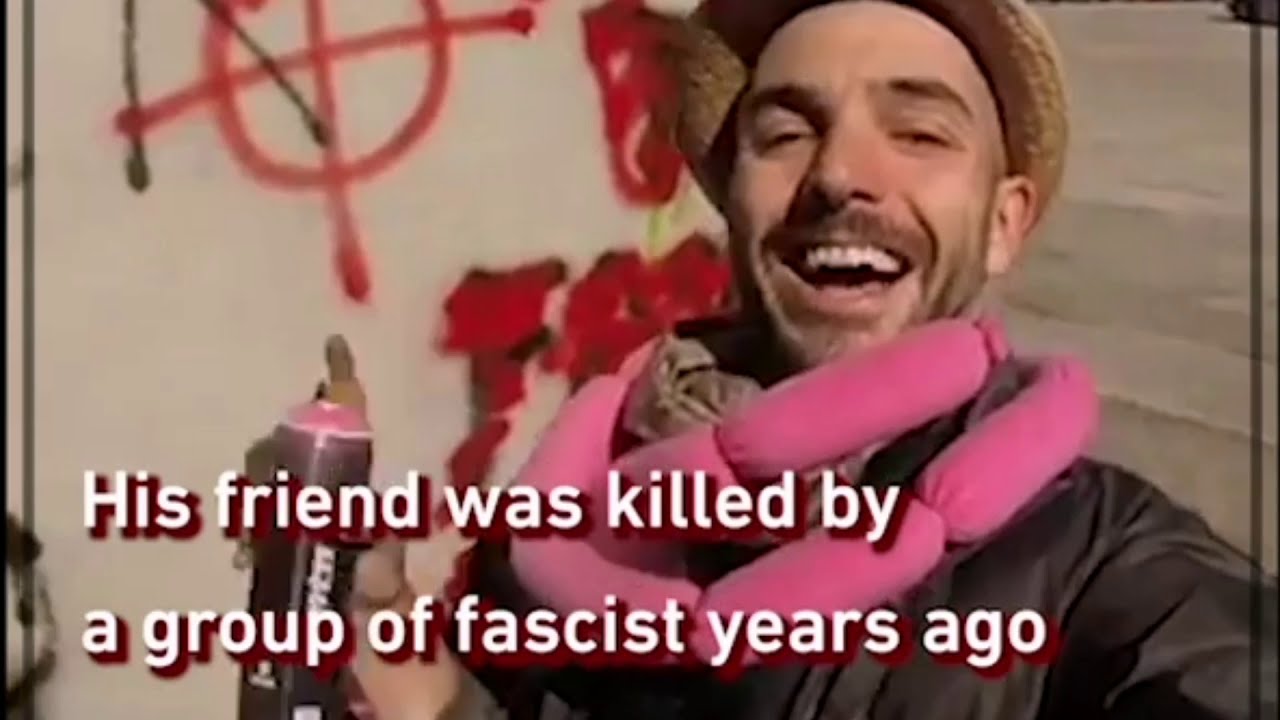
Yet, aside from his hometown’s political climate and his opposition to it, Cibo’s desire to fight far-right propaganda was triggered by an incident that personally hit the artist. He explained: “I have seen the marks of neo-fascist violence on my friends, as eleven years ago a group of neo-fascists killed a fellow university student. After that day I have decided that that was enough; and although it wasn’t much, I would have, should have done something about it.”
And so he did. Short after the death of his friend, Spinazzé came across a wall defaced by a hotchpotch of writings, including a fascist one. Cibo covered up the whole jumble with his first work: a wiener mural. A few days later, the artist noticed that someone had drawn new graffiti over his creation. That was it: the game was on, and Spinazzè’s mission to obliterate any expression of intolerance and hostility from Verona’s walls had officially begun.
“My weapons are art, culture and irony — three things that are completely unknown to these people,” said the artist. “Therefore, for each time they would come back to ruin my work, I would add murals of sauces onto the sausage. This way their hatred became part of my cuisine,” he added. In time the wiener dish was completed in full detail, and eventually those who came to
that wall to scribble neo-Nazi symbols on it finally fell silent.
In an interview with Italian public broadcaster RAI 2, Spinazzè stated that removing hateful inscriptions is both his civic duty and his right. Being someone who makes public art, Cibo feels he needs to take care of own city. After all, Verona is his personal open-air art gallery, and there’s no place for such messages on any of his bricked canvasses.
And if that wasn’t a noble enough reason to take on this commitment, the artist stressed that “antifascism is a value that is both constitutional and non-partisan. Because of this, each citizen must be liable to defend freedom with his or her own skills and languages.” And he has chosen to do so through his fresh and vivid street art. Spinazzè
continued: “There is nothing exceptional in what I do. Instead, it’s disgraceful what everyone else chooses not to do.”
At a time when the Boot’s political landscape is swiftly shifting towards right-wing ranks, Spinazzè’s work and manifesto take on a crucial meaning. It could be argued that the artist’s creations reflect an individual’s love for public spaces, since they aim at restoring and preserving their decorum. As Cibo told us, before battling the the ugly and the bad on buildings, entire Northern Italian towns were in fact plastered with swastikas and Celtics; whereas now those same urban places have become multi-coloured and more pleasant to the sight. Because, let’s face it: a mural of a huge, bright red-white-and-green ‘caprese’ just looks better than a monochromatic, wonky inscription hailing ultra-nationalist political parties.
#streetartist #erasehatred #veronaitaly