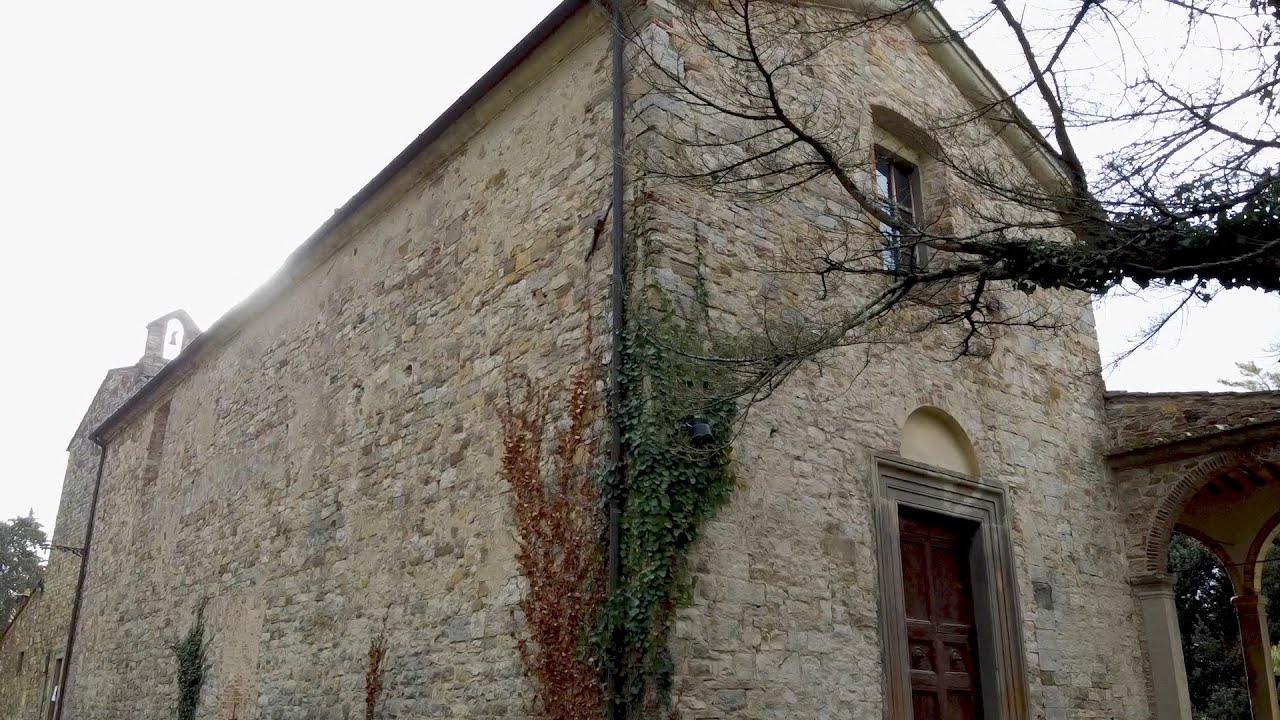
The oratory of Sant’Eufròsino is located in Panzano in Chianti, a fraction of Greve in Chianti, in the province of Florence, diocese of Fiesole. It was described by the Florentine journalist and writer Oriana Fallaci, in her posthumous novel “A hat full of cherries”. Sant’Eufrosino, originally from Cappadocia, was one of the evangelizers of Chianti, so much so that two places of worship named after him were built in the Chianti area, one is the present while the other is the Commenda di Sant’Eufrosino in Volpaia in the municipality of Radda in Chianti. Tradition has it that near Panzano he found death and an oratory was built in the place of his burial, a place of pilgrimage linked to the cult of a spring with thaumaturgical powers, the Fontino di Sant’Eufrosino, consisting of two masonry columns that support a sandstone lintel. Inside this kind of temple there was the source above which the bust of the Saint was located and the temple was covered with a pinnacle spire. The first news of the oratory of Sant’Eufrosino is found in a bull of 11 March 1102 of Pasquale II to the bishop of Fiesole Giovanni. The current building dates back to no earlier than 1441, when Pope Eugene IV was in Florence when a special indulgence was issued to anyone who had made a donation for the construction of the oratory. But it had to be a reconstruction because in the current building are preserved, under the portico, the remains of filaretto in the initial part of the right wall, remains that belong to a building of a more modest size, perhaps the building mentioned in the document of the XII century. In 1514 (approximately), the oratory and the parish church of San Leolino increased the patrimony of the Hospital of Santa Maria Nuova in Florence and in 1565 a cabreo was created, an inventory of the hospital’s properties, the Champion of the Plants of the Spedale possessions of S. Maria Nuova. One of these maps shows the Podere di Sant’Eufrosino above, with its borders, annotations and three buildings: the Chapel, the Worker’s House, the Oratory of San Frosino. In 1852 an association was born which its purpose was to spread the cult of Sant’Eufrosino with printed images, depicting the saint, accompanied by prayers of intercession. The oratory has a structure dating back to the fifteenth century, with a gabled roof with a cross vault and a single nave closed by a scarsella. The portico on the facade and on the right side was added in the seventeenth century, while restorations were made inside that changed the face of the church, the altars were rebuilt and a large niche was built to house the polychrome plaster statue depicting Sant’Eufrosino and a small reliquary. A large transversal arch with capitals in sandstone carved with leaves divides the nave from the presbytery. In the back wall of the presbytery there is the piece of greatest artistic prestige of the oratory. It is a Gothic ambo in the shape of a shrine, located on the left corner of the back wall of the presbytery and which was originally intended to house the saint’s relics. The aedicule is made up of two pillars on which a trilobed arch is set inside a cusp decorated with rampant leaves and at the bottom there are two perforated tiles with four-lobed; on the shelves there is the Peruzzi coat of arms, perhaps the commissioners of the work. This ambo was probably recovered from a Florentine church and donated by the Peruzzi at the time of the expansion of the structure. In the square behind the oratory there is a small chapel that tradition says was erected in memory of a miracle of the saint, which at that point caused a pool of water to spring. Inside it houses a 12th century sandstone altar, as well as traces of fifteenth-century frescoes. There is also the opening of a well, whose waters seem to have therapeutic qualities. Near the oratory there is the so-called Fontino di Sant’Eufrosino. It is a source that Sant’Eufrosino would have used during his life. Above the source a small chapel was built supported by four columns; inside they are kept ex voto.