
To purchase Renaissance War Game Rules use this link:
Music: Thunderstorm – Hanu Dixit
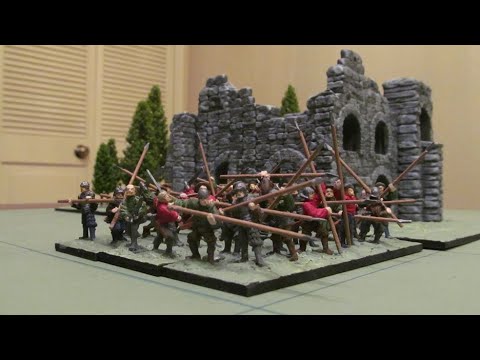
The rules allow solitaire or multiplayer field battles of the period 300 AD – 1850 AD. The rules can be used for other periods at the user’s discretion. Players represent the individual commander of an army or force in opposition. Each commander will need suitably painted figures mounted on movement units or bases, 1 normal die (1-6) for orders, and 1 colored die (1-6) for combat results. A flat table or other surface should be provided for the battlefield. Rulers, templates, markers, records, army lists, and casualty caps are not required.
The battlefield is a rectangular surface of area divided into a minimum of 32 square regions, clearly marked to assist adjudication during the battle. Adjacent to the battlefield are off battlefield rear and flank areas. The dividing line between each area and the battlefield is each side of its rectangle. 1 long side rear area is friendly to each army in conflict. Flank areas are always friendly. All figures on the battlefield and each flank or rear area remain visible to all commanders during the game.
Every convenience has been applied to provide a streamlined and easy to learn system to enhance the experience of the players. Strategy and tactics are clear and players will apply these during the battle to various degrees of success. Most battles should require 60 to 90 minutes to complete. Gaming clutter that turns your site into a rat palace is not necessary and therefore removed from the game.
The rules provide a continuous process that concludes when a victor is determined. The process branches at various events to allow all players the initiative. Player commanders can submit orders to their units. 10 orders are available and 3 are combat related. Each order is tested to determine its resultant action. Advantaged attacks and shooting are possible.
The rules use a grid system so players cannot fudge distances with their rulers. Only necessary action and combat factors are used. Casualty and movement tables are not required. The natural laws of probability will determine momentum shifts and contagions.
The rules describe a square sub-section of the battlefield as a region and the total regions will determine the dimensions of the battlefield. The size of a region will determine the size of a unit base, and this will determine the number of figures that may be contained within. Model soldiers look better in mass. The size of the battlefield will determine the possible soldier density permitted and the required time to conclude a game battle.
A battlefield should be rectangular with its length twice its depth. There is no rule that dictates this, so make a battlefield to your personal requirements. Depending on your gaming site or table, you can make the battlefield enable a soldier density and game duration of your liking. A battlefield of 32 or 50 regions will have a maximum soldier density of 1152 and 1800 models respectively. I recommend arranging regions as 8 x 4 or 10 x 5 so each battlefield can reside on a dining room table. Recommended soldier density is 192 to 288 models per army or force.
The rules define a normal and large scale for use with 25mm and 28mm figures. If you want to use small scale figures such as 15mm, just add additional figures to each unit base. In fact, you can play War Game Rules without using miniature figures at all. Just use unit bases. You may paint the bases, but you must identify the units figure, soldier, and weapon type using a pen, marker, or stickers.
Use a mobile device dice app to create 2 die that have 6 sides. 1 die is normal for order/action testing and is black with white pips. 1 die is colored for combat/result testing and is red with black pips. Roll both die at the same time. Reference the score of the normal die to determine if you can execute the action associated with your order. Reference the score of the colored die only if you execute a combat action.