
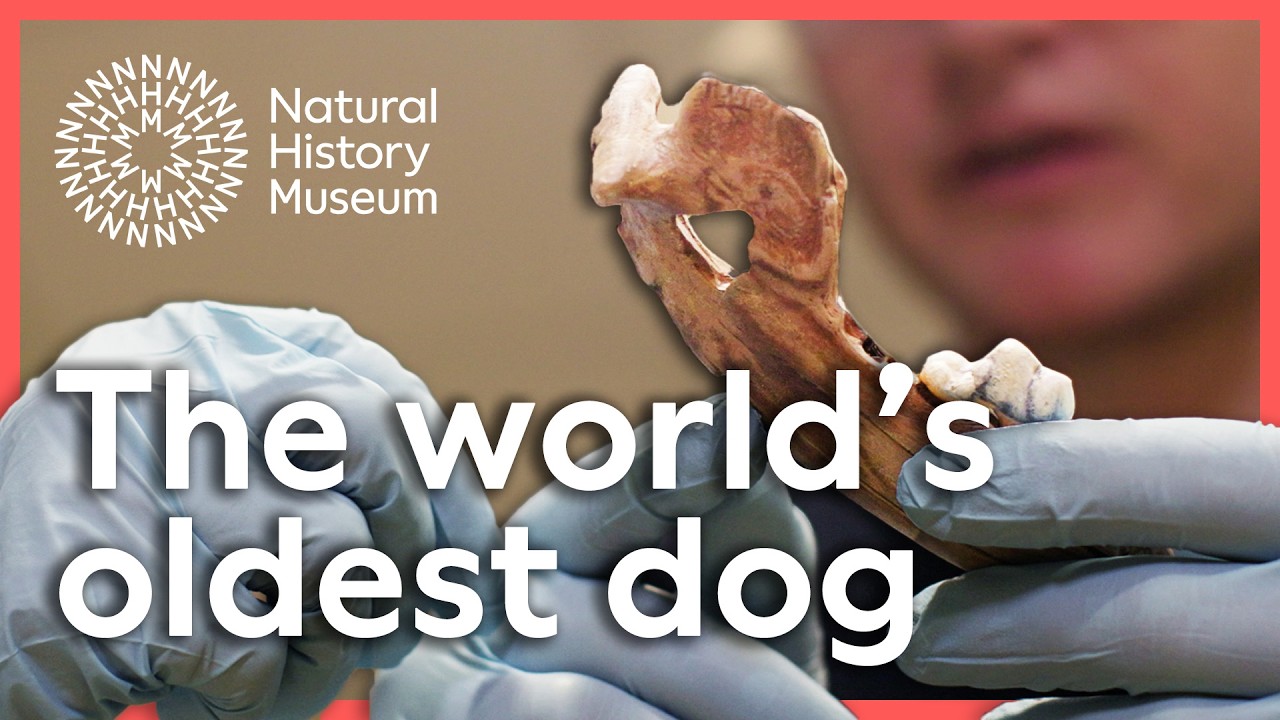
Scientists have found the world’s oldest dogs after analysing five wolf-like fossils from cave sites across Europe, including a cave known for the discovery of the oldest near complete human skeleton found in Britain.
The study has pushed back the domestication timeframe of dogs by 5,000 years, suggesting that our human ancestors lived alongside their own canine companions almost 16,000 years ago.
#NaturalHistoryMuseum #Dog #Discovery
—————-
Subscribe to our channel for the latest natural history content http://www.youtube.com/naturalhistorymuseum?sub_confirmation=1
The Natural History Museum in London is home to more than 80 million objects, including meteorites, dinosaur bones and a giant squid. Our channel brings the Museum to you, from what goes on behind the scenes to surprising science and stories from our scientists.
Browse our shop: https://www.nhmshop.co.uk/
Website: http://www.nhm.ac.uk
Instagram: http://instagram.com/natural_history_museum
TikTok: https://www.tiktok.com/@its_nhm
Bluesky: https://bsky.app/profile/nhm-london.bsky.social
X: https://x.com/nhm_london
Facebook: http://fb.com/naturalhistorymuseum
30 Comments
Great content, thank you!
Talking of domestication, Darwin was very much interested in it, both animals & plants. As for the domestic dog, the term, domestication, might be more complicated, could be too simplistic to describe the evolutionary events like this. An inspiring footage.
Wanna buy a dog ??
Nah mate.
They're great.
You can pat them, and eat them.
Fast pumpkin 98
This video has got me thinking about how the native American people also had dogs but when the Europeans came the native dogs died out, perhaps due to diseases the European dogs brought with them. And I wonder if there are any remains of the native dogs that could be checked to see if they are related in any way to the paleolithic dog you found and what differences there might be. It would be interesting
Domestication is certainly much older than this.
❤❤ Nice vid! Thanks!
What I think changed in wolves is that they began to be fed from humans cooked meat which has had a hand in their evolutionary process into dogs. What grew our brains was seafood, everything at one time came from the sea and mammals like say herbivores they dont get the nutrition and so the larger a species is on land the smaller the brain capacity. Our brains grew because we must have had access to seafood for a very long time making up most of our diet, as its the mammals that have returned to the oceans where their brain size actually grows much larger than any land species. So I think cooked food has played a massive part in domesticating dogs, once we started cooking food it allowed all that extra energy to be put into growing the brain instead of processing plant material for 9 hours everyday…
Scientists have vivid imaginations.
Makes sense that funerary cannibalism didn’t last. Imagine how much pathogens loved it!
You've got to call it "Cheddar Dog"!
Cheddar dog.
Humans have shaped dogs, have dogs shaped humans?
Baboons in Africa had stolen wild dog pups and enslaved these as a.o. guard dogs. Horrible treatment into submission from their very young age. Saw that in a documentary. No clue where to find the reference to it.
If they can do it, we could do that millennia earlier, easily, than we have ever thought so far. And this find doesn't change that. It's nice. It's an accomplishment. Good for the people who found it. Good if peer-reviewed publish. And, …
We have to assume our development into "sapiens" as the proverbial hockey stick with an incredibly long almost flat, straight, shape, like almost asymptote, that curves up, for one reason or another, and in that grows exponentially into a vertical asymptote.
The question is not if this happens, but where and when the tiny jumps in that curve can be found, as irrefutable proof.
Domestication, synergy, submission, enslavement, both between humans and species, are all on that curve. Repeatedly.
A recent study finally shed some light on those Magdalenian burial practices by looking at DNA. It turns out there were 2 different cultures of Magdalenians. The ones from the Goyet lineage which practiced cannibalism, and the ones from the Villabruna lineage who had primary burials. They were otherwise not divided regionally or chronologically so it's the 1st time we can see 2 different cultures integrated for the period. Gough's cave therefore are related to the Goyet Magdalenians.
Other recent research on Magdalenian dogs in France has indicated that those people actually kept dogs for their meat.
If these guys are thinking their dog remains were cannibalized as part of a burial practice at Gough's Cave then that that needs to be researched with the DNA background of the French dog-eaters in mind to see whether there were 2 different dog cultural behaviors…..or maybe these British Magdalenians just consumed dog meat as well.
Don’t like the idea of eating dead relatives after they died.
4:28 Her accent made it sound like she said I started off licking er Cheddar man.
Clever money 82
How did 'dogs' develop?
Why didnt they show what the dog looked like lousy video😮
It would have nice to have had re-creation of how they probably looked: size, thin or stocky, etc.
Dog in sack sack in river.
Most importantly; did they boop it's snoot?
I find it sad and a little disturbing that Goughs Cave now appears to be a Disney theme park with lighting and walkways and a ticket office, I didn't see the mcdonalds but you can be sure it'll be there somewhere. It distracted me from the purpose of the presentation, can you do it again but just with people in white coats in a laboratory, or better still tweed jackets in a museum setting? Its a shame because I think it was very interesting.
? if they were cannibals at that time the majority of the children usually didn't survive did they eat all the babies and where's all the bones ?
The shared diet may be them simply eating our poop, which is one of the behavior of dogs and wolves and other related species.
One thing that i noticed was that the migration was nearly in one direct line, of the 5 "dog" remains. I dont know if that is just consequential or is there a real pattern here?!!!
This video is just a production with offer nothing but speculation.
You just debunked YOURSELF… whose to say someone won't find a older one tomorrow or in the future?
Same as you just did, allegedly.
Go chase yourself.
We didn’t get to see the mutt!