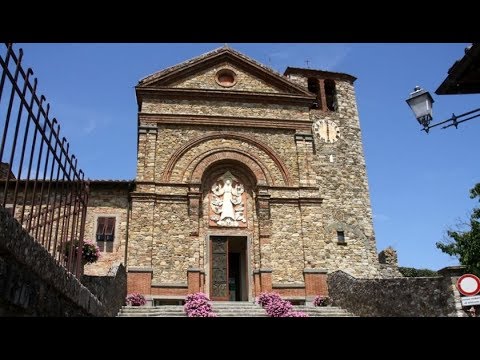
The church of St. Mary is a cult building located in Panzano in Chianti, a fraction of Greve in Chianti in the province of Florence, diocese of Fiesole. The church of St. Mary in Panzano was, from the Renaissance period, with a single nave without an apse and measured about 19 ml. in length and 9 ml. wide. In the rear wall, behind the high altar, there were two stone windows with railings and windows and the same also in the facade. The side altars leaned against the sides and from the left side there was access to a vaulted chapel where the baptismal font was housed, in octagonal shape in pietra serena, built around the year 1730, probably the current one. In the floor there were numerous burials of the most notable Panzanese families of the time: Firidolfi, Quercetani, Petrucci, De Luigi, Baldi, Cappelletti etc.. This Church was derived from the expansion of a primitive Romanesque building, mentioned in the lists of the “Rationes Decimarum for Tuscia” of the years 1274/75, in turn probably enlarged in the fourteenth-fifteenth century with the use as bell tower of one of the perimeter towers of the ancient medieval castle. At the end of 1800 the Church was included between the current two large arches, without side chapels, and the bell tower remained detached from the Church itself. Between the two buildings there was the entrance to the cemetery which then led to the chapel of the Compagnia della SS.ma Annunziata, which is believed to be the same that we see today, except also having direct access from the church, closed in the last restoration of the 60s of the last century. The current appearance of the Church of Panzano is due to the profound restructuring that took place between the end of the 1800s and the beginning of the 1900s with the creation of the side chapels and the extension of the central nave on the front going to incorporate, with the new facade, also part of the bell tower, thus closing the entrance to the old Cemetery which, following the edict of Saint Cloud (issued by Napoleon in 1802 and promulgated for the Kingdom of Italy in 1806), had been abandoned. The extension of the nave also concerned the rear creating the two current half circles. These extensions are clearly recognizable by observing the left side of the Church from the old Camposanto.