
In the southeast of Sicily, beyond the volcanic drama of Etna & far from the touristic rhythms of the island’s north, the Hyblaean plateau stretches quietly toward the sea. Here, around the town of Chiaramonte Gulfi, in the province of Ragusa — often called the “balcony of Sicily” — the landscape opens into a mosaic of limestone ridges, olive groves, carob trees & scattered vineyards shaped more by agriculture spanning millennia, than by appellation.
The elevation brings relief from the island’s heat – closer to the east of Africa than mainland Italy. Even in the height of summer, evenings cool quickly as air moves inland from the Mediterranean, preserving acidity & freshness in the fruit. The soils are pale, calcareous & thin – fractured limestone with very little topsoil – forcing vines to root deeply in search of water & nutrients. It is a place that naturally favours tension over weight, detail over power. It is here that Kalma was founded in 2022 by Nikolas Resin & Waiata May Kalma-de Jong — two growers whose path to Sicily was anything but direct.
Nikolas trained in viticulture & enology in Germany & northern Italy before moving through a series of cellars that have come to define a more progressive edge of modern wine. An early period in South Africa marked a decisive shift away from technical winemaking toward something far more instinctive. Here, fermentation was not controlled so much as guided, and the cellar became a place of response rather than prescription. That experience laid a foundation that would carry through his work: a belief that energy, not precision alone, defines a wine.
From there, his time in Italy & Spain brought further clarity — most notably at Terroir al Límit in Priorat, where a focus on infusion over extraction & a sensitivity to tannin reshaped his understanding of structure in Mediterranean wines. He would later carry this perspective into Sicily, taking on the role of winery manager at COS under legendary Giustavo Occhipinti — a benchmark estate whose commitment to amphora, organic farming & transparency has quietly influenced a generation of vigernons.
Waiata’s path followed a different, but complementary rhythm. Originally from New Zealand, she spent her early years between Montpellier, Melbourne & Paris, building a career as a sommelier before gradually shifting her focus toward farming & production — driven by a desire to understand not just how wines taste, but how they are grown, and why. They met at COS & fell in love, their shared trajectory continued through two defining projects. At Domaine Matassa, they were immersed in a model of farming that blurred the lines between agriculture & ecology — cover crops, biodiversity, and a strong emphasis on vitality in both soil & wine. Later, at Kindeli, they experienced a similarly holistic approach, where vineyard & farm operate as a single organism & winemaking becomes an extension of that system rather than a corrective force. Across these experiences, a common philosophy took shape: that the integrity of a wine is determined long before it reaches the cellar.
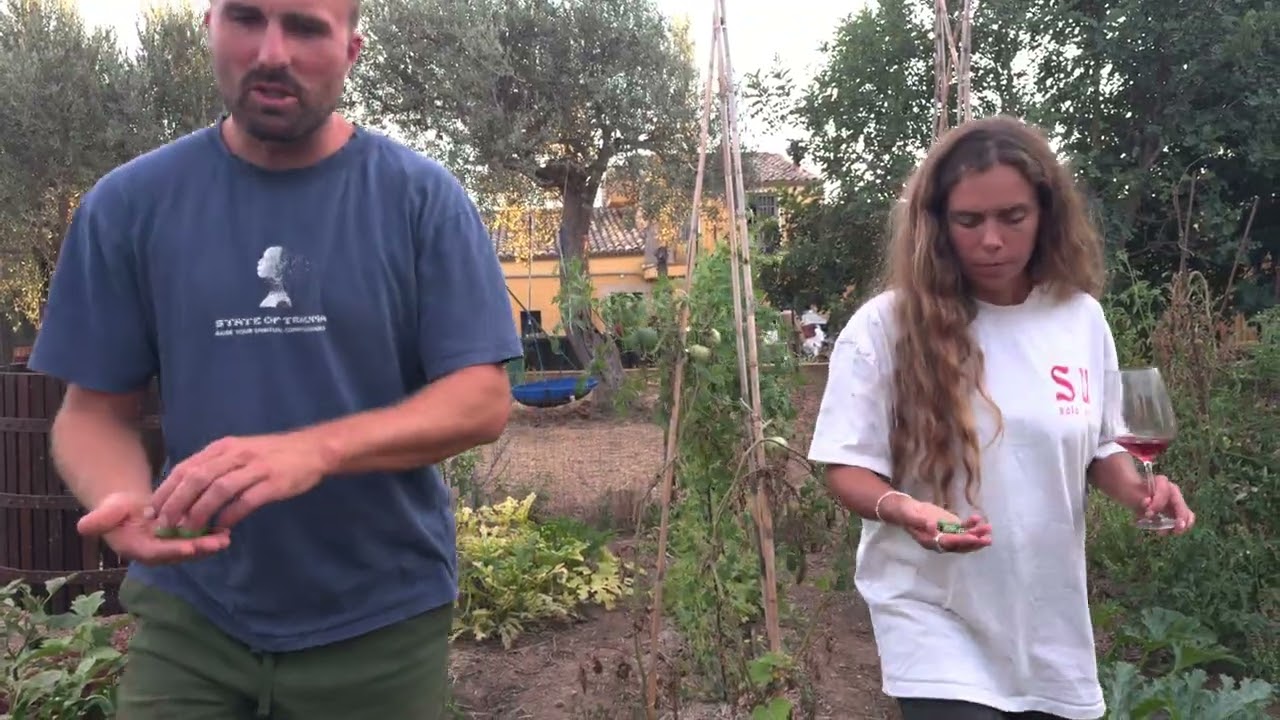
Sicily remained the constant. Drawn back repeatedly by its light, its pace & its agricultural depth, they returned in 2022 with their young family & settled in Chiaramonte Gulfi, purchasing a modest 3.8-hectare hillside farm surrounded by olive & citrus groves. The property reflects the broader landscape — not a vineyard in isolation, but a mixed, living system. Around half the land is planted to vines, many over 50 years old, while roughly a hectare is dedicated to olive trees, with the remainder left to wild growth & biodiversity. This balance is intentional. Kalma is not conceived as a production site, but as a regenerative farm — one where vines exist as part of a wider ecological whole.
Farming follows this philosophy closely. Synthetic treatments are avoided in favour of regenerative practices that prioritise soil life, microbial activity & long-term resilience. Cover crops are allowed to grow freely, encouraging natural competition & balance in the vineyard. The aim is not control, but equilibrium – to create conditions where the vines can find their own expression.
The cellar work, carried out in a restored 19th-century cantina, mirrors this restraint. Fermentations occur spontaneously with indigenous yeasts, extractions lean toward infusion rather than force, and élevage is patient. Additions are kept to an absolute zero. The intention is not to shape the wine, but to accompany it — allowing site & season to articulate itself as clearly as possible. The wines that emerge are defined by this approach.