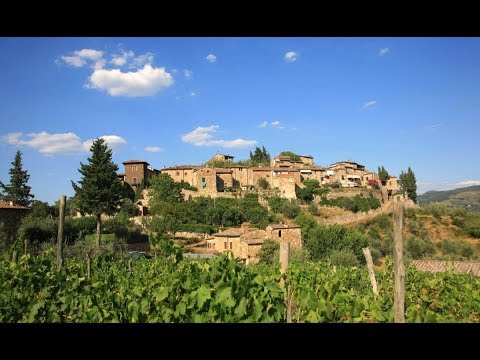
Montefioralle is a fraction of Greve in Chianti in the province of Florence, at a distance of 1.2 km from the municipal capital. The oldest documented memory dates back to February 6, 1085 when an act was drawn up in the Monteficalli castle. The castle was mentioned several other times at the beginning of the XII century as a curtis in which official deeds were drawn up, deeds preserved in the Badia a Passignano archive. Among these documents, the one dated 4 March 1122 is of particular interest; in that document the sale of a good is certified between such a Bucket of Gerardo and Gisla of Guinildo together with the mother Ermengarda of the late Rolando, the characters of this story all bear a name of Germanic origin so much that it was assumed that they were exponents of a noble family of Lombard lineage. In later times the castle and village of Monteficalle was owned by the Ricasoli, Benci di Figline and Gherardini di Montagliari. The village was located along a road called via del Guardingo di Passignano, this road connected the three main valleys of the southern part of the Florentine countryside, the Val d’Elsa, the Val di Pesa and the Val di Greve with the Upper Valdarno. In ancient times the castle was known as Monteficalle and then became Montefioralle in the 18th century. The town developed around the highest part which corresponds to the ancient feudal settlement. Developing around the ancient castle, the village has taken an elliptical shape, consisting of a radial road from which alleyways that all lead to the feudal formwork unfold. Today, a mighty rectangular structure remains of the ancient formwork, with a lining made of Alberese stone. The complex, now demolished and reduced to residential use, should date back between the end of the 12th and the beginning of the 13th century. All around the built-up area there are the walls that repeat the shape of the village. The parts of the walls still preserved today have the remains of some towers, now converted into houses, and the three access doors, all open directly into the walls. The walls made entirely of peeled stone are to be dated between the end of the thirteenth century and the beginning of the fourteenth. The urban fabric shows a very unified style, characterized by buildings with medieval structures. Among these buildings there is a house believed to have been owned by the Florentine navigator Amerigo Vespucci and another that has a fine pointed portal with a Bigallo coat of arms on it. The sacred building of the village is the church of Santo Stefano. In the vicinity of Montefioralle there is the parish church of San Cresci which still preserves the Romanesque structure, with a facade preceded by a narthex and equipped with two mullioned windows.