
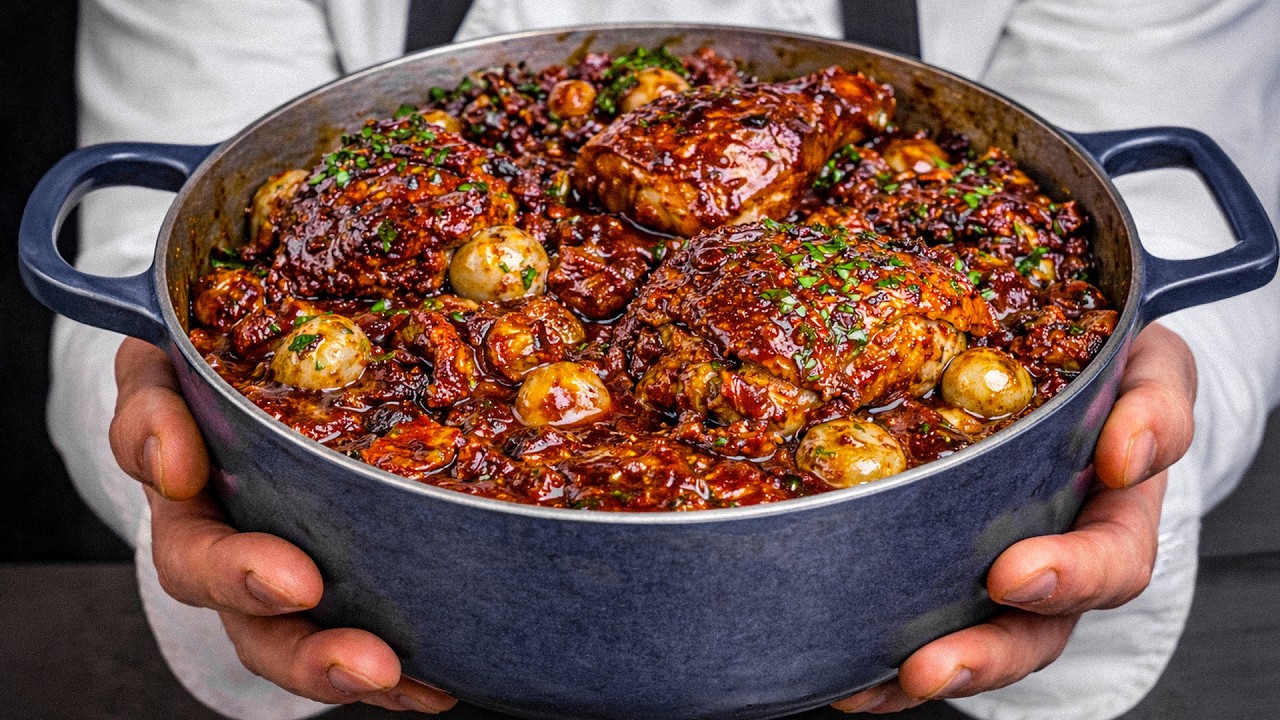
This is Coq au Vin cooked using Michelin-star technique and served to Pierre Koffmann.
In this video, a Michelin-trained chef breaks down how to make restaurant-quality Coq au Vin at home, inspired by the methods of legendary three-Michelin-star chef Pierre Koffmann. Rather than blindly following tradition, we focus on why each step matters — from brining the chicken instead of marinating it in wine, to building flavour through proper caramelisation and controlled reduction.
You’ll learn how chefs actually cook Coq au Vin:
• Why brining creates juicier chicken than wine marinades
• How to brown chicken properly without burning the sauce
• Why garnishes are cooked separately in Michelin kitchens
• How to balance red wine, stock, and aromatics for a refined sauce
• A classic French finishing technique using chicken liver for richness
This is not a shortcut recipe. It’s a technique-led Coq au Vin, showing how a traditional French dish becomes something worthy of a Michelin kitchen — while still being achievable at home.
If you’re searching for:
• A classic Coq au Vin recipe
• Michelin chef techniques
• How to cook Coq au Vin properly
• French chicken recipes done right
This is the version to learn from.
INGREDIENTS
1 Chicken
1L Water
Bay Leaf
Peppercorns
Thyme
50g Salt
1 Carrot
2 Shallots
30g Plain Flour
125ml Cognac
600ml Red Wine
300ml Reduced Chicken Stock
300ml Beef stock
Bouquet Garni (Piece of the dark green end of the leek, bay leaf, thyme)
150g Smoked Lardons
250g Button mushrooms
15 Pearl onions
1 Chicken liver (optional)
Fresh Parsley
RECIPE
1. Mix the brine ingredients in a bowl to dissolve the salt.
2. Break the chicken down into pieces, place in the brine, cover and leave to marinate for 4 hours.
3. If using a whole chicken, cut the carcass into 3 – 4 pieces and roast on 180C until golden.
4. After 4 hours, remove the chicken from the brine and pat the chicken dry. Dust with flour.
5. In a wide based pan, add a dash of olive oil and on a medium heat, brown the skin of the chicken until golden. Turn the chicken over to briefly colour the exposed flesh. Remove from the pan and set aside.
6. If using unpeeled pearl onions, cut the roots off the pearl onions, blanch for 2 mins in simmering water and refresh in ice water. Pinch the end of each onion so they pop out.
7. Add the lardons to the same pan as the chicken and saute until golden. Set aside
8. Add the mushrooms and saute on a medium high heat until starting to colour.
9. Add the pearl onions in with the sauted muchrooms and continue to sautee for 4-5 minutes until lightly browned. Set aside with the lardons
10. Next cut the shallot and peel & cut the carrot into big chunks
11. In the same pan, sauté the onions and carrots vegetables on the same medium heat and cook until just softened and starting to colour (about 5-7 minutes).
12. Turn the heat to medium high and add the cognac and either stir until the brandy has almost entirely evaporated or light the pan to flambee off the alcohol
13. Pour in the wine and allow to reduce by 2 thirds
14. While the wine is reducing, add the roasted carcass, garlic and bouqet garni
15. Add the chicken stock & beef stock, bring to a gently simmer and return the chicken to the pan, skin side up.
16. Cover with a cartouche and simmer for 20-30 mins or until the thickest part of the chicken thigh’s juices run clear
17. Remove the chicken and set aside and strain the sauce to remove the shallot, carrot, bouqet garni and roasted carcass.
18. Reduce the sauce until it starts to thicken slightly and taste balanced
19. Blitz through the chicken liver and pass the sauce through a sieve back into the pan
20. Return the chicken along with the mushrooms, lardons, pearl onions and fresh parsley to coat with the sauce. Warm through and serve!
VIDEO CHAPTERS
00:00 – Coq au Vin for Pierre Koffmann
00:58 – Making the Brine
01:08 – Breaking Down the Chicken
01:35 – Why We Brine the Chicken
02:13 – Preparing the Chicken Legs
02:48 – Roasting the Chicken Bones
03:01 – Brining the Chicken
03:03 – Rinsing & Drying the Chicken
03:16 – Dusting the Chicken with Flour
03:25 – Browning the Chicken
04:37 – Cooking the Garnish Separately
04:47 – Roasting Bacon, Mushrooms & Onions
06:12 – Removing the Chicken from the Pan
06:18 – Rendering the Bacon
06:41 – Using Fat to Build Flavour
07:12 – Preparing the Mirepoix
07:30 – Browning the Mushrooms
08:09 – Cooking Shallots & Carrots
08:17 – Making the Bouquet Garni
08:29 – Adding the Roasted Bones
08:38 – Adding Red Wine
09:11 – Adding Garlic & Seasoning
09:27 – Adding Stock
10:01 – Adding Cognac
10:37 – Reducing the Sauce
10:49 – Adding Bouquet Garni & Stock
11:05 – Returning the Chicken to the Pan
11:26 – Simmering the Coq au Vin
11:50 – Adding a Cartouche
12:06 – Checking the Chicken Is Cooked
12:21 – Reducing & Straining the Sauce
12:51 – Finishing with Chicken Liver
13:36 – Warming the Sauce
14:05 – Recombining Chicken & Sauce
14:16 – Adding the Garnish
14:25 – Final Dish & Tasting
36 Comments
9:45 “…from a peasant dish into a more humble, refined…” 🤔….you don’t half talk some shit.
I"m no chef but I did recently made coq au vin and marinated in wine and it was not chalky or anything like that. It was delicious. I will try this recipe next time. FYI never blow the flame because you're cooking for your customers. You only need to shake the pan or move the vegetables in the pan and the flame will dissipate. Thanks
are you measuring temp in C
You had me until the liver. No thanks.
buttttt ???? it dont mean it is the wright way if made by a Michelin star ( there mostly make dishes whit no food on it ) not the right way it is a full dish food not a teaspoon of food plate .
chicken liver is underrated
You leave the feathers on the wings or can you remove them if you can be bothered?
Lost me when the chicken still had feathers in it!
my best (living) friend has thirty years sobriety and not wanting compromise that success , how can preparer know,that all the alcohol has truly , completely ,been cooked away?
Did you just pour stock in from a bag?
Awesome looking dish. I'm assuming you bring the sauce to a boil after adding the blended raw chicken liver?
My mom's dishes take less effort and taste much better than this exaggerated piece of decadence. I reckon it's for the people that have never and won't ever cook a meal them selves in their entire life.
I make mine with Coca Cola instead of red wine, so it's "Coq au Coke". Super tasty!
bro. i love you guys, but offal is awful. love from Boston, MA, USA.
What happened to the part roast the chicken in the fat of the pancetta for more flavor like the French do
I'm obviously taking COPIOUS notes on your version since, to me, "Coq Au Vin" is right up there among probably the TOP 5 French Haute Cuisine dishes of ALL TIME. Funny, as I was watching your (above) excellent video, (even before clicking PLAY) I was tenderly and anxiously cradling a long cherished bottle of Pinot Noir with the very specific intention to prepare that dish for dinner tomorrow. Of course you will be pleased to learn that I will be preparing it according to your "tweaks". Wish me luck Chef!
I've never seen Coq au Vin done this way. I'm still processing it in my head. I might try it this way.
wrong…through osmosis (by concentration differential) the salty water will actually extract water from the chicken to equalize the concentration difference – a bit like diffusion- and not move into the meat, what you are talking about is reverse osmosis…
Very thourough filming of the process (Minus the dozen parts you skipped filming) bozo.
Ok, I NEED THIS electric burner that you are using in the video. I tried to find something powerful enough to sear the stakes outside after the smoker. But so far everything electric has was extremely underwhelming and barely giving any heat. What is the model? I see that it is Buffalo brand. I would really appreciate if you tell me what it is.
bollocks
Oh dear, doesn't understand osmosis. He said it does the exact opposite of what it actually does.
This is a good chef. Explains the logic behind each step.
what about the rooster blood?
Where's the mashed tatties ya heathens?! Garlic bread is a good side with it too.
This guy adds nothing to Al Pacino's recipe in "Donnie Brasco".
What is the secret for blowing hard to put the flame out without spitting all over the food?
Excellent video, and great recipe. THANK YOU!
It might be good to emphasize earlier on that although this is using traditional methods, that the recipe is a fabulous variation but ends up being very different to what I would call a traditional Coq au Vin.
I was trained by my grandmother who over her lifetime owned three restaurants in Sweden, and also by my father. People have always thought I was silly for taking so much time cooking all vegetables separately to ensure perfect done-ness and building separate flavors. I never knew that was considered a Michelin Technique. I just know that it was what my grandmother taught me and what she practiced in her restaurant kitchens. Come to think of it I don't even know where she learned to cook. She was born in 1907. She was an amazing chef. Her philosophy was that you can make anything better with butter or cream. She was almost as wide as she was tall. She inspired my father to become a fabulous amateur cook who wrote some cookbooks, and taught me to cook starting at the age of 7.
The greatest gift you can give your children is to teach them to cook, teach them to try all kinds of food without prejudice, and inspire them to enjoy food.
Body cam is unwatchable
brits just cant stop yapping. exhausting.
Chef, the edges of thw wongs are not trimmed, and also it still has its feather cuticle
The first coq slapping without a sexual connotation.
This chef reminds me of Ramsey- as jumpy, but much more charming, less „f“😅. Love to watch Fallow!
Will be trying this as my first Coq au Vin attempt.
Found this very difft to follow for example he didn't say he removed the bacon , mushrooms and onions before cooking the carrots
too much oil