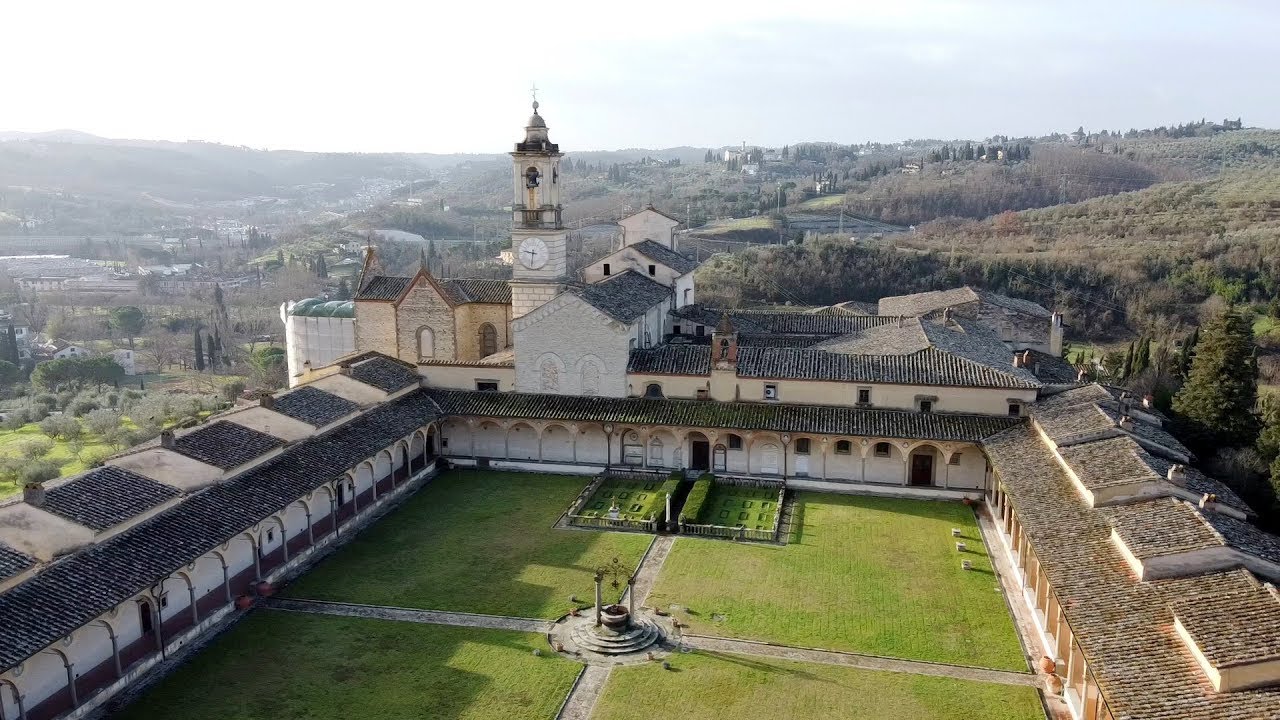
The Florence Charterhouse is a monastery, formerly of the Carthusian Order, which stands on Mount Acuto, at the confluence of Ema with Greve in the Galluzzo zone, surrounded by a high circle of walls. It was built starting from 1341 by Niccolò Acciaiuoli, Grand Siniscalco of the Kingdom of Naples and member of one of the most illustrious Florentine families, and at his death (1365), the building was almost completed. The Charterhouse was then enlarged and enriched by numerous donations over the centuries. The name and the building typology derive from the Grande Chartreuse, the first house of the Carthusian order built in 1084 by San Bruno on the Chartreuse Massif, near Grenoble, and like all the Carthusian churches, this is also located far from the city, in a place originally lonely and silent. After the suppression of religious orders in 1810 the Charterhouse was stripped of about 500 works of art, only partially returned after the return to the Carthusians and the return of the Lorraine (1818). For example, many of the furnishings were irreparably dispersed, as well as many paintings and sculptures. The table of the high altar of the church, commissioned by Niccolò Acciaiuoli to Gherardo Starnina (Madonna and Saints), is now divided between foreign museums and collections. Again it was suppressed in 1866 by decree of the Kingdom of Italy and again, in 1872, the Carthusians were able to return, even if only in use, remaining the property of the Italian State. The earthquake of 1895 required restoration works and a significant new restoration was concluded in the late 1950s. The Carthusians, monks of strict enclosure, were replaced in 1958 by the Cistercian Benedictines, who made the vast complex accessible to the public as well. Since 2017 the Cistercians have been replaced by the Community of San Leolino. The complex was carefully studied and became a fundamental creative stimulus for the famous French-Swiss architect Le Corbusier, who visited it in his youth. The Charterhouse is made up of various buildings: church, chapter house, sacristy, refectory, cloisters, workshops and homes for monks and conversi. It was designed to accommodate a maximum of 18 cloistered monks and 5 converse brothers, as can be seen from the number of houses present throughout the structure. The cloistered monks had a rather large cell, since they had to spend almost all of their existence in meditation. They could only leave the cell on special occasions, such as Sunday, for lunch, for prayer and for the one hour of weekly interview. All other days, the hermit monks remained in their cell, which consisted of two floors and a cellar. On the ground floor, there was a dining room, equipped with a fireplace and a small wall pantry closed by a door which also served as a folding table; the room was used by monks to eat every day other than Sundays and holidays, when everyone gathered and ate in silence, listening to the reading of the Gospels, sacred texts and the Rule, which took place from a pulpit located in the refectory. Meals were served by the converse brothers through a counter next to the cell door. On the same floor of the refectory, there was a small room with a view of the valley, the service and a bedroom with a bed and a kneeler. Outside, the personal garden, which led to the cellar. On the upper floor, there was the study. The space was fundamental for the monks, given their condition of isolation: the only moments of aggregation, except for Sunday and festive lunches, were the church functions and the weekly hour of conversation and recreation, which took place in the so-called “parlor “. The cells of the conversi brothers, on the other hand, were very small and included only one room and the service: the life of the converso brother, at the service of the monastery and the hermit fathers, always took place outside the cell, excluding the moments of rest: they took care of the the vegetable garden and the gardens, the cleanliness of the places, the food, the exchanges … for this reason, they were always on the move. Also for them, as well as for the friars, there was an area reserved for recreation, which consisted of a cloister with a double order of columns. The Certosa del Galluzzo covers an area of 16,000 m².