
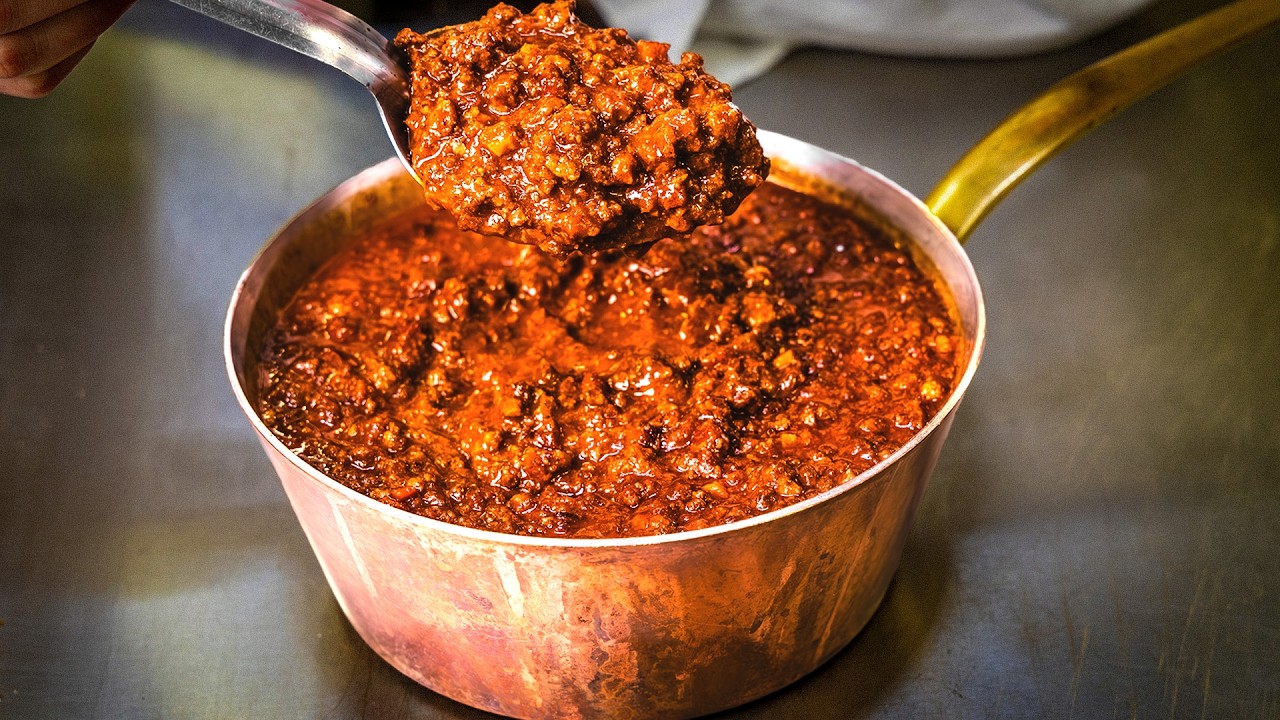
There are endless ways to make ragu. Every region does it differently, and every family has their own version. This isn’t the authentic Italian way or the correct way, this is the chef way.
This ragu recipe is a technique-driven approach using French and European cooking principles to create a deeper, richer, more complete ragu. If you’re searching for a ragu recipe, how to make ragu, or the best ragu recipe, this video breaks down exactly how chefs build flavour step by step.
Instead of rushing everything into one pot, this method focuses on:
– Proper soffritto caramelisation
– Deep browning of the meat (Maillard reaction)
– Layered fat, collagen, and umami
– Controlled reduction and balance
This ragu uses a blend of beef shin and chuck, pork belly for collagen and richness, pancetta for fat and smoke, tomato in controlled amounts, parmesan rind for umami, and milk at two different stages, inspired by techniques used by chefs like Marco Pierre White & Massimo Bottura.
Rather than overpowering the meat, this ragu builds flavour slowly through caramelisation, reduction, and balance — resulting in a sauce that’s rich, glossy, and deeply savoury without being heavy.
WHAT YOU’LL LEARN IN THIS VIDEO:
– How chefs build flavour in ragu
– Why should soffritto be soft and sweet, not dark
– How to properly brown mince for maximum flavour
– Why milk is used in ragu (and when to add it)
– How to balance richness with acidity
– How to finish ragu like a restaurant sauce
RECIPE
INGREDIENTS
1 kg beef mince (50% shin, 50% chuck)
400 g pork belly, diced
100 g pancetta, diced
200 g onion, finely diced
150 g carrots, finely diced
150 g celery, finely diced
1–2 garlic cloves, finely grated
Extra virgin olive oil
Neutral oil
80 g tomato purée
400 g passata
200 ml red wine
Whole milk (added in two stages)
~500 ml chicken or beef stock
1 Parmesan rind
2 bay leaves
Pinch of nutmeg
Salt, to taste
To finish
Cold butter
Extra milk
Gastrique: 100 g balsamic vinegar + 50 g sugar
METHOD
On low heat, add olive oil and pancetta to a heavy pot and slowly render the fat.
Add onion, carrot and celery with a pinch of salt. Sweat gently until soft, pale and sweet, no colour.
Grate in the garlic for the final 1–2 minutes, then remove the soffrito and set aside.
Return the pot to high heat with a little neutral oil. Add the beef mince, breaking it up and cooking hot to drive off moisture.
Once dry, lower the heat slightly and caramelise the beef slowly until deeply browned, scraping the fond regularly.
Add the pork belly and gently warm through — no heavy browning.
Stir in the tomato purée and cook until it darkens and caramelises.
Lower the heat and add the first portion of milk. Let it fully absorb into the meat.
Deglaze with red wine and reduce by about half, scraping the pan clean.
Return the soffrito to the pot, then add passata, stock, Parmesan rind, bay leaves and a pinch of nutmeg.
Bring to a simmer, cover, and cook in a low oven at 120°C for 4½ hours, stirring occasionally.
While cooking, make a gastrique by boiling the vinegar and sugar briefly until lightly thickened.
Once cooked, remove the bay leaves and Parmesan rind.
Finish with a splash of milk, cold butter for gloss, and the gastrique added gradually to balance acidity. Season to taste.
VIDEO CHAPTERS
00:00 – The Chef Way
00:20 – Soffritto Base
02:49 – Cooking the Meat
06:50 – Building & Cooking the Sauce
12:59 – Making Gnocci
13:40 – Making the Gastrique
14:32 – Finishing the Ragu
15:31 – Plating & Tasting
38 Comments
I was fascinated until you added 50g of sugar for roundness.
15:50 You bloody did mate. Couldn't have said that better myself.
I'm gonna have to follow these Fallow fellows!
Marco method – 4 stockpots
You are a chef and have only recently appreciated the importance of milk in a ragu? Shame on you!
TL,DR: caramelize everything
that gastri is just like japanese mirin!!
Carrot is so overrated.
Such an inspiring channel
"I've nailed that" haha. Definitely going to try this recipe.
Tried this tonight, really easy to make and the whole family loved it. Only thing I changed was to hold back just a little on the gastrique and let people drizzle additional over their own plate if they wanted, as we all have different palettes in that regard.
Absolute cracker of a dish, thanks as always for sharing Fallow!
Is he using smoked or uncooked pancetta? Also, I imagine would need to skim off some fat at the end?
I like Adam Ragusea's trick of adding just a bit of finely chopped chicken liver.
Matty Matheson is using Milk in his version of Lasagna close to the end of the cooking process.
let me guess, dangerously high amounts of fat?
Putting in all the ground beef at once? This is where you lost me. You want color on the beef … you don‘t want to boil it. Put half of it in or even less. And everything will be much nicer and not swimming in water.
Chicken Stock in Ragout? Stock out of a plastic bag? Ugh
Well done but too much talking for simple Bolognese sauce
Thank you so much for sharing this. It looks delicious and I can’t wait to try making it. I love your channel.
use pork not beef
Awesome recipe and easy to follow – but the idea that a 5 hour recipe is a midweek meal is jokes 😂
Nice recipe. Way way too much talking, omg.
I'm a very amateur cook but do pride myself in my spag bol – always added dash of milk in before wine as it adds something I couldn't put my finger on.. until now! Thank you for enlightening me! Can't believe my culinary instincts were so in tune with Marco Pierre White's hahaha
As if he'd never heard of milk before.
Meh… mines better…😄.. in all seriousness i do make an excellent ragu… whether its as nice as this i am not sure though…👌
His 'ultimate' ragu recipe – made using two techniques involving milk that he says he hadn't heard about until a couple of days ago. I wonder how his ultimate ragu will be made next week?
Is there a breakdown of the amount of these ingredients for first timers?
oh man this looks insane, can't wait to try it out
This guy's really into caramelising stuff.
Let me guess, butter and MSG.
Love the stuff you do and listening to you, but wearing rings and watches while cooking is hella unhygienic imo
This looks amazing, but the British accent of the taster kind of reduces the credibility a bit.
Mince went so dark I thought you burnt it.
Here is a young man from Bologna (the birthplace of ragù). The video is great, and almost everything is correct. The soffritto (vegetables and pancetta) should not be removed, but left in the pot, and when it begins to soften, add the ground meat (both pork and beef). The milk is added after adding the tomato sauce to reduce the acidity. It is not common to add Parmesan rinds, but in the past they were added so as not to waste anything, as it is a poor peasant recipe. Then it must be cooked at a low temperature for many hours (at least 2), ideally 4 hours. Butter is NOT added.
bringing 2 autistic people together at the end was so touching. love this channel
It doesn't taste better.
You had never heard of adding milk to ragù until a couple weeks ago? It's been a part of the recipe for ragù alla Bolognese since before the recipe was first published by Pellegrino Artusi in 1891.
Unreal. I borrowed a few tips and my ragu is like twice as good! Thanks!!!
Do you ever think you might do one of these for cassoulet?