
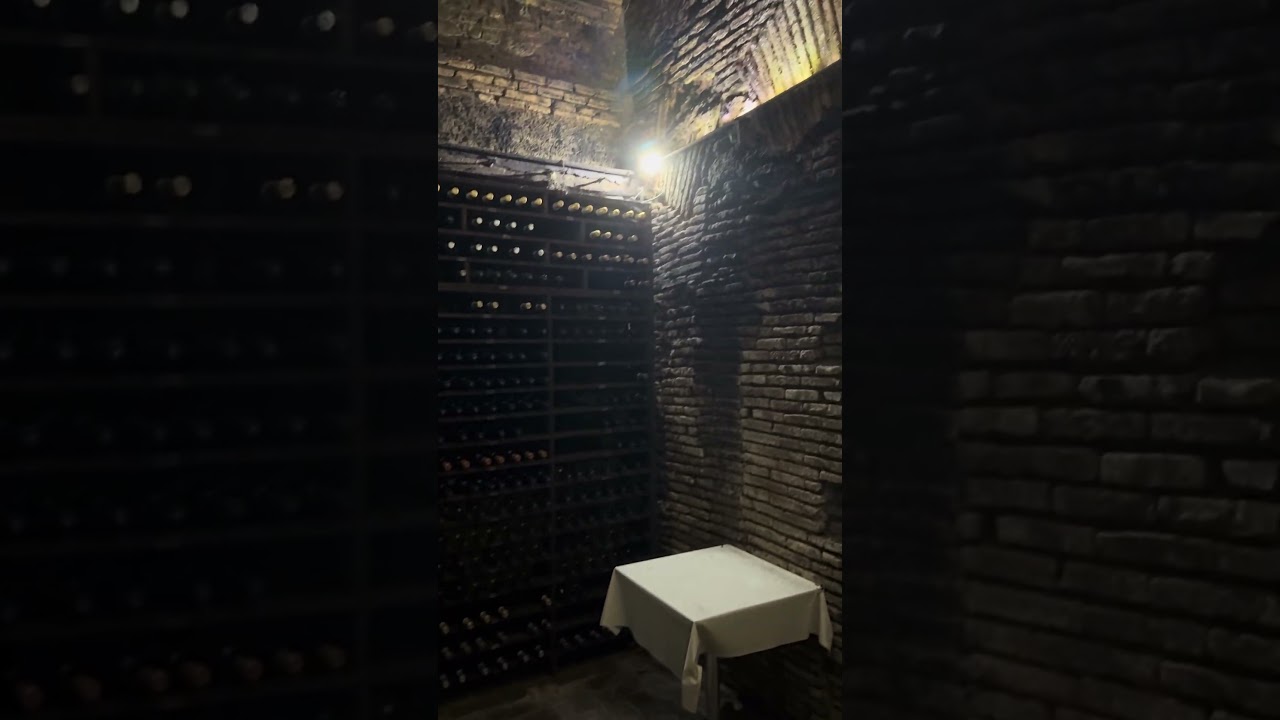
In the heart of Trastevere, far beneath the tourist-laden cobblestones, lies a space where the air itself feels different—heavier, cooler, and ancient. This is the wine cellar of Spirito di Vino, a sanctuary of silence that claims a birthdate around 80 BC, making it approximately 160 years older than the Colosseum.
The Descent:
The journey begins in a beautiful but relatively unassuming 19th-century building on Via dei Genovesi. But to find the story, you must leave the dining room and find the narrow, steep staircase leading down.
As you descend, you are literally walking back through time. The deeper you go, the further you travel from the modern Italian Republic. You pass through the medieval layers, where the building once served as a convent and later a bronze foundry, until you hit the bottom—the original street level of Ancient Rome.
The Chamber of History:
The cellar is a cavernous, vaulted room constructed of original Roman brickwork. Unlike the ruins in the Forum that have been bleached by centuries of sun and rain, these bricks are pristine, preserved in the eternal dark.
The architecture tells the story of its original purpose. This was not initially a wine cellar, but a commercial structure connected to the bustling river trade of the Roman Republic. It is widely believed by historians to have been part of the Vicolo delle Palme (Alley of the Palms), an area historically associated with Rome’s first Jewish community. In fact, just above the cellar entrance, Hebrew inscriptions found on a marble column suggest this site may have once been home to Rome’s earliest synagogue before the diaspora moved across the river.
The Atmosphere:
Down here, the humidity is constant, and the temperature never wavers—a natural climate control that the Romans inadvertently perfected for wine storage. The room is lined with wooden racks holding thousands of bottles, sleeping in the same silence that would have greeted a Roman merchant counting amphorae of olive oil or grain over two thousand years ago.
The walls curve in perfect Roman arches, a testament to engineering that predates the Empire itself. If you run your hand along the rough stone, you are touching the same materials that were laid when Julius Caesar was a young man, long before the first gladiator ever stepped foot in the Colosseum.
The Modern Guardian:
Today, the cellar is the pride of the Catalani family, who restored the building. They treat the space not just as a storage room, but as a museum of continuity. It serves as a reminder that while the Rome above ground has burned, rebuilt, and modernized, this pocket of the city has remained a quiet witness to it all—waiting, preserving, and enduring.
Would you like me to find the current visiting hours or reservation details for Spirito di Vino so you can see this cellar yourself?