
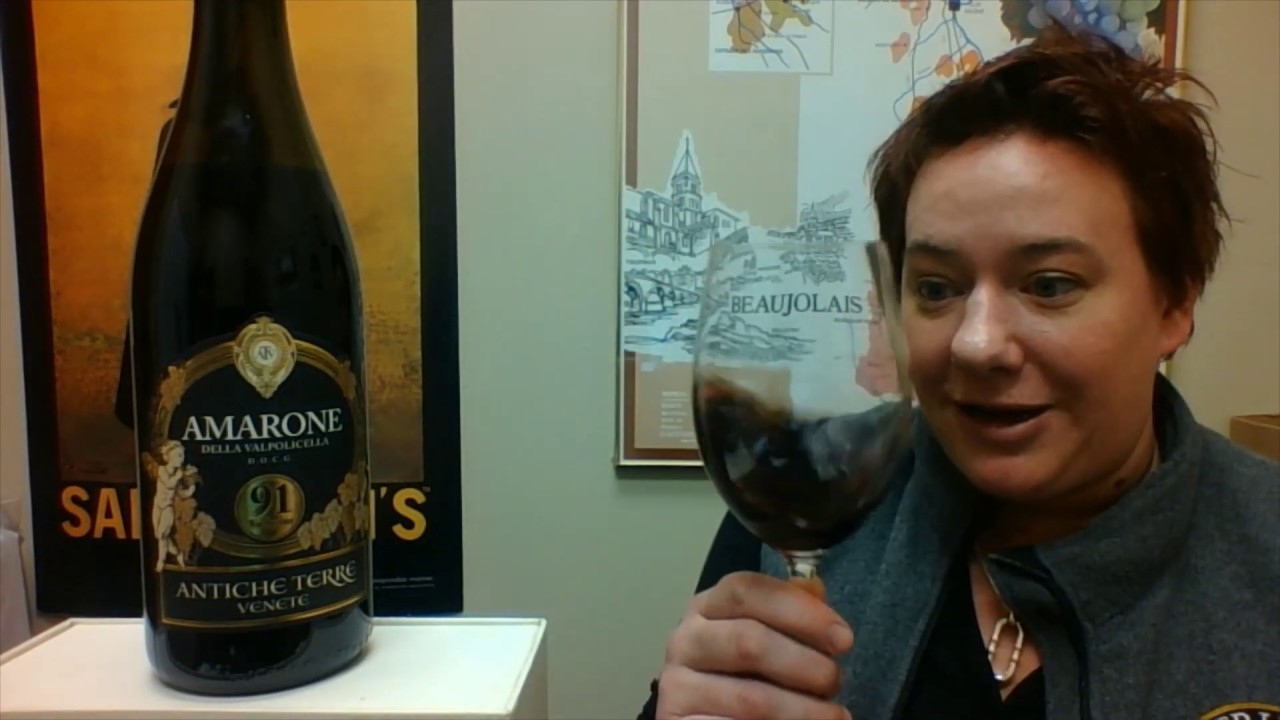
Love is in the air and there are few things I love more than waxing poetic about fine Italian wines. This week we travel to the northeastern region of the Veneto to one of Italy’s iconic wine production areas: Amarone della Valpolicella. Not only is this week’s wine simply put elegant and seducing, but it is also a ‘sparkly rainbow unicorn wine’. Usually Amarone can be found on the shelf for $50 or higher, and they’d be well worth the money. However, I found an excellent example of this upper echelon wine, for only $30! It was…as the Godfather says ‘a deal I couldn’t refuse’.
Amarone is a wine whose roots reach back into antiquity and yet has a fresh resurgence that makes it one of Italy’s most beloved and collectable wines. This staple of the Italian wine canon is made in the appassimento tradition where the grapes are dried post-harvest and pre- fementation. These raisinated grapes are essential to the concentrated flavors and the sweet counterpart to the bitter tannins that make this wine so complex and thought-provoking.
Produced in the Valpolicella Classico vineyards of northeastern Italy in the Veneto region, Amarone was granted DOC status in the 1968 vintage and was elevated to a Demoninazione di Origine Controllata e Garantita (DOCG), the highest level of Italian wine classification, in 2010. The DOCG status is highly regulated and limits production levels. The Amarone DOCG is unique in that most DOC or other delimited wine making areas are specific to the land that it is produced,which in this case is Valpolicella, but Amarone AOCG refers to the production of the wine. To qualify for this classification, an Amarone DOCG is produced using Corvina, which must make up from 50%-95% of the base of the wine, Rondinella- which is required to comprise at least 5-30% of the wine and up to 25% indigenous, non-aromatic red grapes with no variety exceeding 10% of the finished wine. Ultimately, Amarone is a mixuture of the territory, microclimatic conditions, unique grape varietals, and wine making techniques.
The appassimento process happens in a room called the fruttaio. Grape cluster dry on bamboo shelves or in crates that allow for airflow underneath for more complete drying. The DOCG dictates that after harvest this process must continue until December 1st, however many producers will allow 80 to 120 days for the fruit to dry and concentrate its flavors. The grapes lose 30%-50% of their total weight during is step. The drying concentrates the flavors and increases the sugar levels in the finished juice, but because of the loss of weight, it takes that many more grape bunches to produce the same amount of traditional wine.
Once the wines are pressed and fermentation finished, the residual sugar level must not breach 9 grams per liter and the minimum alcohol level must be 14%. For a Rosso, the wine must rest a minimum for of 2 years or for Riserva, a minimum for 4 years.
Antiche Terre Amarone della Valpolicella is hand harvested and the grapes are dried for 3 to 4 months. When pressed the wine undergoes a slow fermentation and aged in small oak barrels for 12 to 18 months.
Wine Spectator- 91 Points
A rich red, with creamy tannins and juicy acidity, showeing an expressive range of fig cake, sun-dried black herry, coffee liqueur, dried thyme and smoke flavors. A balanced crowd-pleaser. Drink now through 2027.
So get yourself a bottle or two, grab someone you like and let your senses be seduced by this romantic wine!
Cin Cin!
Jill