
Follow me on Bluesky @intercitysimon.com https://bsky.app/profile/intercitysimon.com
Italy is well known for its excellent high-speed trains that criss-cross the country at speeds of up to 300 km/h.
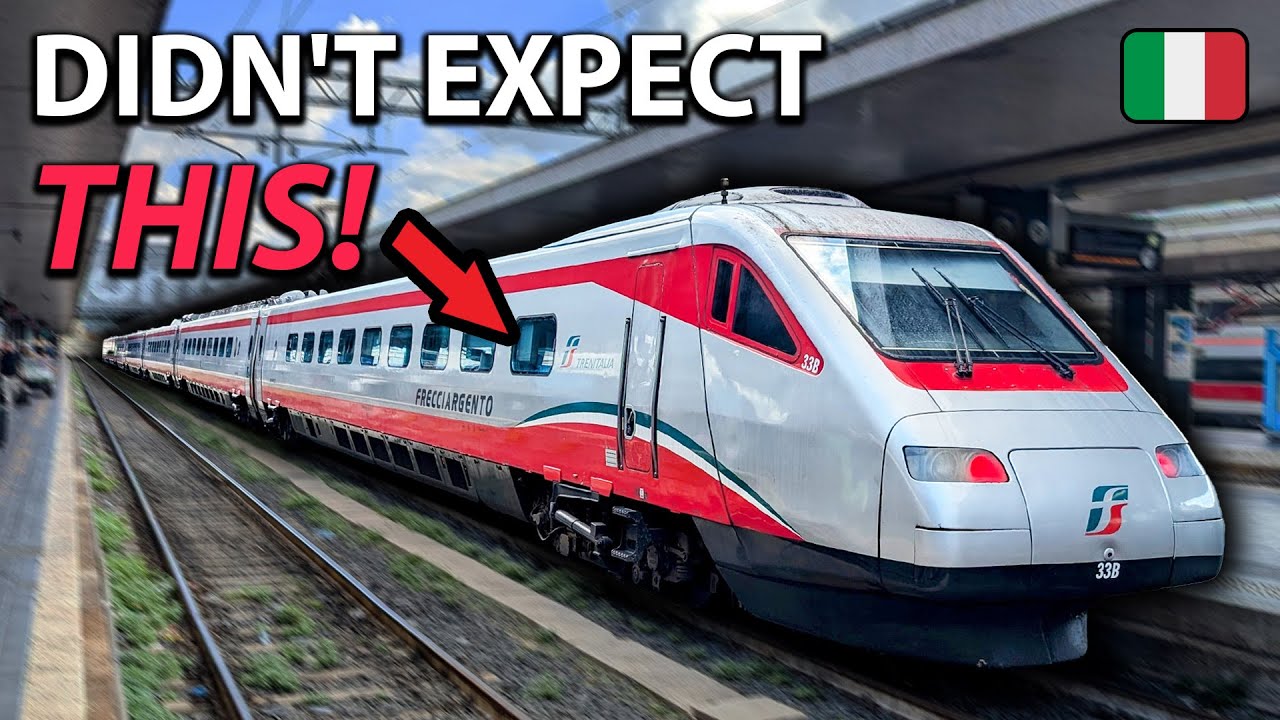
But on some secondary lines, you might come across the older ETR 485 Pendolino. Having been in service for almost 30 years, does this train still meet the usual high standards? Not really. Join me in this video to find out why I was left disappointed by this particular high-speed train.
Train type: ETR 485 “Pendolino”
Route: Rome to Lecce
Train: AV 8315
Distance: 629km
Journey time: 5h24m
Average speed: 117km/h
Price: 36€
00:00 Intro
00:43 Rome Termini
02:33 Boarding and Departing
04:12 Route Map
04:52 Special Night train
05:22 High-Speed Section
06:48 Slow Mountian Line
07:15 Train Interior Showcase
09:30 High-speed Railway construction
10:05 Pendolino Tilt Function
10:50 200 km/h line towards Foggia and Lecce
11:42 Seat tour (No Legroom)
12:30 Barletta and Bari
12:58 Summary of issues
13:30 Arrival Lecce
#Travel #Trains #TripReport
35 Comments
The pendolino was never meant to be a HS train, but to use at their best the standard rail lines. HS railway is only from Rome to Naples, from there onward is standard rail line, very old. Now an (almost) HS railway is being built from Naples to Bari. It should be completed by 2028. Retry! 🤣
They might be getting old and tired – and maybe not much cared about -; they might also be narrow (also due to the poor utilization of spaces), but I'm affectionate with these trains: their tilting system makes them the diamond tip on old curved panoramic lines. And also because I like the sound and I have a miniature model of this train, still in the old white and red livery; and because it's implemented in many countries about Europe (like the shiny Portuguese Alfa Pendular); he'll surely bring you to memorable places and experiences. 🚄
Until 2020, the 460/70s and the 485s were the only high speed trains that went to Reggio Calabria, in south Italy. I rode them many times in the past, and I can confirm that the ride is not quite comfortable at high speed.
The fact that high speed trains take conventional lines is not uncommon, in fact after only one hour of high speed Rome-Naples, the rest of the line to Reggio is a conventional one because no high speed line is built.
And that might shock you, but even the ETR 500 models (that replaced the 460s) after Naples, run on conventional line, and stop more often (6 hours journey) than services with the 485s (5 hours journey) despite the fact Frecciarossa services should make less stops.
These trains were born for a different type of use, since they're "Pendolino". So, they were meant to ride on "conventional" lines, offering a faster service than any other intercity.
Levels of service were just first and second classes, which were enough. They didn't have ever been the Diamond train of Italy because the weren't build to ride on high speed lines (ETR 500s, on the other hand, were/are exclusively designed for these kind of lines).
So that is: etr 500 is still on top of his performances because the company has 100% interested and 100% revenue on it.
Etr 460/485 (470 are actually in greece) have just been abandoned on maintenance, since they're deadline has already been touched. You might expect the same on the ETR 600s.
It's not about the train being bad… it's about how you keep it alive
the best class is business ETR500
Your click bait titles are getting annoying.
The ETR 480 had their time and they are definitely on their way out, they are still technically functional and, as you have seen are used in one of the less wealthy parts of Italy where people are more likely to accept an older train for a relatively cheaper fare.
I’m quite surprised that the tilting function is still operating as I recall that in some models was de-activated as no spare parts are produced and re-engineering works were too costly for a train that is running into the sunset.
These trainsets are going to be withdrawn in the next years.
I travelled first class between Brindisi and Caserta, interior looks cheap and plastic. In my carriage where I sat, A/C was KO on the left side, luggage displaced everywhere thanks to the ridiculously small racks, even in the vestibules.
Poor choice in the bistro car, no meals, just some depressing cold sandwiches that definitely aren't worth the money.
The plaza in front has just been rebuilt, fortunately.
I read an old FRA (USA) document from early 1980s before they imposed restrictions throwing USA back to the 1950s to help steel-only Budd. The speed limit in curves isn't due to passenger comfort but rather the tracks. In a curve, a train will generate "G" forces that pushes the train outward. This lateral force can cause the wheels to push the rail sideways and result in the rail shifting outwards or roll over, causing derailment. Banking/canting the track has two advantages: first, a portion of the car's weight is shifted to the inside of curve, countering some of the total lateral G force it exerts, and secondly, some of the lateral force still exerted will be applied vertically to the banked rails, reducing the true lateral force exerted on them. This allows for higher speeds.
"Cant defficiency" is the measure of insufficient banking to achieve 0 lateral forces on rails. Tracks have a maximum cant defficiency based on how they are buillt (attachments between rail and ties, height of the rail etc) Think of standard north american tracks where rail is held onto soft wooden ties by loose large spikes/nails). Technically, this dictates a maximum speed for every type of train (speed + mass = force exerted on the rails on each curve). In practice, they tend to put 1 or 2 speed limits (pax vs freight for instance). A tilting train may have permission to exceed this speed by x%.
A tilting train paliates some of the cant defficiency by tilting only the car body. However, the bogies do not tilt, so their mass still exert 100% of lateral forces. A heavy non tilting loco would be the speed limit for the train since it would be the one exerting the most lateral forces on rail during a curve. So the advantage of tilting train is reduced, unless you have a light locomotive. (Canada's LRC's orginal locomotives were non banking but built to be lighter). An EMU would have no heavy locomotive at front sp big advantage but each bogie in the train would be heavier, but likely allow higher speeds. However, the weight of the banking system on the bogie would reduce max speed in a curve !
The other aspect is that tilting trains may be imposed tilting limits due to proximity of other tracks in curves (to prevent sideswiping a passing train). And those tlting limits may be small enough that gains from tilting are reduced. (eg: Acela in USA). Whether the Pendolino you took has an adjustment where on single track, the driver can press a button to enable greater tilting is unknown to me.
Not sure up to what speed the tilting mechanism remains active on the ETR 485. True high speed traisn don,t have tilting systems because tracks are assumed to have been built with the banking built-in (and there is very conscious requirement to keep true high seed train light).
Interiors and seat pitch are not necessarily dictated by train type. Trenitalia could refurbish interiors with new seats and greater seat pitch if it wanted. One has to assume that they choose that seat pitch due to marketing, costs, and how much demand there is on the lines served by that model. If those trains are slated to be replaced soon, it doesn't make much sense to refurbish them. However, your point to avoir ETR 480s is valid since in the end, that is the product TrenItalia has chosen to offer on those routes. It is also possible that lack of competition results in denser seating and older trains.
Italians can’t build good trains. Their trains are awful.
i never know italy have hsr until i watch this yaa italy is famous about culture like piza similar like my name and the home of fast car like ferrari ,but this fast train is even give the good experience from far place
Comparing with ETR500 is irrelevant. ETR460/70/85. The latter are not true high-speed trains, they are 30 year old trains with excellent tilt capability in most part due to having steel spring secondary suspension and hydraulic rams controlling the tilt. They cannot possibly isolate the cabin as well as a high-speed train.
Greece has the Pendolino ETR 485 purchased in 2020 and they lied about the fact that they are bought new. They are trains from 1996 that come all the way from Switzerland. After the death of 57 people nothing has ever changed
When I lived in Italy in the year 2000 those trains were running between northern Italy and Swiss cities like Zurich and Geneva under the name of "Cisalpino". They were great trains back then. However, I think they show their age now. Thank you for the great video.
This might be the worst high-speed train in the entire fleet mainly because it belongs in a museum. Yes, the ETR 500 is older, but it uses a more modern design. The 460/70/80 is a 2nd class high-speed train.
You are very wrong, the worst Italian high speed train is the ETR 700
If only Italy had American technology.
It’s the train of italians, the last one made only by italians, it’s like an old Ferrari, if you travel with an old Ferrari you can’t expect perfection, a funny thing you didn’t say about this train: with regular manutentions is the most reliable train of the italian line, I’m talking a out Freccia argento F 485, not the similar freccia bianca, with all tese informations i think that with an interior refresh it cloud be quite good also nowadays, and with his hystorical meaning is the best one For me, that’s because I’m italian and this is the real last 100% italian Pendolino, it’s glorious
The square in front of Rome Termini station has been renovated and officially inaugurated in January 2025.
Mi sembra che sia esagerata usare una certa terminologia. che mi pare inappropriata.
You are too unkind ! The ETR 480 was built as a tilting train for use on non high speed lines. They are getting old, but still offer an acceptable service on such a long route to Lecce.
hi simon so have you been to norway but did you known norway also have this strange looking high speed train ? are you planing to do trip report on norwegian train i mean norway very close to denmark right ?
We have the same train in Greece fully renovated. And I think yes it’s awful.
the real and very efficient Italian high speed operates on the Turin-Milan-Bologna-Florence-Rome-Naples line where the Frecciarossa and Italo trains travel at 300km/h. On all other lines and destinations, even if they use high speed trains, the tracks are not suitable for traveling at 250 or 300km/h and therefore trains that are already more than 20 years old are used, it is normal therefore that the comfort is a little lower. The real high speed only operates from Turin to Naples. Soon it will also be operational from Naples to Bari.
Can't be worse than AnsaldoBreda products like V250😆
Bevor du mit dem Zug fährst übe wie man die Städte ausprichst. Katastrophal wie die Bahnhöfe ausprichst. Ich bin Italiener und z.BSp. Kaiserslautern kann ich sehr gut aussprechen und auch deutsch schreiben . Du bist deutscher und es wundert mich nicht das es nur zum kritisieren gedreht hast
No, it's not and Frecciabianca neither. They're just older
Drecks KI Video voller Fehler
If you don't mind my asking, how tall are you? I'm 6'5" (196cm) and it looks like there'd be nowhere near enough leg room for me. I have the same problem on planes.
nice vid, I don't know what happened to these sets in the last years, looks like Trenitalia abandoned them a bit.
I remember riding them multiple times 6/7 years ago, and the ride was buttery smooth
It is a train built in the early 90s, it was designed to travel on both fast lines at a maximum of 250 km/h and slower ones, but it could travel on slow lines at speeds of about 20 or 30 km/h more thanks to the pendulum system, through gyroscopes, I don't know if that system is still active, because the spare parts came from the United Kingdom and the company that produced them has now gone bankrupt, so most likely the system is deactivated (there was a button on the driver's dashboard with a green light that if it was on the system was active), due to the presence of these hydraulic systems the carriages are narrower and smaller than the ETR500, which are more comfortable even than the ETR1000, up to 20 years ago there was still the restaurant carriage, today eliminated on all Italian high-speed trains and on all intercity trains (serious mistake), often transformed into a bistro or bar carriage. There was also a diesel version of this train (diesel engine with alternator and synchronous electric bogie motors) to be used also on non-electrified lines, which in the 90s were 60% of the total railway lines. Today it is an intercity service, not high speed, I believe that the maximum speed has been limited to 200 km/h due to the age of the train, because it is so many years old. It certainly does not have the comfort of modern trains but I am happy to see it still in circulation because it is a piece of Italian transport history.
Congratulations for the video! The ETR485 was built in 1997, it was in line with the standards of the time. In 2004 it was transformed into a multi-voltage train to be able to go on modern high-speed lines. If you want to travel on the best Italian train take the ETR400 Frecciarossa 1000.
It is wrong to call it "the worst high-speed train in Italy". It is simply the oldest AV electric train of all currently used in the "Frecciargento" service. It is a train of great merit and success because it swings, which helps in curves not to lower the speed too much and helps to reduce the time. It reaches a maximum speed of 280km/h and can be powered by both 3Kv and 25Kv. It also has a chopper traction system, and you can also hear it thanks to the sound it produces when it gives traction. In conclusion, in my opinion, this train is very comfortable. and even though he's almost 30, all in all he wears them very well. pin me plss❤