
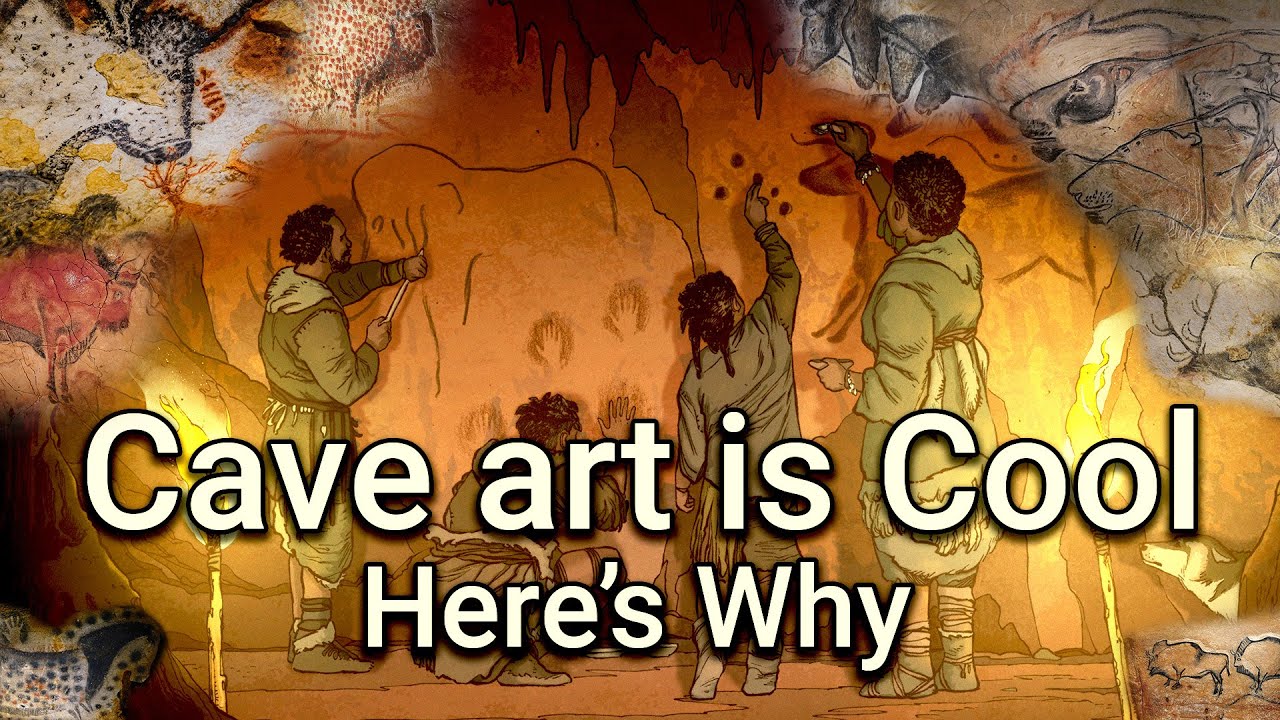
In my latest overlong video we take a deep dive into the intricacies, mysteries and controversies of Paleolithic Cave art, examining how it was made, if it changed over time, and why it was made in the first place. Its pretty cool.
Join this channel to get access to perks:
https://www.youtube.com/channel/UCSwFnHpDt-lZgR_7Sqisi6A/join
Help support us elsewhere at:
https://www.patreon.com/thehistocrat
https://bsky.app/profile/thehistocrat.bsky.social
You can find more of Ettore’s excellent artwork below:
https://www.instagram.com/ettore.mazza/
https://ettoremazza.tumblr.com/
#Paleolithic #Archaeology #History
27 Comments
General Sources:
Clottes (2010) Cave Art. Phaidon Press.
Clottes (2016) What is Paleolithic Art? Cave Paintings and the Dawn of Human Creativity. University of Chicago Press.
Bahn (2016) Images of the Ice Age. Third Edition. Oxford University Press.
Bahn (2024) Cave Art: A Guide to the Decorated Ice Age Caves of Europe. Third Edition. Archaeopress.
Lorblanchet & Bahn (2017) The First Artists: In Search of the World’s Oldest Art. Thames & Hudson.
David (2017) Cave Art. Thames & Hudson.
Clottes & Lewis-Williams (1998) The Shamans of Prehistory: Trance Magic in the Painted Caves (English Translation). Harry N. Abrams Inc., Publishers.
Chauvet et al. (1996). Chauvet Cave. The Discovery of the World’s Oldest Paintings. Thames & Hudson.
Aujoulat (2005) The Splendour of Lascaux. Thames & Hudson.
Leroi-Gourhan (1967) Treasures of Prehistoric Art. Harry N. Abrams Inc., Publishers.
Scarre et al. (2018) The Human Past. Fourth Edition. Thames & Hudson, pg. 137-148.
Minvielle (1972) Sur les chemins de la prehistoire. Denoel (original text in French).
Murray (2007) Milestones in Archaeology: A Chronological Encyclopedia, ABC CLIO, pg. 191-193, 223-226, 263-265.
Madariaga de la Campa (2001) Sanz de Sautuola and the Discovery of the Caves of Altamira. Fundación Marcelino Botín
de Sautuola (1976) Escritos Y Documentos. Insititucion Cultural de Cantabria.
Academic Papers:
Brumm et al. (2021) Oldest cave art found in Sulawesi. Science Advances, 7(3), eabd4648.
https://www.science.org/doi/10.1126/sciadv.abd4648
Oktaviana et al. (2024) Narrative cave art in Indonesia by 51,200 years ago. Nature, 631, 814-818.
https://www.nature.com/articles/s41586-024-07541-7
Majkić et al. (2017) A decorated raven bone from the Zaskalnaya VI (Kolosovskaya) Neanderthal site, Crimea. PLOS One, 12(3), e0173435.
https://journals.plos.org/plosone/article?id=10.1371/journal.pone.0173435
Henshilwood et al. (2011) A 100,000-Year-Old Ochre-Processing Workshop at Blombos Cave, South Africa. Science, 334(6053), pg. 219-222.
https://www.science.org/doi/10.1126/science.1211535
Flanders & Key (2023) The West Tofts handaxe: A remarkably average, structurally flawed, utilitarian biface. Journal of Archaeological Science, 160, 105888.
https://www.sciencedirect.com/science/article/pii/S0305440323001681
Pike et al. (2012) U-Series Dating of Paleolithic Art in 11 Caves in Spain. Science, 336(6087), pg. 1409-1413.
https://www.science.org/doi/10.1126/science.1219957
Hoffmann et al. (2018) U-Th dating of carbonate crusts reveals Neandertal origin of Iberian cave art. Science, 359(6378), 912-915.
https://www.science.org/doi/10.1126/science.aap7778
Floss (2015) The Oldest Portable Art: the Aurignacian Ivory Figurines from the Swabian Jura (Southwest Germany). Palethnologie, 7, 315-329.
https://journals.openedition.org/palethnologie/888#:~:text=Four%20cave%20sites%20in%20the,are%20known%20from%20the%20region.
Hurel (2017) Les peintures préhistoriques de la grotte d’Altamira à Santillane (original text in Spanish). Bibnum.
https://journals.openedition.org/bibnum/709
Clottes et al. (1990b) La préparation des peintures magdaléniennes des cavernes ariégeoises (original text in French). Bulletin de la Société préhistorique française, 87(6), pg. 170-92
https://www.persee.fr/doc/bspf_0249-7638_1990_num_87_6_10434
Couraud (1982) Techniques de peintures prehistoriques (original text in French). Experiences. Couleur. Revue du Centre Frangais de la Couleur, 19, pg. 3-6.
Couraud (1988) Pigments utilises en prehistoire, provenance, preparation, mode d"utilisation (original text in French). L 'Anthropologie, 92(1), pg. 7-28.
Halverson (1987) Art for Art's Sake in the Paleolithic. Current Anthropology, 28(1), pg. 63-88.
https://www.jstor.org/stable/2743113
Garrido (1978) Les matériaux de peinture de la caverne d'Altamira (original text in French). COM Committee for Conservation 5th Triennial Meeting Zagreb Yugoslavia 1-8 October 1978.
https://www.icom-cc-publications-online.org/3884/Les-materiaux-de-peinture-de-la-caverne-dAltamira
Galeta et al. (2014) Is sex estimation from handprints in prehistoric cave art reliable? A view from biological and forensic anthropology. Journal of Archaeological Science, 45, pg. 141-149.
https://www.sciencedirect.com/science/article/abs/pii/S0305440314000363#:~:text=Sex%20estimation%20of%20prehistoric%20handprints,does%20not%20generalise%20across%20populations.
Fernández-Navarro et al. (2022) Visualizing childhood in Upper Palaeolithic societies: Experimental and archaeological approach to artists’ age estimation through cave art hand stencils, Journal of Archaeological Science, 140, 105574.
https://www.sciencedirect.com/science/article/pii/S0305440322000322
Lasheras (2014) The Altamira Cave. In ‘Cantabrian Pleiostocene Art’, pg. 615-627.
https://www.rockartscandinavia.com/images/articles/altamiraa9.pdf
Dupont et al. (2007) Invasion of the French Paleolithic painted cave of Lascaux by members of the Fusarium solani species complex. Mycologia, 99(4), pg. 526–533.
https://www.tandfonline.com/doi/abs/10.1080/15572536.2007.11832546
Fritz & Tosello (2015) From Guesture to Myth: Artists’ techniques on the walls of Chauvet Cave. In ‘Aurignacian Genius: Art, Technology and Society of the First Modern Humans in Europe, Proceedings of the International Symposium’, pg. 281-314.
https://journals.openedition.org/palethnologie/876
Quiles et al. (2016) A high-precision chronological model for the decorated Upper Paleolithic cave of Chauvet-Pont d’Arc, Ardèche, France. PNAS, 113(17), pg. 4670-4675.
https://www.pnas.org/doi/10.1073/pnas.1523158113
I was in a museum that had a bone from the stone ages with marks on it that stem from leisurely scratching it, meaning it’s one of the first artifacts of conscious thought. These are also as beautiful.
21:53 that’s my favorite too! I have a replica that sits on my desk
I often wonder if they used other pigments that just don't last as long as charcoal and ochre last.
What game is that image from, the 'stick man hunting a wooly mammoth'… I feel like I might almost remember being able to have more than one 'stick man'?
love the concept of moonmilk
playing far cry primal made me watch this. its really interesting and im fascinated by our ancestors! what great people they were
I love, absolutely love your series’ on Mesopotamia and china, the videos on specific mythology isn’t really my thing but to each their own, this is the middle ground I am very interested in.
I love cave art so much I got a tattoo of one of the bulls from the cave of Altamira with a line from the Steely Dan song of the same name
Cave Art was painted on stones as well. I wish I could email you directly, take a peek. 👀
I teach people how to see the art
Venerated animals definitely could have been hunted by those who worship them, perhaps hunting them was a part of their worship. The Elk God provides the tribe with the nourishment of his body if they can prove themselves in the act of the hunt.
Australian Aboriginal Wall Painting as usual is ignored and this video is basically Euro centric.
Some of this Aboriginal cave art is possibly over 25000 yrs old.
Considering it’s a proven fact that Aborigines got to Australia 40000 yrs ago,their cave art could be older.
It’s cool because the paint is old, enough said.
This is amazing 👏
I'm glad I found this, if you know nothing about Cave Art you most certainly will when this video concludes. Very well done!
Two hours well spent. No snacks needed.
Different people in different places at different times might, and this is a wild idea, have had different reasons for making art. I'm sure there is also a big dose of survivor bias. Who can begin to guess how much more art existed in other places on other things that we'll never know about?
Well done, British Mr Beast
i am watching this from my iStonetablet from my microcaveapartment ☺
You know, I'm just a layman, haven't spent my life researching these things and I mean no disrespect to those who have, but… I think the "why" isn't something we get to know without asking the artists themselves. I mean, we can't meaningfully explain half the things modern human cultures do. Such a vast difference in time between the art and the modern world… The world back then would have practically been another planet. Think of all the problems in your life. And all the problems in their lives. Totally different. I don't think we can accurately place ourselves in their mind set to even try to begin to understand the people of the distant past.
That said, we know a few things that haven't changed, don't we? People likely wanted to make meaningful connections with their group, express themselves, and our pattern recognizing brains concoct all kinds of superstitions to this day. I don't know why the art was made and I think we don't get to know why.
I don't believe in ghosts or magic or any gods but something about that art makes me feel a certain way. It's probably almost a magical experience to look upon the works of our ancestors and imagine how similar they were to us and how different their world was. Some day I want to go see that replica cave in France for myself.
Charles I'm loving the mustache
Egyptians never figured out perspective.
Don't forget — just because its the Stone Age doesn't mean there was a lot of wood carving going on. I doubt rock carving came first.
You’re lucky I like this subject. I’m willing to look past your accent
Dude, thank u for making this. I have been a fan and channel member of urs for years, and enjoy all ur work. But u have no idea how long i been waiting for someone to make a whole video on prehistoric cave paintings like this. I have developed somewhat of an obsession with it over time. Its hard for me to explain why, or what it is exactly about it, that moves me so much emotionally, and fascinates me, but it definitely does. Its just such a hautingly beautiful, and tangible visual representation of the human race, and a snapshot of our existence here in deep time…
Idk? Kinda like it has an almost spiritual sense to it when I study it. Cave of Forgotten Dreams is an amazing documentary that came out years ago, that covers the topic well. But other than that and a few little bits of info here and there, its not a very widely depicted topic. Stellar job tho with this man! Lots of info ive never seen or heard anywhere else. Keep up the good work.
Excellent video, dude. One of my favorite subjects.
I love the idea of the Venus statue and I believe that they were indeed made by female artists, looking down at their own bodies, which does depict very similar proportions